This article will count 0.25 units (15 minutes) of unverifiable CPD. Remember to log these units under your membership profile.
National Treasury's first-quarter numbers look good. Revenue up R51.5 billion on last year, spending almost flat, and the state banking cash instead of borrowing it.
Somebody funded that improvement. It was your clients, and most of them have no idea it happened.
What Treasury actually published
On 30 July 2026, National Treasury released its statement of national government revenue, expenditure and borrowing as at 30 June 2026. These statements are published every month in terms of section 32 of the Public Finance Management Act of 1999, and the figures now line up with the Budget Review tabled in February 2026.
Three months into the 2026/27 financial year:
Revenue: R505.6 billion, or 24.28% of the annual estimate. Last year at the same point it was R454.1 billion, or 22.77%.
Expenditure: R503.6 billion, or 21.13% of the annual budget, against R480.1 billion and 20.65% a year ago.
Revenue therefore came in R1.9 billion ahead of spending for the quarter.
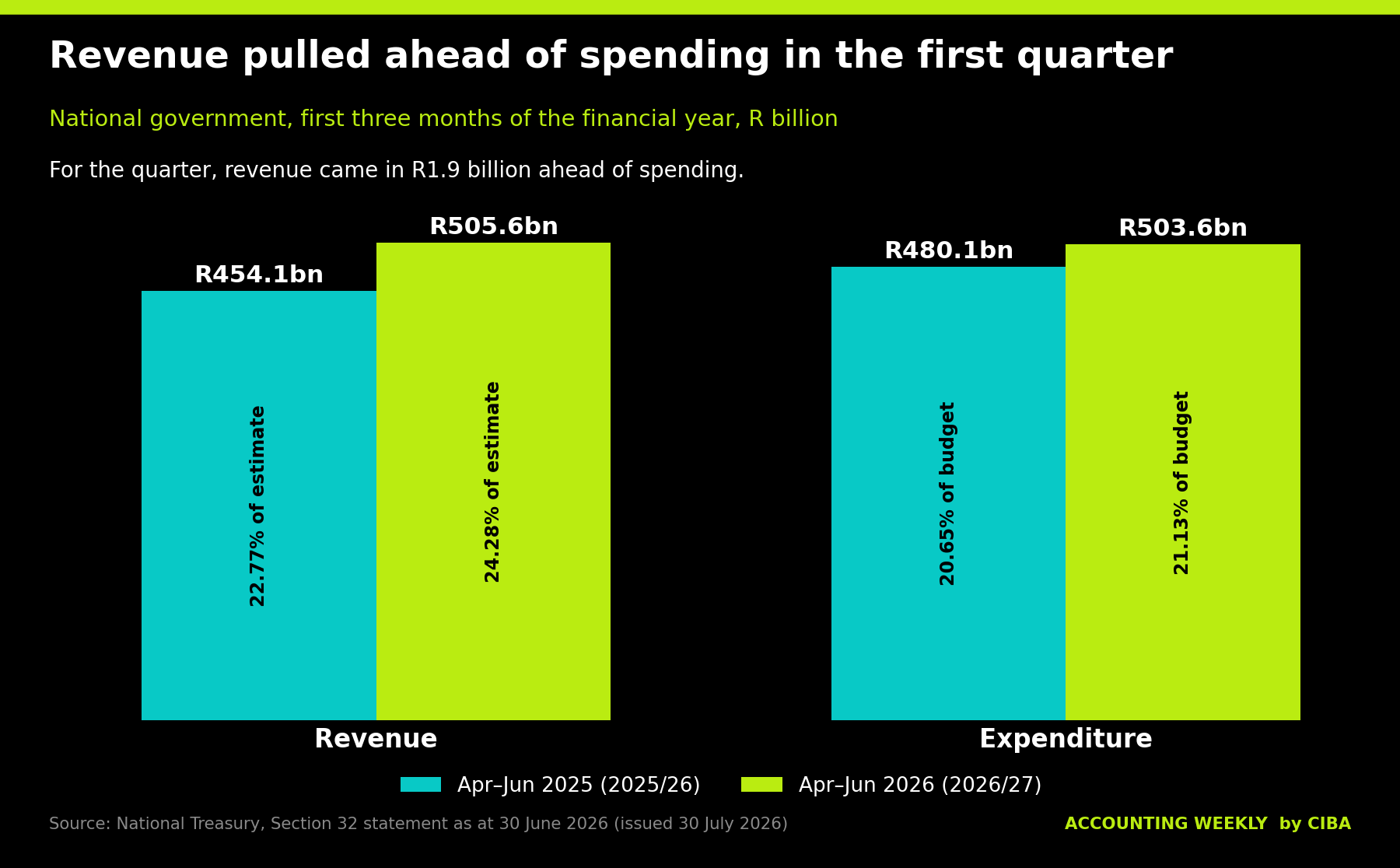
Collections grew more than twice as fast as spending
That is the part worth stopping on. Revenue is up 11.3% year on year. Spending is up 4.9%. In June alone, revenue rose 13.6% while total expenditure actually fell 1.56%.
Revenue growing at 11.3% in an economy that is not growing anywhere near that rate does not happen by accident. While the Section 32 report does not explain the source of the higher collections, recent SARS reports point to increased debt recovery, stronger compliance programmes and enhanced enforcement as contributing factors. What it does tell you is that collection is getting harder, more accurate, and more expensive to get wrong. Accounting Weekly reported earlier this year that SARS recovered R79.4 billion in outstanding tax debt in the first ten months of 2025/26, with VAT alone accounting for R38.8 billion of it. That is the machine behind these numbers.
Your clients are line items in that R505.6 billion. Every late IRP6, every thin VAT file, every reconciliation you postponed is a small piece of it.
One spending line grew fast, and it is tiny
The June expenditure detail is where most commentary gets sloppy. Payments for capital assets jumped 39.78% compared with June 2025. That sounds like an infrastructure story until you look at the rand amounts: R938 million to R1.3 billion, which is under 1% of the month's total spending.
Everything else went the other way. Voted transfers and subsidies fell 5.21%. Voted current payments fell 2.22%. Current payments under direct charges dropped 12.92%. Only transfers and subsidies under direct charges rose, by 6.28%.
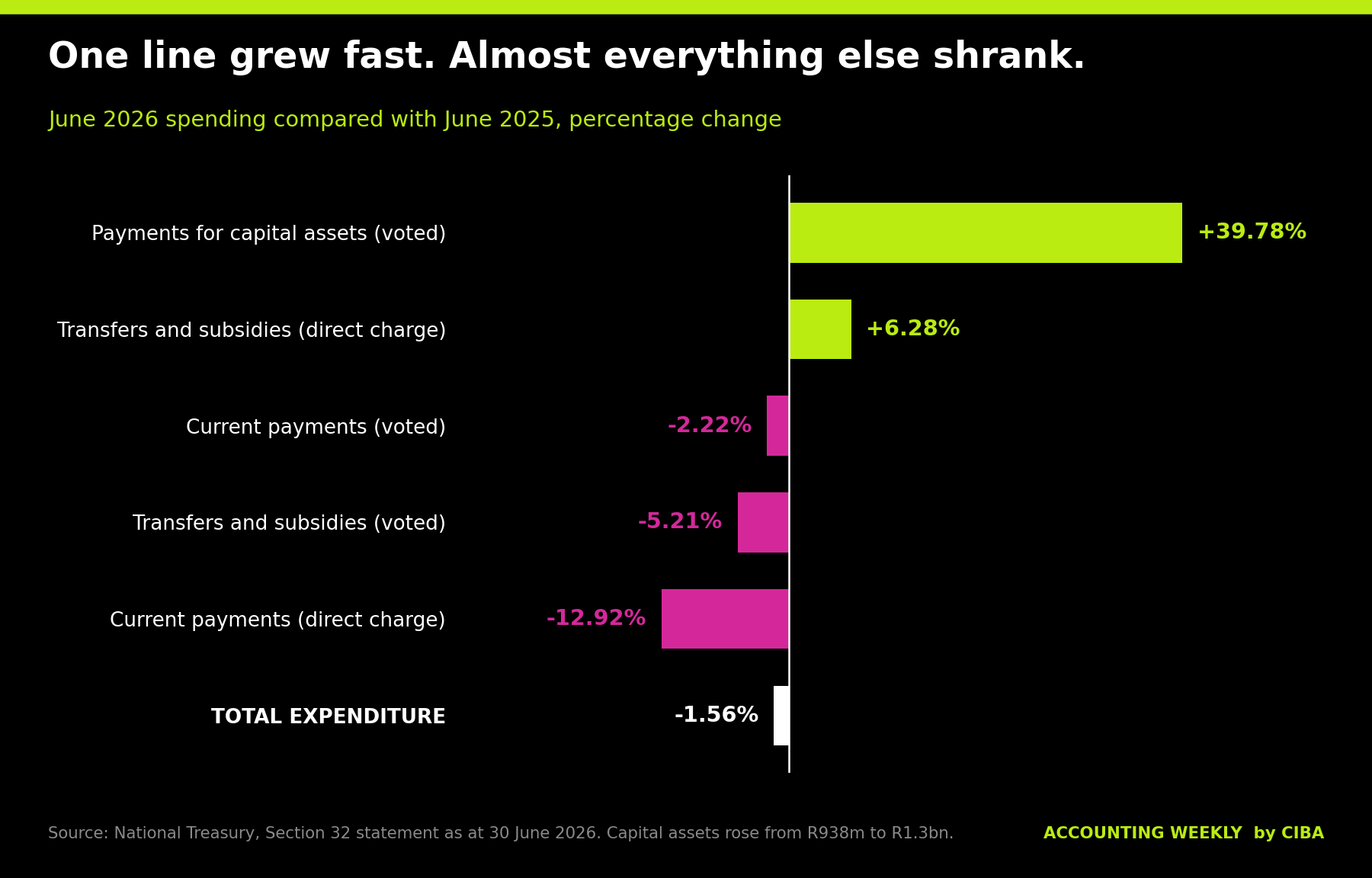
This matters if you have clients in construction, civil engineering, security, cleaning, catering or transport who live off government contracts. A 39.78% jump off a base of under a billion rand is not a pipeline. Do not let a client sign a lease or hire a crew because they read a percentage in a headline.
The direction of travel is the opposite. As we covered in Prove It or Lose It: Treasury's New Budget Rules, Treasury's new savings and programme assessment tools mean departments that cannot prove results lose their budgets. Programmes get closed. Baselines get reprioritised. Contract volumes and payment timelines shift, and the supplier feels it before anyone explains it to them.
June was a banking month, not a borrowing month
Look at the financing table and the quarter's real story appears.
In June, government raised R28.2 billion in domestic long-term loans and R2.5 billion in net domestic short-term loans. No foreign loans at all. Meanwhile cash and other balances rose by R109.7 billion. Treasury notes that a negative value in the financing table means exactly that: cash going up, not down.
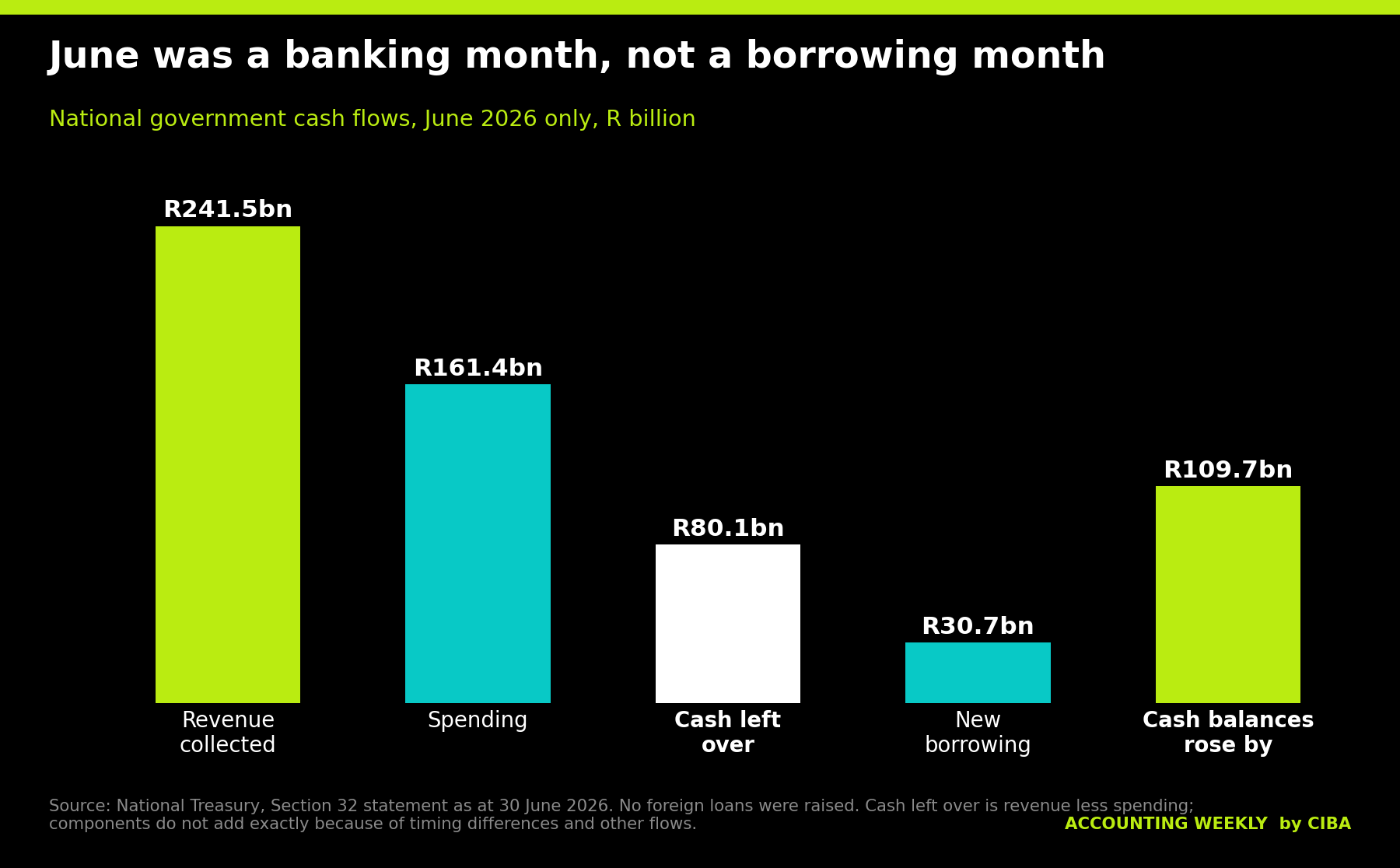
June brought in R241.5 billion and spent R161.4 billion. The state had a big collection month and put the difference in the bank.
Here is the part your clients need to hear. The government's cash cycle is lumpy, and so is theirs. Their next heavy payment month is not some distant Budget event. It is 31 August 2026, when the first provisional tax payment for the 2026/27 year falls due. Our guide on what SMMEs need to know before 31 August sets out who qualifies and what an underestimate costs.
The practical takeaway
Four things you can act on this week:
Start first-period provisional estimates now. Pull February to July figures for every provisional client. An IRP6 built in the last week of August is how understatement penalties happen.
Rerun cash flows for government-dependent clients. Model slower payment cycles and thinner contract volumes. Show them the number before their bank does.
Sell the quarterly fiscal note. Turn each section 32 statement into a one-page client memo: what collections are doing, what spending is doing, what it means for their sector. Ten clients, R500 a quarter, is R20,000 a year of advisory income off a document that takes you an hour.
Stress-test VAT and PAYE files. Collections are up and enforcement is the reason. Do not let your client be the easy one to find.
You are not a spectator in these numbers. That R505.6 billion moved because thousands of accountants filed, reconciled and paid on behalf of businesses that would otherwise be non-compliant. The state runs on work you do.