This article will count 0.25 units (15 minutes) of unverifiable CPD. Remember to log these units under your membership profile.
Your client moves his own Bitcoin off a local exchange into his own cold wallet. Same person. Same coins. No physical border crossed. Yet under the draft Manual it is treated as a cross-border outflow. Treasury and the SARB now want that treated as money leaving South Africa.
What was published
On 3 August 2026, National Treasury and the South African Reserve Bank released the draft Crypto Assets Manual for cross-border activities for public comment.
The Manual supports the draft Capital Flow Management Regulations, 2026, published on 17 April. The Regulations set the law and the Manual tells you how it will run day to day. It covers four things:
How a business applies to become an Authorised Crypto Asset Service Provider (CASP)
Which cross-border crypto transactions are permitted and on what conditions
The administrative duties that come with them, and
What must be reported to the Financial Surveillance Department (FinSurv).
The draft does not change the legal status of crypto assets. The SARB specifically notes that the proposal does not distinguish between different crypto assets and does not make crypto assets an official currency in South Africa.
The trigger point is the whole story
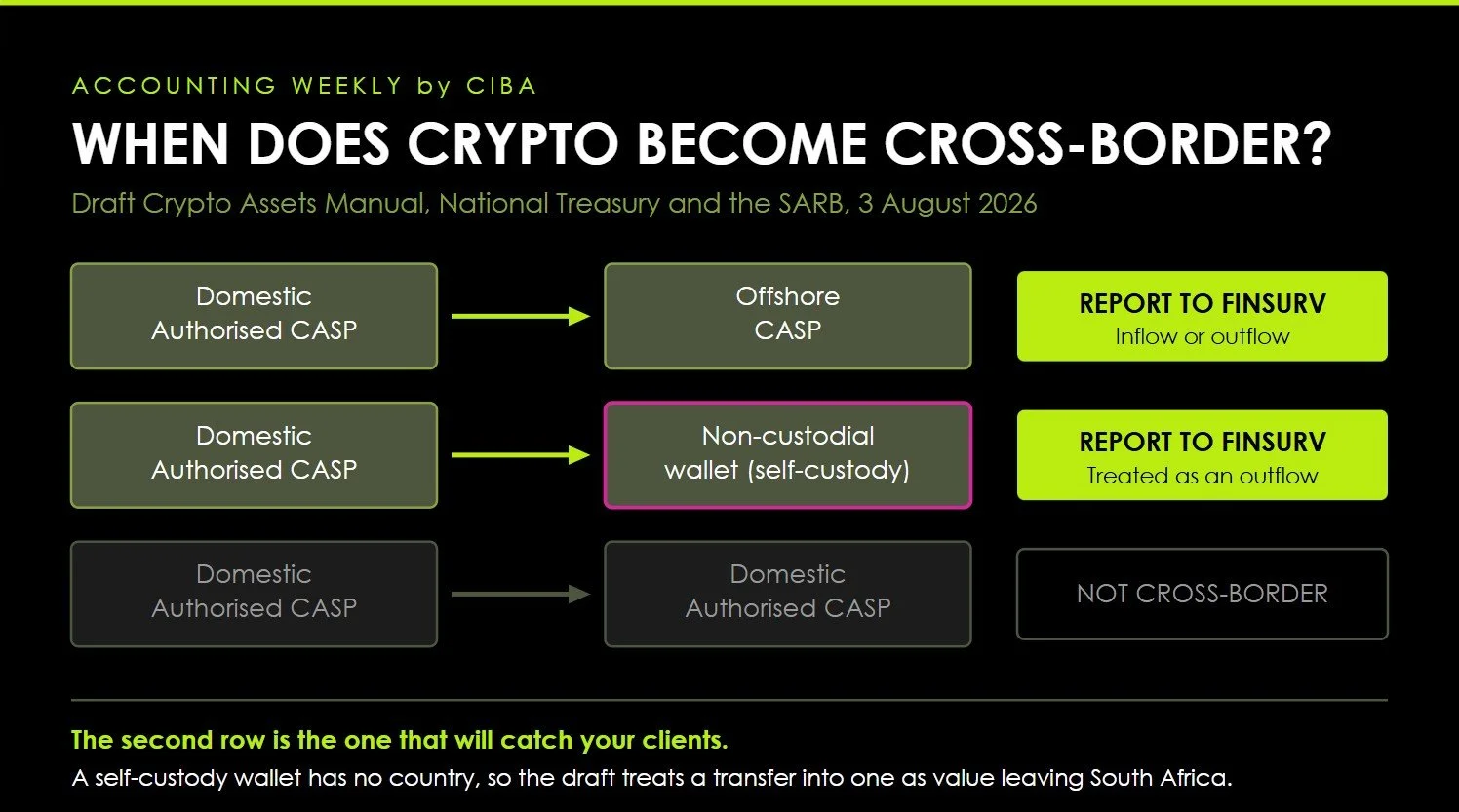
The Manual finally says when a crypto transaction becomes cross-border. Two events do it.
One, crypto moves between a domestic Authorised CASP and an offshore CASP. That one is obvious.
Two, crypto moves from a domestic Authorised CASP to a non-custodial wallet. That one is not obvious at all, and it is the one that will catch your clients. A self-custody wallet has no country. Under the draft, moving coins into one is an outflow that must be reported to FinSurv.
The SARB calls this an activity-based approach. In plain terms: it regulates the platform and the movement, not the coin.
The line that changes your advice
One sentence in the media statement carries more weight than the rest of the document combined. At this stage, only individuals will be allowed to externalise crypto through an Authorised CASP, and only within their single discretionary allowance or their foreign capital allowance. Read that again as a practitioner. Not companies. Not trusts. Not partnerships.
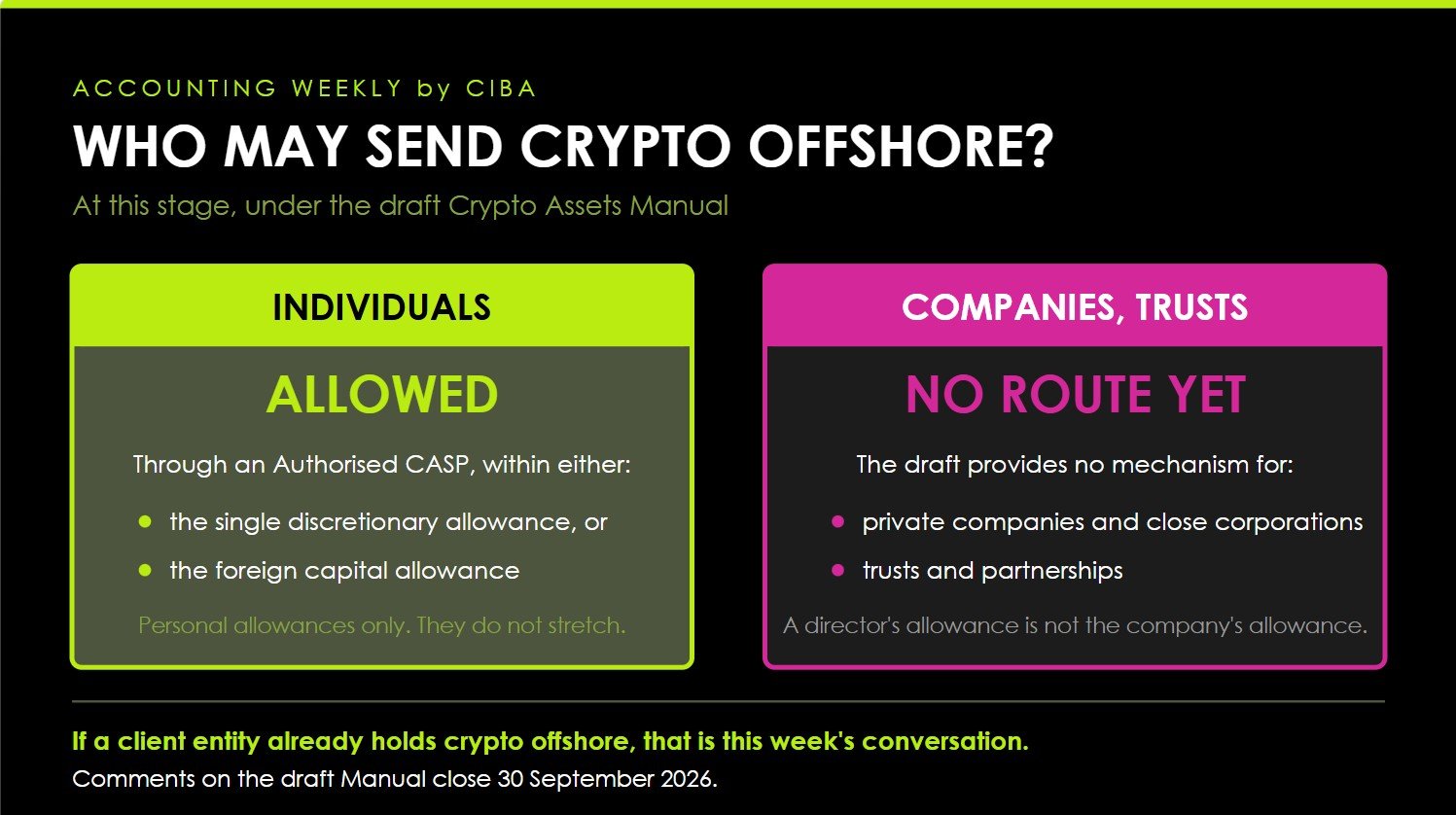
Think about the small software house in Centurion invoicing a client in Berlin, or the online retailer settling a supplier in USDT. If the client is a Pty Ltd and it holds crypto offshore, the draft gives it no route out. The individual director has a personal allowance. The current draft provides no equivalent route for South African companies. Those are two different taxpayers, two different balance sheets, and one very awkward conversation if the money is already sitting in the wrong place.
That is a structuring question, and structuring questions are billed by the hour, not by the invoice batch.
Three things to do this week
Flag the exposed clients. Run your client list and mark anyone holding crypto, invoicing offshore, or paying suppliers in stablecoins. Split them into individuals and entities. The entities are the urgent ones.
Reconcile wallet movements now. If a transfer to a non-custodial wallet becomes a reportable outflow, your client needs records showing what moved, when, and at what value. Most do not have this. Start the file before the rule commences, not after.
Send a briefing note. One page explaining the trigger point, the individuals-only limitation, and the 30 September deadline. Charge for it. This is exactly the shift Accounting Weekly described in the tax treatment of crypto gains: every new compliance duty is a service somebody has to be paid to deliver.
Have your say
Comments go to SARB-FinSurvDocuments@resbank.co.za by close of business on 30 September 2026, using the format set out in Annexure A of the Manual.
Treasury has been honest that the comments already submitted on the draft Regulations have not yet been worked into this Manual. Both documents will still change. That is not a reason to wait. It is the reason to comment.
When your clients can move money legally and cheaply across borders, they trade, they hire, and they grow. When they cannot, that activity leaves the country or stops. You are not filing forms here. You are keeping South African businesses inside the formal economy.
👉 Join CIBA and we'll show you how to turn cross-border crypto compliance into a service your clients will pay for.