New U.S. Taxpayer Protection Laws and What We Should Note
This article will count 0.25 units (15 minutes) of unverifiable CPD. Remember to log these units under your membership profile.
Two new bills passed by the U.S. House of Representatives are reshaping how American taxpayers are treated by the Internal Revenue Services (IRS), dealing with how penalties are imposed, and how fairly tax disputes are resolved. While these U.S. reforms don’t apply directly to South Africa, they provide valuable insights into how modern tax systems are evolving to better protect taxpayers. Understanding these shifts can help local professionals improve compliance strategies and client representation, especially as SARS continues to automate and enforce more aggressively.
Below we look at the U.S. changes and compare how similar matters are handled in South Africa.
What’s Changing in the U.S.?
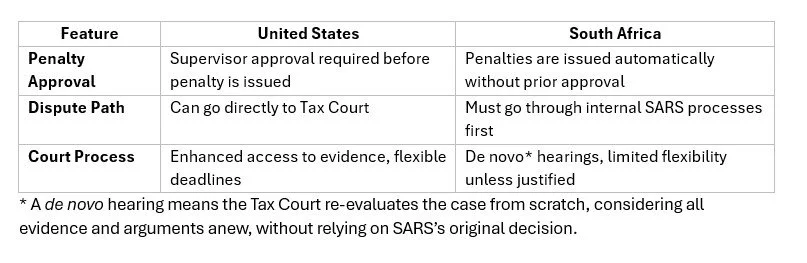
This bill ensures that IRS agents cannot impose penalties on taxpayers unless they receive written approval from their direct supervisor beforehand. As House Ways and Means Committee chairman Jason Smith put it:
“American taxpayers should not be at the mercy of rogue IRS agents who are handing out fines without reasonable due process.”
The new process is important because it:
Promotes accountability in issuing penalties
Reduces arbitrary enforcement
Provides better protection for taxpayers.
Tax Court Improvement Act (H.R. 5349)
This bill updates the procedures of the U.S. Tax Court to make it more efficient and equitable. Key changes include:
Allowing earlier access to documents and evidence
Requiring judges to follow standard conflict-of-interest rules
Permitting deadline extensions for taxpayers who miss filing dates due to valid reasons.
This is important as it:
Improves the fairness of court proceedings
Reduces delays
Gives taxpayers more flexibility when genuine issues arise.
How Does South Africa Compare?
South Africa handles similar tax processes through SARS, but there are key differences in how penalties and disputes are managed.
Penalty Process in South Africa
SARS can automatically issue penalties for non-compliance, such as late submissions or missing returns. No prior approval from a supervisor is required. This system relies on automated enforcement rather than discretionary oversight.
Dispute Resolution Process
South African taxpayers can challenge penalties through the following steps:
Request for Remission (RFR): Explains why the penalty should be waived
Notice of Objection (NOO): Filed if the RFR is declined
Appeal Lodged if the objection is unsuccessful, possibly leading to the Tax Board or Tax Court
Tax Court Procedures
Apply under the Tax Administration Act available only for taxpayers who completed the RFR, objection, and appeal stages. The court reviews disputes from the beginning (de novo) and allows new evidence and testimony.
Key Differences in US and RSA Processes
What Are the New Bills Mean for South African Accountants
While these U.S. reforms don’t apply in South Africa, they highlight global trends in taxpayer rights and enforcement fairness. For local accountants, this means:
Being proactive in managing client compliance to avoid automatic penalties
Helping clients understand and navigate the SARS dispute process
Staying informed about international practices to better advise cross-border clients.
Summary and Reflection
The U.S. reforms place greater emphasis on taxpayer protections and accountability in enforcement. In South Africa, while remedies exist, the onus is on taxpayers and their advisors to challenge penalties after they are issued. CIBA fully supports the intent behind the new U.S. legislation, as it closely aligns with our core values of fairness, transparency, and accountability. Requiring IRS agents to get proper approval before issuing penalties, and improving how tax disputes are handled in court, reflects the kind of ethical, well-governed system CIBA advocates for. These reforms mirror our commitment to protecting both taxpayers and professionals through clear, responsible processes, something we believe is essential in any modern tax environment.
Source article: Accounting Today