This article will count 0.25 units (15 minutes) of unverifiable CPD. Remember to log these units under your membership profile.
Artificial intelligence is no longer something accountants are experimenting with. It is already part of the profession. From drafting emails to analysing data and researching technical topics, AI tools are being used daily across practices of all sizes.
Yet there is a noticeable gap between using AI and using it well.
Many professionals remain passive users. They ask simple questions, accept the answers provided, and move on. The result is often underwhelming. The output lacks depth, relevance, or practical value. In some cases, it may even be incorrect.
The real opportunity lies in a shift in approach. Accountants need to move from simply using AI to actively shaping how it works for them.
The quality of output depends on the quality of input
One of the most important realities to understand is that AI responds exactly to what it is given. It does not interpret intent in the way a human would. It does not fill in gaps or assumptions unless prompted to do so.
This means that vague instructions lead to vague answers.
A simple request such as “Explain ESG reporting” will produce a general explanation. It may be technically correct, but it is unlikely to be useful in a professional context. Compare that to a more structured request that includes the purpose, the industry, and the required output format. The difference in quality is immediate.
Effective use of AI starts with clear thinking. Before asking a question, the accountant must be clear on what is required, why it is required, and how the answer will be used.
In practice, strong prompts tend to include:
A clear task
Relevant context
A defined structure or format
A specific perspective or role
A suitable tone for the intended audience
This is not about complexity. It is about clarity.
Professional scepticism still applies
There is a common misconception that AI improves accuracy by default. In reality, AI improves speed. Accuracy still depends on the user.
This is where professional judgement becomes critical.
Accountants are already trained to question information, assess reliability, and consider alternative interpretations. These same principles must now be applied to AI-generated outputs.
Accepting an answer without interrogation introduces risk. AI can produce responses that sound convincing but are incomplete, outdated, or simply incorrect.
A practical approach is to treat AI output as a first draft rather than a final answer. It should be reviewed, challenged, and refined before being relied on.
Strong critical thinking involves:
Identifying what the real question is
Testing whether the answer addresses that question
Considering whether additional information is needed
Comparing the response to known standards or frameworks
Applying professional judgement before finalising any conclusion
This is not a new skill. It is simply being applied in a new context.
Where AI actually saves time
The real value of AI is not in replacing technical work, but in accelerating it.
When used correctly, it can significantly reduce time spent on:
Researching unfamiliar topics
Drafting initial reports or communications
Summarising large volumes of information
Structuring technical explanations for clients
It can also assist with learning. Accountants can use AI to explore new areas, test understanding, and build confidence in unfamiliar topics.
However, the biggest gains come when AI is applied to repeatable processes.
For example, an accounting practice can:
Standardise responses to common client queries
Develop internal guidance tools for staff
Create structured workflows for technical reviews
Build templates that improve consistency and efficiency
In these cases, AI becomes part of the system rather than an occasional tool.
From tools to tailored solutions
A more advanced application of AI involves creating customised solutions that align with how a practice operates.
Instead of relying only on external software, accountants can design tools that support their specific needs. These may include:
Internal assistants that guide junior staff through procedures
Technical support tools that interpret standards and legislation
Review frameworks that help assess compliance and consistency
Decision-support tools that assist with complex judgements
This approach changes the role of the accountant. It moves from adapting to technology to shaping it.
The benefit is not only efficiency, but also consistency and scalability.
Managing risk in an AI-driven environment
While the opportunities are significant, the risks must be managed carefully.
Confidentiality remains a priority. Sensitive client information should not be shared with AI tools unless appropriate safeguards are in place.
There is also a responsibility to ensure that outputs are accurate and appropriate. Delegating thinking to AI does not remove accountability. The accountant remains responsible for the final outcome.
Clear internal policies are becoming increasingly important. These should address:
What information can and cannot be used in AI tools
How outputs should be reviewed
Where human oversight is required
How data protection requirements are maintained
Ethics, judgement, and responsibility remain at the centre of the profession.
The real competitive advantage
There is a growing narrative that AI will replace accountants. This view oversimplifies what is actually happening.
AI is not replacing the profession. It is raising the standard.
Accountants who use AI effectively will be able to work faster, provide deeper insights, and deliver more value to clients. Those who do not adapt may find themselves at a disadvantage.
The differentiator is not access to technology. These tools are widely available.
The differentiator is how they are used.
Accountants who ask better questions, apply stronger judgement, and design smarter processes will stand out. They will move beyond producing information and focus on interpreting and applying it.
A practical way forward
For accountants looking to improve their use of AI, the starting point is simple:
Be more intentional.
Take time to think before prompting. Be specific about what is required. Question the outputs. Refine the process.
AI is not a shortcut to avoid thinking. It is a tool that rewards better thinking.
Those who understand this will not only save time. They will strengthen their role in a profession that is evolving rapidly.
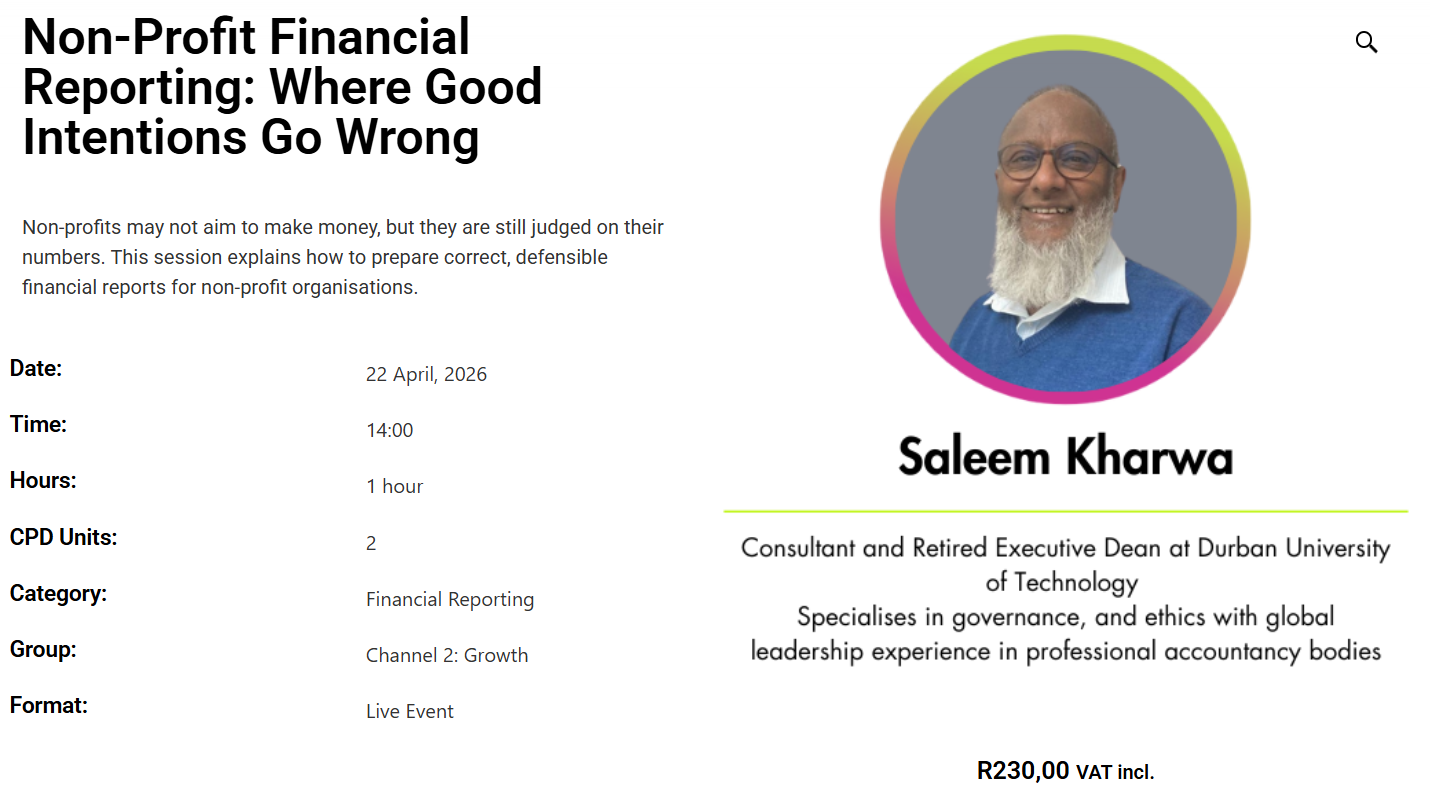
Many non-profits don’t struggle because of bad intentions. They struggle because their financial reporting doesn’t tell the full story.
And in today’s environment, that’s a real risk.
Funders want transparency. Regulators expect compliance. Boards need clarity. Yet too often, financial statements for non-profit organisations fall short, especially when it comes to donations, grants, and restricted funds.
That’s exactly what we’re tackling in this upcoming session:
Non-Profit Financial Reporting: Where Good Intentions Go Wrong
📅 22 April 2026
⏰ 14:00
🎓 2 CPD Units
💻 Live Online
Presented by Saleem Kharwa, this session focuses on the practical side of non-profit reporting. Not theory. Not checklists. Real-world guidance on how to prepare financial statements that stand up to scrutiny.
We’ll cover:
• How non-profits differ from traditional businesses
• Correct treatment of donations, grants, and restricted funds
• Common reporting mistakes that raise red flags
• What funders and regulators actually look for
• How to reduce your reporting risk
If you work with non-profits, this is not just about compliance. It’s about protecting the organisation and your professional credibility.
👉 Join us here



Trending