This article will count 0.25 units (15 minutes) of unverifiable CPD. Remember to log these units under your membership profile.
Introduction
Many NPOs and tax practitioners are often surprised when SARS taxes an NPO at 27% on its taxable income, as these organisations generally expect to be fully exempt from income tax.
Being non-profit in nature or registered as an NPO under the NPO Act, or as an NPC under the Companies Act, does not in itself qualify an organisation for preferential tax treatment or recognition as a Public Benefit Organisation (PBO).
When Will a PBO Be Fully Exempt from Income Tax?
A Public Benefit Organisation (PBO) will only become fully tax exempt after it has applied for and obtained approval as a tax-exempt organisation from the Tax Exemption Unit (TEU) of SARS. TEU issues an approval letter confirming the organisation’s exemption status and assigns a unique exemption reference number in addition to its normal tax reference number.
Once approved, as per section 30(3) of the Income Tax Act, the organisation must submit the IT12EI tax return via eFiling, rather than the standard ITR14 form used by other entities.
An organisation that merely operates on a non-profit basis or is registered as an NPO or NPC but has not obtained SARS approval, will not qualify for preferential tax treatment. Such an organisation will be subject to income tax at the rate of 27% and must file the standard ITR14 return.
Who Qualifies as a Fully Tax-Exempt Institution?
SARS may approve an organisation as a PBO only if it:
Complies with prescribed conditions ensuring activities and resources further its object
Submits a founding document and meets all statutory requirements
Did not knowingly participate in a tax-avoidance scheme
Pays reasonable remuneration and does not unduly benefit any person
Complies with reporting requirements
Does not use its resources to support any political party
Ensures fiduciaries are not disqualified under applicable legislation, i.e. Trust Property Control Act, the NPO Act, or the Companies Act.
Tax Regime for SARS-Approved PBOs
The Income Tax Act provides for exemption from income tax on receipts and accruals that is derived from:
The carrying on of Public Benefit Activities (PBAs). These may be categorised as:
Welfare and humanitarian
Health care
Education and development
Conservation, environment and animal welfare
Land and housing.
These activities do not apply to duties and offerings to faith-based organisations.
Permissible business undertakings or trading activities
Other business undertakings or trading activities not exceeding the basic exemption.
A PBO may carry on permissible business undertakings provided its sole or principal object remains the carrying on of one or more PBAs.
Receipts and accruals from business undertakings or trading activities will be exempt only if the undertaking or activity is:
Integral and directly related to the sole or principal object
Conducted substantially on a cost-recovery basis – not to make profit
Not resulting in unfair competition with taxable entities
Of an occasional nature and substantially assisted by volunteers
Approved by the Minister by notice in the Government Gazette
All PBAs must be carried on in a non-profit manner with an altruistic or philanthropic intent.
Illustrative Examples (SARS Guidance)
Integral and directly related
A PBO’s principal object is providing free healthcare services, and it also supplies medication at cost. This is regarded as integral and directly related to its healthcare services to poor and needy persons, which is the PBO’s sole or principal object PBA.Unrelated trading activity
A museum operates a theatre for educational purposes during the week but screens mainstream films at market prices over weekends. The weekend activity is regarded as unrelated to its principal objective and also seen to be in competition with the private sector.Substantially the whole directed towards recovery of cost
SARS interprets “substantially the whole” as 90% or more but accepts not less than 85% where precise planning is difficult. Cost recovery refers to recouping direct and reasonable indirect costs, not generating profit.
A PBO charging tuition fees on a cost-recovery basis for training unemployed persons. The fees are based on the estimated cost to the PBO in providing the tuition including the cost of hiring a hall and tuition materials. As substantially the whole of the activities is regarded as being directed towards the recovery of cost, this activity meets the requirement, even where fees are its main income source.
Recovery of cost
A school tuck shop operated by volunteers and pricing goods to cover costs, including reserves for asset replacement, is regarded as operating on a cost-recovery basis. It is operating on school premises so it is not in competition with similar private sector activities.Unfair competition
An orphanage operating a service station for profit to augment its income. This activity is commercial trading that does not qualify as a permissible business undertaking and is subject to partial taxation.
Further Considerations for Permissible Activities
SARS considers the following when deciding whether the receipts of a PBO will be exempt from income tax:
The scope and benevolent nature of the activity
Its direct connection to the PBO’s principal object
Profitability of the activity, and
The level of economic distortion that will be caused by tax exemption.
Basic Exemption
Receipts and accruals from non-permissible business undertakings or trading activities are exempt to the extent that they do not exceed the greater of:
5% of the total receipts and accruals for the year of assessment, or
R200 000
The basic exemption:
Cannot create a loss
Is a threshold calculation, not a deduction
Applies collectively to all non-permissible activities.
Total receipts and accruals include all amounts received or accrued from any source, whether capital or revenue in nature.
The exemption is not applied on a pro rata basis for partial-year operations.
Illustrative example - Basic Exemption
A PBO conducts PBAs from a property it owns. To augment its income, it lets a portion of the property not used for carrying on its PBAs. Rental income of R90 000 earned by a PBO with total receipts of R590 000.
The rental income is not derived from a permissible business undertaking or trading activity and is regarded as a commercial trading activity, which is subject to the basic exemption. The basic exemption is calculated as an amount equal to the greater of 5% of the total receipts and accruals of the PBO, or R200 000. 5% of the total receipts = R29 500 (R590 000 * 5%). So the R90 000 receipt form letting the property will be exempt since it is less than RR200 000.
The other receipts and accruals of R500 000 (donations of R450 000 + interest of R50 000) are also exempt from income tax since they were not derived from a business undertaking or trading activity.
Conclusion
A PBO that conducts non-permissible business undertakings or trading activities will, subject to the basic exemption, be taxed on receipts and accruals exceeding the exemption threshold.
A PBO with taxable income is taxed at:
28% for years of assessment ending before 31 March 2023
27% for companies for years ending on or after 1 April 2023
27% for trusts for years commencing on or after 1 March 2023
Partial taxation applies only to PBOs authorised to issue section 18A certificates.
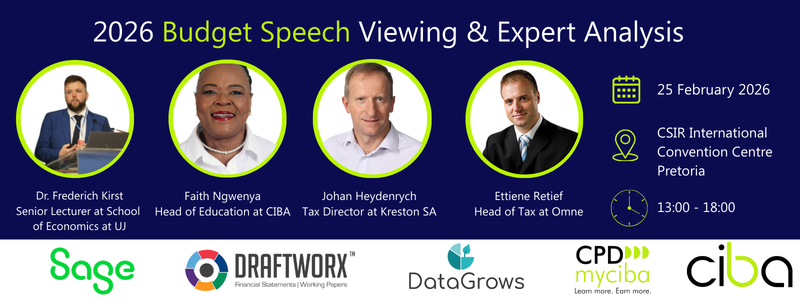
🔴 LIVE: 2026 Budget Speech Viewing & Expert Analysis
Understand the Budget as it happens. Know what to do next.
On 25 February 2026, South Africa’s National Budget Speech will set the tone for tax, compliance, and economic decision-making in the year ahead. CIBA invites you to a live Budget Speech Viewing & Expert Analysis Event, designed specifically for finance professionals who cannot afford to “wait and see” what it means.
Join us for a real-time viewing of the Budget Speech, streamed directly from Parliament, with live expert commentary translating policy announcements into clear, practical implications for your practice and your clients.
You will hear expert insights from Johan Heydenrych, Ettiene Retief, and Dr Frederich Kirst, as the Budget unfolds — not weeks later.
Whether you advise clients, manage tax risk, or lead financial decisions, this session helps you move from policy to action immediately. The event concludes with a cocktail networking session for in-person attendees.
📍 Venue: CSIR International Convention Centre, Pretoria
🕐 Time: 13:00 – 16:00 (Cocktails from 16:00)
💻 Attendance: In-person or Online
🎟️ Limited seats available
IN-PERSON: Register here
ONLINE: Register here
Don’t just hear the Budget. Understand it. Apply it.



Trending