SONA 2026: Practical Progress or Incremental Change? A Tax and Business Perspective
This article will count 0.25 units (15 minutes) of unverifiable CPD. Remember to log these units under your membership profile.
The 2026 State of the Nation Address presented a familiar narrative of reform, inclusion, and growth, echoing many of the themes that have defined recent policy direction. While the intent to support small businesses, expand infrastructure, and modernise administration is clear, the real question for practitioners and SMMEs is whether the measures outlined represent meaningful acceleration or simply incremental progress. For members of the Chartered Institute for Business Accountants, the speech offers both opportunity and reason for cautious scrutiny.
Government’s continued emphasis on SMME participation in the economy is welcome, but it also highlights a persistent gap between policy ambition and implementation capacity. Simplified licensing, improved access to funding, and expanded procurement opportunities have long been on the reform agenda, yet many small businesses still face administrative delays and fragmented support mechanisms. Without clearer timelines and stronger coordination across departments, the risk remains that these commitments will translate into limited short-term relief for enterprises already under pressure. For practitioners, this means balancing optimism with realism when advising clients on the pace at which opportunities may materialise.
Infrastructure investment similarly carries promise, particularly in its potential to draw more small suppliers into formal value chains. However, experience suggests that project execution and payment cycles can be uneven, placing cash-flow strain on smaller contractors. This reality reinforces the importance of robust financial planning and tax management. Practitioners will need to guide clients carefully, ensuring that growth opportunities do not inadvertently create compliance exposure or liquidity risks. In this sense, the profession becomes not only an enabler of participation but also a safeguard against the unintended consequences of policy rollout.
The commitment to administrative simplification and digitalisation is perhaps one of the more tangible aspects of the address, yet even here progress has been gradual. While more integrated systems promise reduced red tape, businesses often experience transitional complexity as new platforms are introduced. For SMMEs, the shift can initially increase reliance on professional support rather than reduce it. Practitioners therefore remain central to helping clients interpret evolving processes, anticipate tax liabilities, and maintain compliance in an environment that is still stabilising.
From a tax perspective, the speech did not introduce major reforms, but it underscored the growing importance of compliance as a gateway to economic participation. Access to funding, incentives, and public sector opportunities increasingly depends on demonstrable tax good standing. This places practitioners at the heart of enterprise readiness, helping businesses maintain clean compliance records while identifying legitimate optimisation strategies. Yet the absence of significant tax relief measures for small enterprises may limit the immediate financial impact of broader economic initiatives, particularly for firms already navigating tight margins.
For practitioners themselves, the environment presents a nuanced outlook. On one hand, the expanding focus on enterprise development naturally increases demand for advisory services, policy interpretation, and ongoing financial guidance. On the other, slower-than-expected reform implementation may temper client confidence and delay investment decisions. Firms that position themselves as strategic partners, able to translate policy signals into practical, risk-aware actions will be best placed to support clients through this uncertainty while sustaining their own growth.
SMMEs stand to benefit from improved market access and expanded funding pathways, but the degree of impact will depend heavily on execution. Procurement reforms and localisation targets can open doors, yet only businesses with strong governance and reliable financial information will be able to capitalise fully. Similarly, administrative efficiencies may reduce compliance costs over time, but the transition period may still require careful navigation. In this context, the accountant’s role as a trusted advisor becomes even more critical.
For CIBA members, the opportunity lies in turning policy direction into structured client solutions while maintaining a pragmatic perspective. Packaging services around funding readiness, tax health, and financial strategy enables practitioners to generate new revenue streams while delivering tangible value. At the same time, a critical understanding of policy limitations allows professionals to provide balanced advice that protects clients from over-exposure to uncertain timelines or regulatory shifts.
SONA 2026 ultimately reflects a steady continuation of reform rather than a decisive break from past approaches. Its success will depend less on the announcements themselves and more on the effectiveness of implementation in the months ahead. For the accounting profession, this underscores a broader truth: practitioners remain key translators between policy intent and business reality. By helping enterprises navigate compliance, manage risk, and plan for sustainable growth, accountants play a direct role in ensuring that national priorities translate into measurable outcomes.
In this sense, the address offers both encouragement and a reminder of the work still to be done. The policy direction is broadly constructive, but meaningful impact will require consistent execution and clearer operational pathways. For CIBA members, maintaining a balanced, practical, and slightly sceptical lens will be essential, not only to safeguard clients, but also to reinforce the profession’s role as a credible voice in South Africa’s economic development.
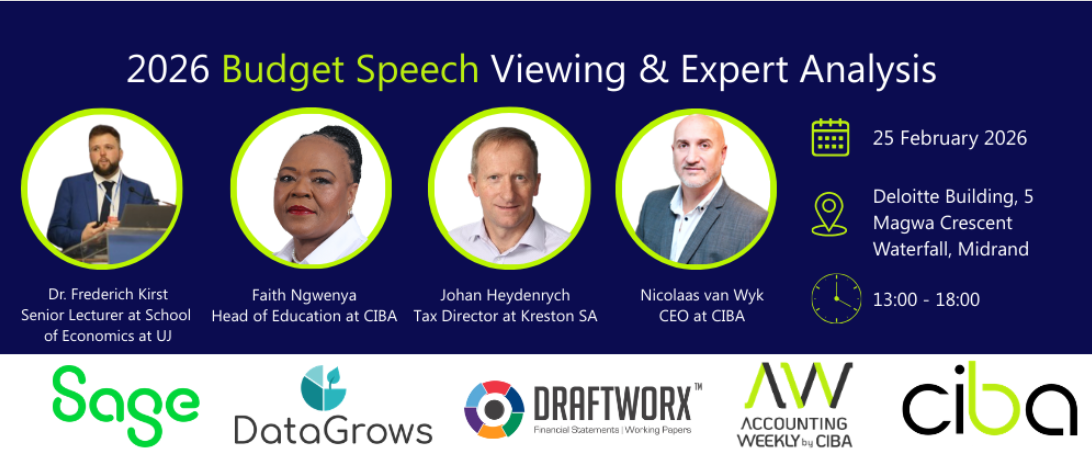
Don’t miss the CIBA Budget 2026/27 Event
🔴 LIVE: 2026 Budget Speech Viewing & Expert Analysis
Understand the Budget as it happens. Know what to do next.
On 25 February 2026, South Africa’s National Budget Speech will set the tone for tax, compliance, and economic decision-making in the year ahead. CIBA invites you to a live Budget Speech Viewing & Expert Analysis Event, designed specifically for finance professionals who cannot afford to “wait and see” what it means.
Join us for a real-time viewing of the Budget Speech, streamed directly from Parliament, with live expert commentary translating policy announcements into clear, practical implications for your practice and your clients.
You will hear expert insights from Johan Heydenrych, Ettiene Retief, and Dr Frederich Kirst, as the Budget unfolds — not weeks later.
Whether you advise clients, manage tax risk, or lead financial decisions, this session helps you move from policy to action immediately. The event concludes with a cocktail networking session for in-person attendees.
📍 Venue: CSIR International Convention Centre, Pretoria
🕐 Time: 13:00 – 16:00 (Cocktails from 16:00)
💻 Attendance: In-person or Online
🎟️ Limited seats available
IN-PERSON: Register here
ONLINE: Register here
Don’t just hear the Budget. Understand it. Apply it.



Trending