This article will count 0.25 units (15 minutes) of unverifiable CPD. Remember to log these units under your membership profile.
Media article published by the South African Revenue Service
This article aims to inform trust taxpayers of the specific tax obligations associated with a trust throughout its lifecycle, from registration with SARS to the final step of deregistration with SARS, including all the important requirements that must be met in between.
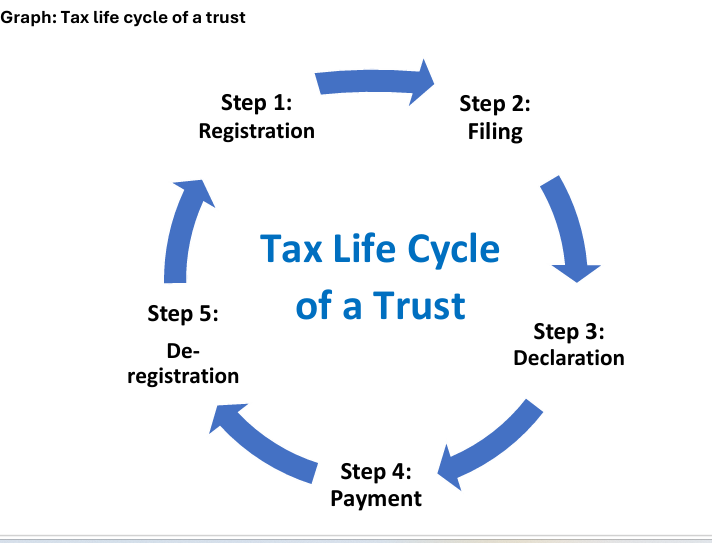
Step 1: Registration
Any trust must be registered for Income Tax within 21 business days of registering with the Master of the High Court. There is an easy digital solution for trusts to register for income tax via the SARS Online Query System (SOQS) which is accessible on the SARS website. Registration can also be done at a SARS branch after making an eBooking appointment via the SARS website. A list of documents required for registering a trust for income tax may be found on the SARS website. SARS is currently identifying trusts that should be registered and ensuring that qualifying trusts are brought into the tax net.
It is important to note that SARS must be notified of any changes in the registered details of a trust within 21 business days of change occurring. This includes changes to postal and physical address, representative taxpayer, banking particulars used for transactions with SARS, electronic address used for communication with SARS or any other details that the Commissioner may require by public notice. Failure to notify SARS of changes to registered particulars may constitute an offence under section 234 of the Tax Administration Act.
Step 2: Filing
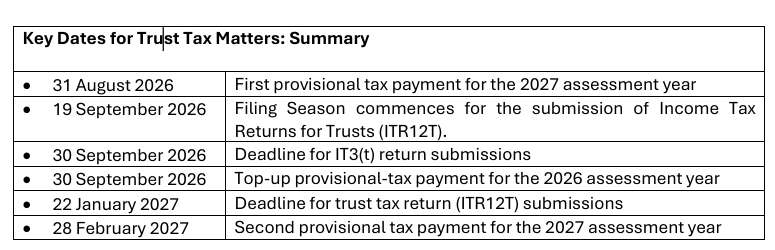
Key Dates for Trust Tax Matters: Summary
All trusts are required to file an annual income tax return (ITR12T), regardless of whether they are active, passive, or economically inactive.
Trusts have three major filing requirements, namely:
1. Provisional Tax Returns (IRP6)
Trusts that are provisional taxpayers must submit two provisional tax returns each year. The first provisional tax return is due within six months from the commencement of the year of assessment and the second by the end of the year of assessment. Where the trust's year-end is the last day of February, these returns are generally due on 31 August and the last day of February respectively.
2. Annual Income Tax Return (ITR12T)
Trusts are required to submit an Income Tax Return for Trusts (ITR12T) by the deadline prescribed in the annual public notice. The deadline for the 2026 filing season is 22 January 2027.
3. IT3(t) submissions
The IT3(t) third-party data return must be submitted by the representative taxpayers of trusts by 30 September.
The purpose of the IT3(t) return is for the representative taxpayers of a trust to provide details of amounts vested in or distributed to beneficiaries for a specific year of assessment. This information is used to prepopulate the beneficiary schedules in the trust's Income Tax Return (ITR12T) as well as the relevant beneficiaries’ tax returns, with the amounts vested or distributed by the trust.
These filing requirements can be performed on eFiling. The IT3(t) return may also be submitted via Connect: Direct or HTTPS. The appropriate channel for submitting IT3(t) returns will depend on the volume of records and the frequency of submissions.
Step 3: Declaration accuracy
There appears to be a misconception amongst trust taxpayers that passive trusts are not actively used in the production of income, and thus file nil returns for such trusts. The existence of passive assets does not relieve a trust from the obligation to disclose its assets, liabilities, and all relevant financial information.
Taxpayers are reminded that all assets, including dormant or passive assets, must be disclosed. In addition, all income and expenditure relating to such assets — for example, a holiday home or immovable property and the upkeep of such property — must be accurately declared.
Trusts reporting nil returns or assessed-loss positions should base these positions on the complete disclosure of the trust’s assets, income, expenditure, and liabilities. Nil returns or assessed-loss positions must be fully supported by the trust’s records and underlying circumstances.
This filing season, a priority for SARS will be analysing disparities in the submission of nil returns and assessed-loss positions. This focus aims to improve compliance and reporting accuracy by all trusts.
Step 4: Payment
Where a payment is payable, it becomes due on the date indicated on the SARS Notice of Assessment letter.
Step 5: Deregistration
The termination of a trust at the Master of the High Court (Master) does not automatically deregister a trust with SARS. The trust remains on the SARS register until the SARS deregistration process is completed. Trusts should ensure that their tax affairs are fully regularised before termination with the Master. Once a trust has been terminated by the Master, a deregistration request (in the form of a letter) must be submitted to SARS, together with the required supporting documentation. Deregistration requests may be submitted via email to contactus@sars.gov.za or through a SARS branch by booking an appointment.
Documents required for the deregistration process may include:
• Deregistration request and effective termination date;
• Termination confirmation from the Master;
• Trustees’ resolution or minutes approving the deregistration;
• Distribution list or financial statements, where applicable;
• For Collective Investment Schemes, a letter from the Financial Services Conduct Authority (FSCA) confirming cessation;
• A certified copy of the main trustee’s identity document;
• A Power of Attorney, where the request is submitted by a third party; and
• A certified copy of the third party’s identity document.
All the tax affairs of the trust must be regularised before deregistration. This includes ensuring that all outstanding returns have been submitted, all obligations have been met, and that the trust's tax account reflects a nil balance.
Trustees Remain Liable for a Trust’s Tax Affairs
SARS emphasises that the responsibility for obtaining, maintaining, and updating accurate trust information rests exclusively with the trustees. The Trust Property Control Act No. 57 of 1988 (TPCA) mandates trustees to act with care, diligence, and skill in managing trust affairs. In addition, the “joint action rule” requires co-trustees to act collectively in the administration of a trust. Although trustees may delegate certain functions, they retain ultimate responsibility and accountability. The TPCA limits the effectiveness of provisions that seek to exempt trustees from liability in circumstances prescribed by law.
Trustees may appoint a tax practitioner to help administer the trust and fulfil its obligations. However, the trustees remain legally liable and responsible for the trust’s tax compliance in the eyes of the law. Under certain circumstances provided for in the Tax Administration Act, trustees may be held personally liable for a trust’s tax obligations. Trustees should therefore ensure that the trust remains fully compliant with its tax obligations.



Trending