South Africa Needs a Parliament of Taxpayers, Not a Parliament of Administrators
This article will count 0.25 units (15 minutes) of unverifiable CPD. Remember to log these units under your membership profile.
Reclaiming the Fiscal Sovereignty of the People: Parliament, the State, and the Democratic Inversion of Taxation
In every constitutional democracy, a silent tension exists between two centres of authority: the elected Parliament, which draws its legitimacy from the consent of the people, and the unelected State administration, which draws its power from continuity, expertise, and institutional memory.
South Africa’s constitutional order is no exception. Yet nowhere is this tension more visible—and more consequential, than in the realm of taxation.
Parliament’s Forgotten Power
Parliament is not a spectator in fiscal governance. The Constitution vests in it a profound authority: only Parliament may impose taxes, and it may do so only after scrutinising the State’s intended expenditure, service by service.
In theory, Parliament could decide:
“South Africa shall abolish income tax.”
“The State may raise only consumption-based taxes.”
“The Executive must first justify every service it intends to offer before any tax is authorised.”
These choices would be radical, but they would be fully constitutional. Parliament’s fiscal sovereignty is immense.
And yet, paradoxically, it is almost never exercised.
Tax as Choice, Not Inevitability
Modern fiscal discourse treats taxation as a natural force, something that rises automatically with expenditure, like water behind a dam. This is a profound conceptual error. There is nothing in economics, political theory, or the South African Constitution that makes taxation inevitable or predetermined.
📌The Tax Illusion
Citizens are repeatedly told:
“The State needs revenue; therefore taxes must rise.”
“Government programmes require funding; therefore the tax base must expand.”
This logic treats tax as the dependent variable responding to the State’s spending ambitions. Constitutionally, this is inverted.
“Expenditure is the dependent variable. Tax is the choice.”
The sovereign power, Parliament, decides:
What level of State activity is necessary
What level of tax is tolerable
Which tax philosophy best serves the nation
And which services require collective financing.
Nothing forces South Africa into a high-tax, high-friction model. Those are policy choices, not constitutional mandates.
📌 The Range of Tax Choices Available
Globally, nations pick tax models that reflect their values:
Minimal tax: Saudi Arabia, UAE
Flat tax: Estonia, Lithuania
Territorial tax: Hong Kong, Singapore
Consumption-only: Various Gulf states
Simple business tax: Georgia
Progressive tax: South Africa, USA, UK.
South Africa has a progressive tax system because Parliament inherited this model from the UK.
It has never revisited that choice, never evaluated alternatives, and never exercised its full constitutional freedom to design a tax system that reflects the country’s present needs.
📌 The Constitutional Philosophy of Choice
The Constitution does not tell us how much tax must be collected. It only tells us who has the power to decide the tax system, if any.
That “who” is Parliament, the elected representatives of taxpayers. And in South Africa, ‘taxpayer’ does not mean only the wealthy or those earning a salary. Every person contributes: the poorest households pay VAT on food and electricity; commuters pay fuel levies; consumers pay excise duties; workers pay income tax; investors pay capital taxes.
The entire nation is taxed, and reflected in our democratic electorate.
Tax is therefore:
a democratic choice
a philosophical choice
a strategic choice
a developmental choice
Not an administrative inevitability.
The Rise of the Administrative State
Over decades, South Africa has drifted into a familiar global pattern: the administrative State, Treasury, SARS, the fiscal bureaucracy, behaves as if taxation is its intrinsic right.
The Executive designs the Budget, decides the revenue targets, and portrays taxation as an unavoidable technical exercise. Parliament, rather than interrogating the assumptions and demanding justification, is increasingly handed the Budget as a fait accompli, expected to endorse, not decide.
This is the democratic inversion at the heart of our fiscal system.
“This is the democratic inversion at the heart of our fiscal system”
A profound inversion has occurred:
The unelected State sets the revenue requirement.
SARS commits to collecting it.
Parliament scrutinises margins, not fundamentals.
The electorate becomes a revenue base, not the source of sovereignty.
The Social Contract Distorted
Taxation is not obedience. Tax is not property of the State. Taxation is the modern expression of the social contract: a voluntary surrender of private property in exchange for agreed-upon public goods.
Yet today, the social contract functions in reverse:
The State announces its expenditure.
The State demands taxation to meet it.
Parliament reacts instead of deciding.
Citizens bear obligations without meaningful influence.
The result is a fiscal architecture where the people pay, but the State defines the meaning of payment.
The Algorithmic Leviathan
Artificial Intelligence (AI) amplifies this imbalance. SARS now wields capabilities that were inconceivable at the dawn of democracy:
automated assessments
algorithmic risk-profiling
mass data fusion
behavioural prediction
instant penalties
enforcement without meaningful human oversight
These tools exponentially strengthen the State’s capacity, but they weaken the citizen’s position if they are not democratically controlled.
The Constitution did not contemplate an algorithmic Leviathan. A new equilibrium is required before administrative efficiency becomes administrative dominance.
Restoring Parliamentary Fiscal Sovereignty
The solution is not hostility toward SARS or toward the State. The solution is democracy.
Parliament must reclaim its constitutional role:
The State must justify its services before taxation is authorised.
Expenditure must follow democratic choice, not bureaucratic momentum.
AI enforcement must be subject to parliamentary standards, not institutional convenience.
Taxpayers must be treated as principals, not subjects.
Taxation must reflect the public interest, not institutional preservation.
In a constitutional democracy, the State is the creation of the people. It does not own them, it answers to them.
Parliament must remember this truth and resume its role as the apex democratic guardian of taxpayers, with the constitutional freedom to choose the tax philosophy of the nation, whether zero tax, minimal tax, consumption-only tax, flat tax, or any alternative that advances South Africa’s interests.
🔴 LIVE: 2026 Budget Speech Viewing & Expert Analysis
Understand the Budget as it happens. Know what to do next.
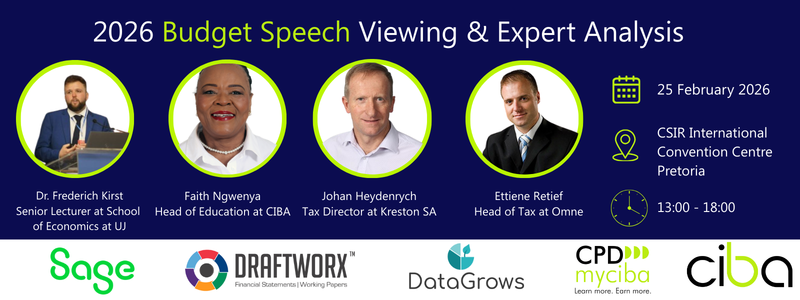
On 25 February 2026, South Africa’s National Budget Speech will set the tone for tax, compliance, and economic decision-making in the year ahead. CIBA invites you to a live Budget Speech Viewing & Expert Analysis Event, designed specifically for finance professionals who cannot afford to “wait and see” what it means.
Join us for a real-time viewing of the Budget Speech, streamed directly from Parliament, with live expert commentary translating policy announcements into clear, practical implications for your practice and your clients.
You will hear expert insights from Johan Heydenrych, Ettiene Retief, and Dr Frederich Kirst, as the Budget unfolds — not weeks later.
Whether you advise clients, manage tax risk, or lead financial decisions, this session helps you move from policy to action immediately. The event concludes with a cocktail networking session for in-person attendees.
📍 Venue: CSIR International Convention Centre, Pretoria
🕐 Time: 13:00 – 16:00 (Cocktails from 16:00)
💻 Attendance: In-person or Online
🎟️ Limited seats available
IN-PERSON: Register here
ONLINE: Register here
Don’t just hear the Budget. Understand it. Apply it.
#BudgetSpeech2026 #TaxProfessionals #FinanceLeadership #CIBA #SAEconomy