Budget 2026 Review: Growth, Relief and Reality
This article will count 0.25 units (15 minutes) of unverifiable CPD. Remember to log these units under your membership profile.
Setting a national budget is never simple. In recent years we have seen delays, tax increases, occasional tax relief, and shifting spending priorities. Against that backdrop, this year’s Budget arrives with cautious optimism.
South Africa has been removed from the FATF grey list, secured its first credit rating upgrade in 16 years, and borrowing costs have eased. These are meaningful milestones. The Minister of Finance has committed to stabilising debt this year, while increasing infrastructure spending to support growth. The key question remains: will delivery match intention?
As the Minister stated in his speech:
“The lesson is a simple but powerful one: steady structural reform and responsible public finances are the bedrock of a prosperous and more inclusive South Africa.”
Below is a summary of the key aspects of the 2026/27 Budget that will directly affect taxpayers and businesses.
National Treasury’s Budget Plan
The 2026/27 Budget follows a two-pronged strategy aimed at stimulating growth while maintaining fiscal discipline.
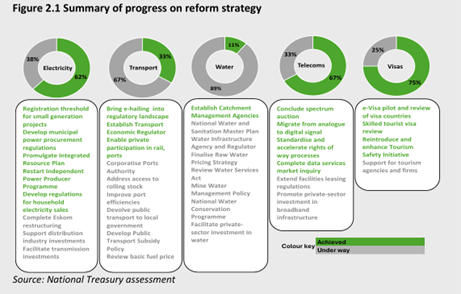
First, government plans to increase strategic infrastructure investment, particularly in electricity supply, transport and water. The objective is to unlock private investment, improve productivity and support job creation.
Second, Treasury aims to promote entrepreneurship by adjusting VAT registration thresholds and micro-business tax regimes, while also implementing inflationary adjustments to personal income tax and other thresholds.
While these measures are positive, infrastructure investment remains a long-term growth lever. The success of this strategy depends on effective execution, strong accountability and eliminating inefficiencies that have affected past projects.
Economic Outlook and Fiscal Strategy
Economic growth is projected at 1.6 percent for 2026 (1.4 percent in 2025), reflecting modest improvement. Real GDP growth is expected to average 1.8 percent over the medium term, reaching 2 percent by 2028.
Inflation is forecast to increase slightly to 3.4 percent (from 3.2 percent in 2025).
The budget deficit is expected to decline to 4 percent of GDP, with further reductions projected over the following two years toward 3 percent.
However, risks remain. External shocks such as global instability, health crises like COVID-19, or agricultural disruptions such as foot-and-mouth disease can derail projections.
Revenue and Key Tax Proposals
Gross tax revenue has been revised upward by R21.3 billion compared to the 2025 Budget. This is largely due to stronger-than-expected collections by SARS, which reduced the need for previously proposed tax increases.
Despite this improvement, South Africa’s tax base remains narrow. Approximately 60 percent of personal income tax revenue (R844.8 billion) is paid by just 13 percent of taxpayers. Government also remains heavily reliant on a small number of major tax categories.
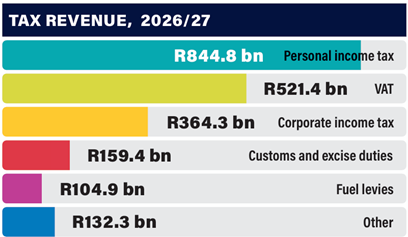
2026 Budget Review, National Treasury
This raises an important structural issue: sustainable growth requires a broader tax base, which in turn depends on entrepreneurship, SME growth and job creation.
Positive Relief for Taxpayers
Gross tax revenue is estimated to reach R2.01 trillion in 2026. Revenue is projected to increase to R2.38 trillion by 2028/29, with the tax-to-GDP ratio averaging 26.1 percent.
After two years without inflationary relief, personal income tax brackets and medical tax credits will be fully adjusted for inflation. Other thresholds and limits have also been adjusted.
Personal Income Tax Adjustment
Tax bracket and rebate adjustments will compensate individuals for inflation, which had not been adjusted over the past two years.
For example, an individual earning R500 000 per year would have paid R100 272 (20.7 percent) in 2025/26. In 2026/27, tax payable reduces to R98 417 (19.7 percent), increasing monthly take-home pay by approximately R154.57.
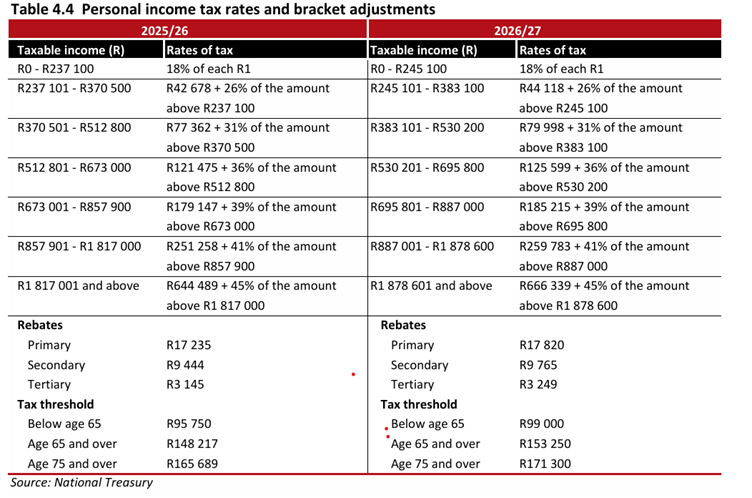
2026 Budget Review, National Treasury
VAT Registration Threshold
The compulsory VAT registration threshold increases from R1 million to R2.3 million annual turnover. This provides small businesses with more breathing room before mandatory VAT compliance applies, reducing administrative pressure during early growth stages.
Capital Gains Tax and Donations Tax
The CGT exclusion for small business asset disposals increases to R15 million.
The annual donations tax exemption increases from R100 000 to R150 000, meaning tax will only apply to donations exceeding R150 000 per year.
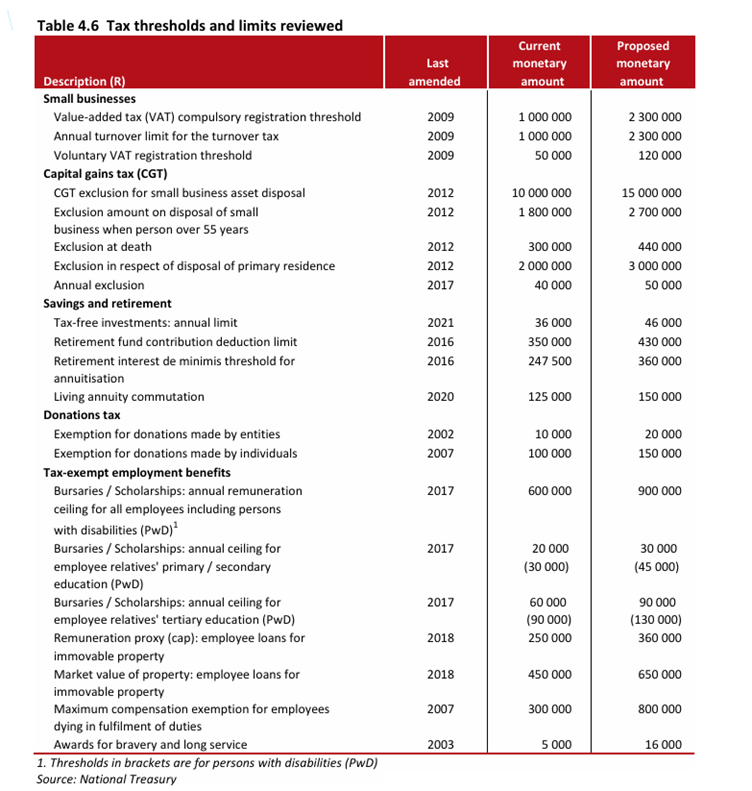
2026 Budget Review, National Treasury
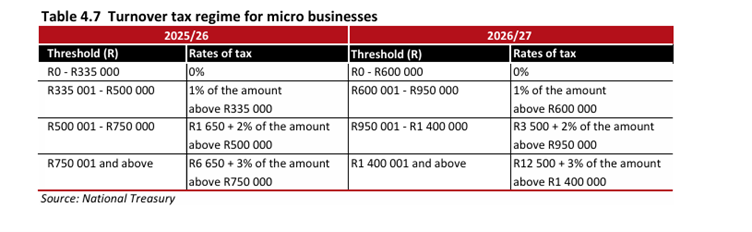
Micro Business Thresholds
Micro-business thresholds will also be adjusted for inflation, providing further relief to small enterprises.
2026 Budget Review, National Treasury
Where Additional Revenue Will Come From
Excise duties on alcohol and tobacco increase by 3.4 percent.
The General Fuel Levy increases by 9 cents per litre on petrol and 8 cents per litre on diesel.
The Road Accident Fund Levy increases by 7 cents per litre on both petrol and diesel.
The Carbon Tax on fuel increases by 5 cents per litre for petrol and 6 cents per litre for diesel.
Government Spending
Government expenditure is projected to grow at an average annual rate of 3.9 percent, increasing from R2.58 trillion in 2025/26 to R2.89 trillion in 2028/29.
For 2026/27, total planned expenditure amounts to R2 669.7 billion. Of this, R1 431.9 billion is allocated as follows:
Debt service costs: R432.4 billion
Basic Education: R358.6 billion
Health: R330.5 billion
Social Grants: R310.4 billion.
The remaining 18 spending categories will share R1 237.8 billion.
Debt service costs remain a significant concern, consuming a substantial portion of available funds. Social grants also represent a large share of expenditure. Long-term fiscal sustainability will depend on accelerating economic growth and reducing unemployment.
In addition to social grant increases, the Minister announced the deployment of the defence force to address illegal mining and gangsterism.
Spending Controls and Efficiency Measures
Government intends to reduce fraud within the social grants system, eliminate ghost employees and improve operational efficiencies. These measures are aimed at improving fiscal discipline without resorting to excessive new taxation.
Infrastructure Development
Over the medium term, infrastructure spending will exceed R1 trillion. Public infrastructure is prioritised to enhance economic growth. Public-private partnerships remain an important delivery mechanism.
Effective governance and transparent implementation will determine whether this spending translates into measurable economic returns.
2026 Budget Review, National Treasury
Global Economic Outlook
The global economy is projected to grow by 3.3 percent in 2026. Emerging markets, including India and Sub-Saharan Africa, are expected to outperform, supported by resilient domestic demand.
However, global trade remains unpredictable, with geopolitical tensions and shifting alliances influencing growth patterns. South Africa’s strategy to diversify trading partners and reduce vulnerability to external shocks will be critical.
Conclusion
Budget 2026 reflects a balancing act between fiscal discipline and growth stimulation. There is clear intent to stabilise debt, support infrastructure development and provide targeted tax relief.
The success of this Budget will depend less on announcements and more on execution. Expanding the tax base, improving infrastructure delivery, and strengthening accountability will ultimately determine whether South Africa moves from slow recovery to sustained growth.
Read more in these documents available on the National Treasury website:
Budget Review:
Estimates of National Expenditure: