This article will count 0.25 units (15 minutes) of unverifiable CPD. Remember to log these units under your membership profile.
SARS published Binding Private Ruling 430 on 17 August 2026. It deals with a South African trust that wanted to unwind a cross-border loan chain without triggering tax. The ruling is short, but the mechanics are worth understanding because the same shape of problem turns up regularly in practice. Here is what happened, in plain terms.
Three parties and a chain of IOUs
The parties to this BPR are:
The Applicant: a South African resident discretionary trust
Co-Applicant 1: a South African resident individual, who is a beneficiary of both trusts in the structure
Co-Applicant 2: a non-resident (foreign) trustThe applicant is a South African resident discretionary trust. Co-applicant 1 is a South African resident individual, and he is a beneficiary of both trusts in the structure.
The best way to picture the arrangement is as a chain of IOUs.
In 2022, the SA trust (The Applicant) lent money to the individual who owes the trust (Co-Applicant 1). No interest is charged on that loan.
Co-Applicant 1 then applied to the South African Reserve Bank for permission to send the money offshore. The SARB approved it as a foreign direct investment in May 2024. He lent the money to the foreign trust, this time with interest at an arm's length rate, supported by a transfer pricing benchmark study.
The foreign trust passed the money on again to a foreign company it wholly owns, and that company invested it in a mix of traditional assets, venture capital, private equity and private credit.
So the individual sits in the middle of the chain. He owes one party and is owed by another. He has been declaring the interest that accrues to him under section 24J in his South African returns every year, even though none of that money has come home yet.
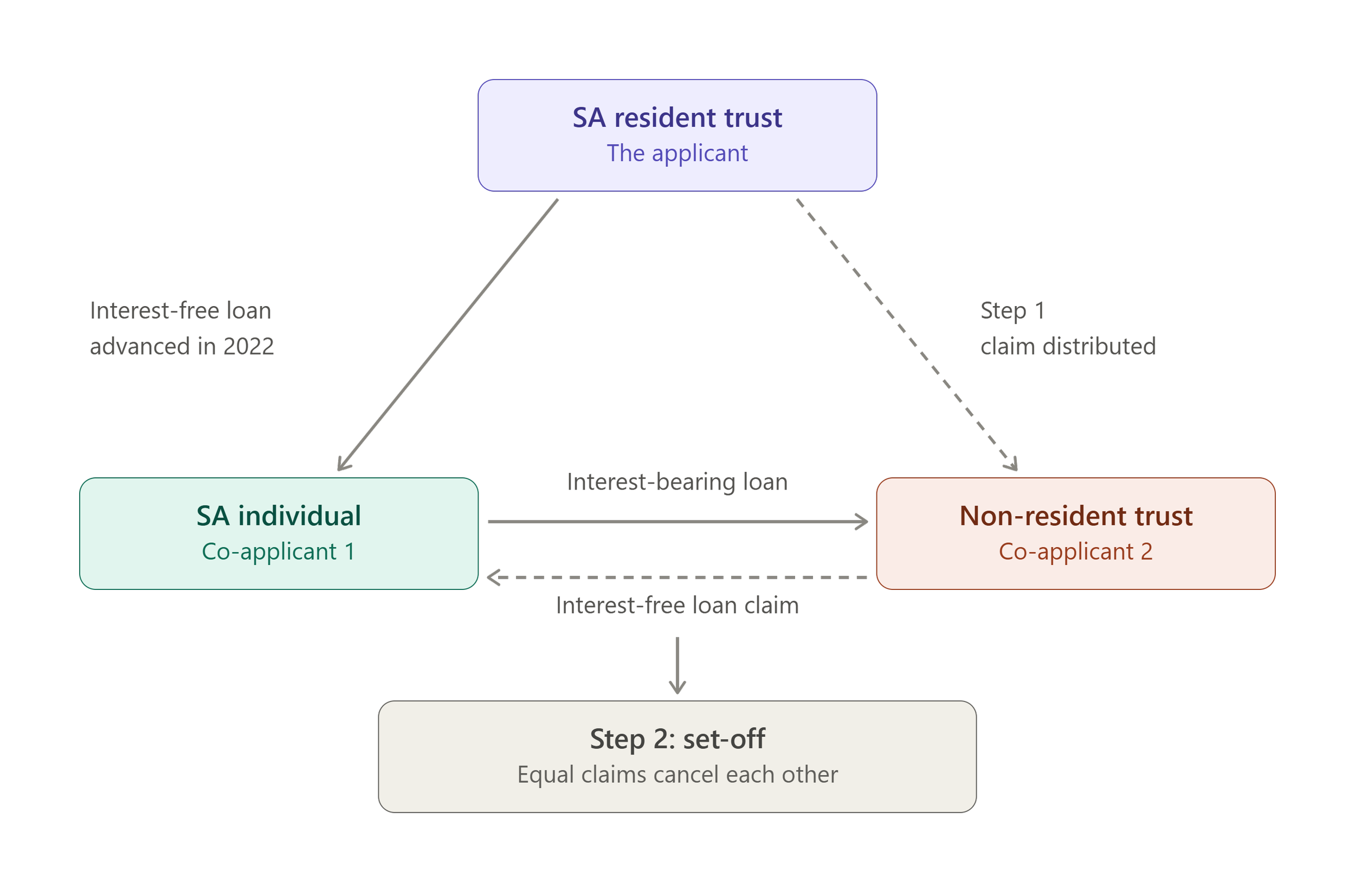
Step 1: The trust (The Applicant) gives its IOU away
The SA trust does not collect the debt. Instead, it distributes part of its loan claim against the individual to the foreign trust. Nothing physical moves and no cash changes hands. What changes is who the individual owes: the SA trust steps out and the foreign trust steps in.
The trust deed permits this. The trustees may vest income or capital allocated to a beneficiary in any trust or company in which that beneficiary has a beneficial interest. Because the individual is a beneficiary of both trusts, distributing to the foreign trust counts as distributing for his benefit.
The critical detail is the amount. The trust distributes an amount equal to the current outstanding capital balance of the loan that the foreign trust owes the individual.
Step 2: The two IOUs cancel each other
After Step 1, the individual and the foreign trust each hold an IOU against the other, and both are for the same amount. They sign a written agreement setting the two off against each other. Because the claims are equal in value, both are settled in full and simply disappear. Again, no money moves.
The chain is unwound. Nobody is left owing anybody anything on the capital.
One thing survives. The set-off extinguishes the capital portion of the offshore loan. The accrued interest has not yet been remitted to South Africa and, according to the BPR, the capitalised interest will be remitted when the individual requires the funds.
The three tax questions SARS answered
Is this a donation?
Yes. SARS confirmed that giving away a loan claim for nothing is a "donation, settlement or other disposition" for the purposes of section 7(8) and paragraph 72 of the Eighth Schedule. Those are anti-avoidance rules designed to stop a South African resident from shifting assets to a foreign party so that the income or gains escape the SA tax net. If they apply, the income or gain is pulled back and taxed in the hands of the person who made the disposition.
Do the anti-avoidance rules bite?
No, and this is the practical heart of the ruling. SARS ruled that the attribution rules do not apply because no amount would have constituted income for the foreign trust, had it been a South African resident, by reason of or in consequence of the donation. SARS also ruled that no capital gain would be attributable to the donation of the interest-free loan claim.
Is donations tax payable?
No. Section 54 imposes donations tax on residents, and the SA trust is a resident, so this was a live risk on a gratuitous disposal. SARS ruled that the exemption in section 56(1)(l) applies, which covers property disposed of under and in pursuance of a trust. Because the trust deed authorised the distribution, it is a trust distribution rather than a taxable gift.
What SARS deliberately did not say
The ruling contains two pointed silences. SARS expressed no view on the interpretation and application of the general anti-avoidance provisions or doctrine in the context of the proposed transaction.
SARS also expressed no view on whether the transaction is permissible under the exchange control regulations. That is a separate question for the SARB and the authorised dealer, and getting Step 1 and Step 2 right for income tax purposes says nothing about whether the arrangement passes exchange control.
Read it for the reasoning, not the outcome
A binding private ruling binds SARS and the named applicants and nobody else. The preamble is explicit that it does not constitute a practice generally prevailing, so it cannot be relied on for a client with similar facts. It is valid for three years from 6 August 2026.
What it does offer is a clear worked example of the reasoning in this particular transaction. The outcome depended on the specific facts, including that the trust deed authorised the distribution, the distribution was of an interest-free loan claim, and the amount distributed matched the outstanding capital balance of the offshore loan so that the two claims could be settled by set-off.
Remove any one of those three and the answer changes.