This article will count 0.25 units (15 minutes) of unverifiable CPD. Remember to log these units under your membership profile.
SARS published Binding Private Ruling 429 on 14 August 2026. It deals with a group of companies funding a long-term share incentive scheme, and it answers a set of questions about the tax treatment of cash grants made to an employee share incentive trust, the trust's acquisition and disposal of shares, and the vesting of those shares in qualifying employees.
Who is involved
There are four groups of players.
The Applicant is a South African resident company.
Co-Applicants 1 to 8 are resident subsidiaries of the Applicant.
Co-Applicant 9 (the Trust) is a resident discretionary trust.
The qualifying employees are senior management employees of the Applicant and Co-Applicants 1 to 8.
How the scheme works
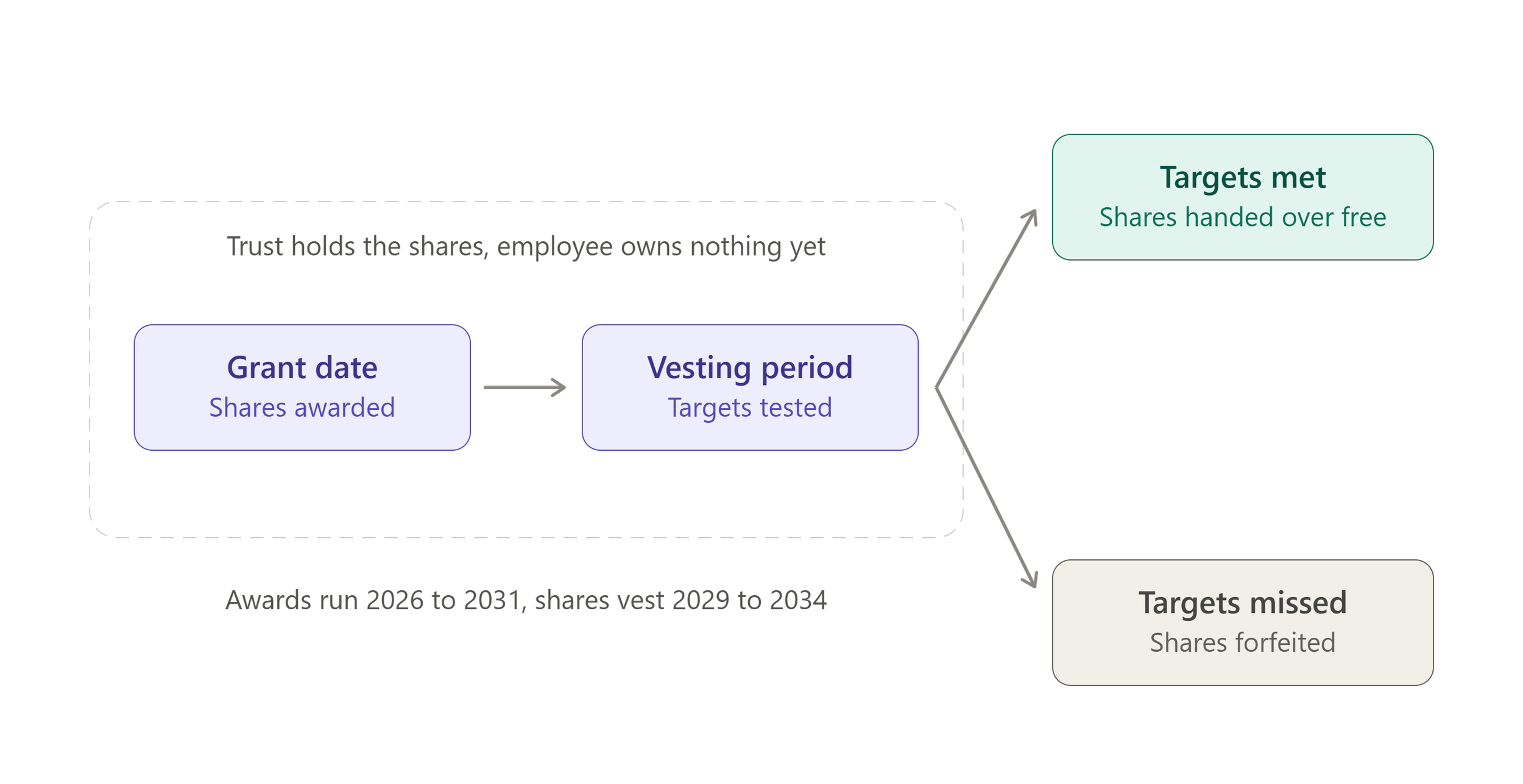
The Applicant implemented a long-term share incentive scheme and settled the Trust in 2014. It is a forfeitable share award scheme. Shares are granted by the Trust to qualifying employees on the grant date and held by the Trust until the respective vesting dates. T
e shares are subject to a risk of forfeiture if the performance targets of the relevant companies and qualifying employees are not met over the predetermined vesting periods.
The annual cycle
The proposed transaction runs the same loop every year, with the money going out one way and the shares coming back the other.
The applicant company pays cash into the Trust. It will do this annually from 2026 to 2031 in respect of qualifying employees of the Applicant and Co-Applicants 1 to 8.
The Applicant recovers part of that cash from the subsidiaries. Each of Co-Applicants 1 to 8 reimburses the Applicant for the contributions relating to its own qualifying employees.
The Trust turns the cash into shares. It uses the total cash grant to purchase shares in the Applicant on the open market, or the Applicant issues new shares to the Trust at current market value.
The Trust makes the awards. Annually from 2026 to 2031, the Trust makes share awards to qualifying employees of the Applicant and Co-Applicants 1 to 8.
The Trust transfers the shares. From 2029 to 2034, at the respective vesting dates, the Trust transfers the shares to the qualifying employees for nil consideration.
Note the three-year gap between the start of the cash grants in 2026 and the first vesting dates in 2029. SARS nevertheless ruled that the employers' section 11(a) deductions are subject to section 23H.
What the employers can deduct
SARS ruled that the Applicant may deduct the portion of the total cash grant relating to its own qualifying employees under section 11(a). Co-Applicants 1 to 8 may likewise deduct the portion relating to their own qualifying employees under section 11(a).
But there is an important qualification: section 23H applies to those section 11(a) deductions. The BPR therefore confirms that the deductions are subject to the timing provisions in section 23H.
The practical timing of the deductions will therefore be subject to section 23H rather than simply following the date on which the cash grant is made.
What happens inside the Trust
SARS made five rulings on the Trust side, and taken together they are an important part of the document.
The cash grant is not gross income of the Trust. SARS ruled that the cash grant received by the Trust must not be included in the Trust's gross income.
The disposal happens at vesting, not at grant. SARS ruled that the granting of shares by the Trust to qualifying employees constitutes a disposal under paragraph 11(1)(d), and that under paragraph 13(1)(a)(iiB), the time of disposal is when the shares vest in the qualifying employees as contemplated in section 8C. The grant date is therefore not the relevant disposal date for this ruling.
Paragraph 20(3)(b) does not apply. SARS ruled that paragraph 20(3)(b) will not apply to the expenditure incurred by the Trust to acquire the shares.
Paragraph 38(1) does not apply. SARS ruled that paragraph 38(1) will not apply to the disposal of the shares by the Trust to qualifying employees.
The capital losses are not subject to paragraph 39(1). SARS ruled that any capital losses determined by the Trust will not be subject to paragraph 39(1), by reason of paragraph 39(4).
The result: a usable capital loss
Taken together, these rulings mean that paragraph 20(3)(b) does not reduce the expenditure incurred by the Trust in acquiring the shares, while paragraph 38(1) does not apply to the disposal of the shares to qualifying employees. The resulting capital loss, if any, is then subject to the provisions of paragraph 39.
SARS specifically ruled that any capital losses determined by the Trust will not be subject to paragraph 39(1), by reason of paragraph 39(4).
The limits of the BPR
A binding private ruling binds SARS and the named applicants. The preamble is explicit that it does not constitute a practice generally prevailing. It should therefore not be treated as establishing a practice generally prevailing or as a ruling that can automatically be applied to other share incentive schemes. The ruling applies to the Applicant and Co-Applicants in relation to the proposed transaction.
The ruling is valid until 31 July 2034.
Also worth noting what the ruling does not cover. The BPR determines the income tax and capital gains tax consequences arising from the cash grants made by the employers to the Trust, the Trust's receipt of those grants and the vesting of shares in qualifying employees. Section 8C is referred to in determining when the shares vest for purposes of paragraph 13(1)(a)(iiB), but the ruling does not make a separate ruling on the employees' tax liability under section 8C.
For anyone advising on share incentive schemes, the ruling provides a useful example of the tax treatment of an employer-funded employee incentive trust. The employers' section 11(a) deductions are subject to section 23H, while the Trust's cash grants are not included in its gross income. For the Trust's shares, SARS ruled that the disposal occurs when the shares vest, paragraph 20(3)(b) does not apply to the acquisition expenditure, paragraph 38(1) does not apply to the disposal, and any resulting capital losses are not subject to paragraph 39(1) by reason of paragraph 39(4).