This article will count 0.25 units (15 minutes) of unverifiable CPD. Remember to log these units under your membership profile.
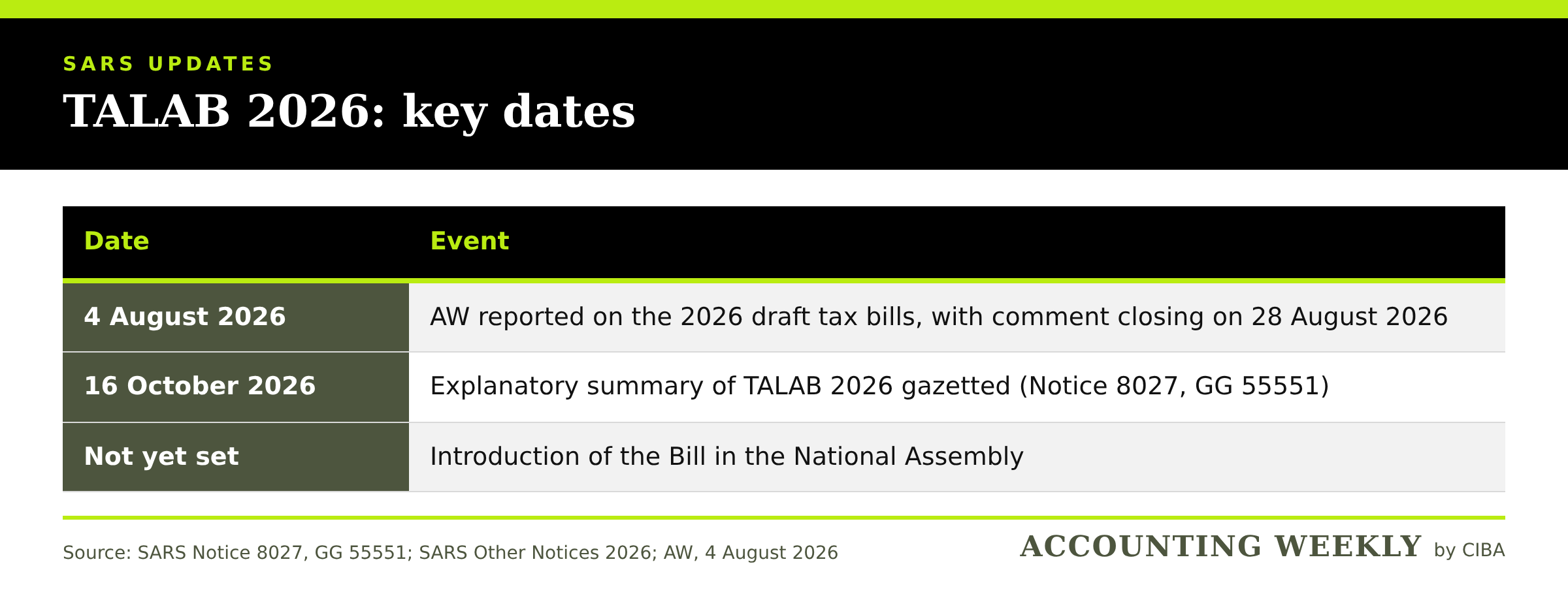
The Minister of Finance intends to introduce the Tax Administration Laws Amendment Bill, 2026 (TALAB) in the National Assembly. SARS published the Bill’s explanatory summary in General Notice 8027, Government Gazette 55551, on 16 October 2026, under Rule 276(1)(b) and (c) of the National Assembly Rules. The notice says the Bill will be introduced “in the near future” and gives no date.
What changed
Nothing has changed in law yet. The summary sets out what the Bill proposes.
Income Tax Act, 1962
Certain exempt entities would be excluded from the definition of “provisional taxpayer” in the Fourth Schedule.
Non-resident employers would face an additional requirement in their duty to withhold employees’ tax. The summary does not describe the requirement.
The taxable income threshold used for the penalty on underestimated provisional tax would be adjusted.
For that penalty, the estimate would be deemed equal to the payment the provisional taxpayer made for it, or nil if nothing was paid. The Commissioner may decide otherwise if satisfied that non-payment was not intended to postpone payment and was not due to negligence.
Customs and Excise Act, 1964
The Act would expressly cover goods temporarily exported under international carnets, and the Commissioner could make rules on carnet types, issue, validity, replacement, submission and release of goods.
Carbon tax refund claims would be confirmed as refunds under the Customs and Excise Act.
The Commissioner’s discretion to excuse non-compliance with rebate of duty conditions would be limited.
Value-Added Tax Act, 1991
Tax invoices issued when a vendor acquires second-hand goods would need additional information, and documentary requirements for second-hand goods would be expanded.
The difference in return submission and payment dates between eFiling vendors and other vendors would be removed.
Tax Administration Act, 2011
Banks would have to report a client’s deposit if they reasonably suspect it is linked to a tax offence.
The period in which SARS may not take collection steps after deciding a penalty remittance request would be adjusted.
Voluntary disclosure applicants could also apply for remission of interest.
A taxpayer’s compliance status could show as compliant while a request for remission of an administrative non-compliance penalty is pending.
Who it affects
Provisional taxpayers and their practitioners, exempt entities, non-resident employers with South African employees, VAT vendors dealing in second-hand goods, vendors who file outside eFiling, importers and exporters using carnets, and banks.
Key dates
What this means for accountants and finance professionals
Provisional tax. If the penalty proposal is enacted, the underestimate penalty will be measured against what the client actually paid for that estimate. A sound estimate that is not paid on time would then count for nothing. Payment follow-up becomes part of the provisional tax service.
Tax compliance status. A client with a penalty remission request still pending could keep a compliant status. This matters for clients who need a tax compliance status for tenders, licences or funding.
Voluntary disclosure. Clients applying for VDP relief could also ask for interest to be remitted, which changes the cost of coming forward.
Bank reporting. Banks would report deposits they suspect are linked to a tax offence. Practitioners should expect SARS to have more information about clients’ deposits than before.
VAT. Vendors who file outside eFiling would work to the same submission and payment dates as eFilers. Vendors dealing in second-hand goods will need to update their invoice templates and record keeping.
Finance teams. Non-resident employers with South African staff should check their payroll withholding once the new requirement is published.
What to do
Read the explanatory summary in Notice 8027 on the SARS Other Notices page.
Compare it with the draft TALAB you reviewed in August. Note which proposals survived.
Flag provisional tax clients with irregular payment patterns. The proposed penalty rule ties the estimate to what was actually paid.
Tell second-hand goods dealers that their invoice and record requirements are likely to tighten.
Watch for the Bill’s introduction in Parliament, when the full wording and dates will be available.
Sources: SARS Notice 8027, GG 55551 · SARS Other Notices 2026 · AW, 4 August 2026