This article will count 0.25 units (15 minutes) of unverifiable CPD. Remember to log these units under your membership profile.
Treasury published the 2026 draft tax bills on 30 July. You have until 28 August to comment. After that, the drafting is largely settled and you are back to explaining changes to clients instead of shaping them.
What was published
National Treasury and SARS released two draft bills for public comment on 30 July 2026, each with a supporting memorandum:
2026 draft Taxation Laws Amendment Bill (TLAB), plus the draft Explanatory Memorandum
2026 draft Tax Administration Laws Amendment Bill (TALAB), plus the draft Memorandum on the Objects of the TALAB
Both bills give effect to the tax proposals announced in the 2026 Budget on 25 February 2026. The TLAB covers Chapter 4 and Annexure C of the Budget Review. The TALAB covers the tax administration items in Annexure C. Both also carry technical corrections. We covered the underlying Budget in Budget 2026 Review: Growth, Relief and Reality.
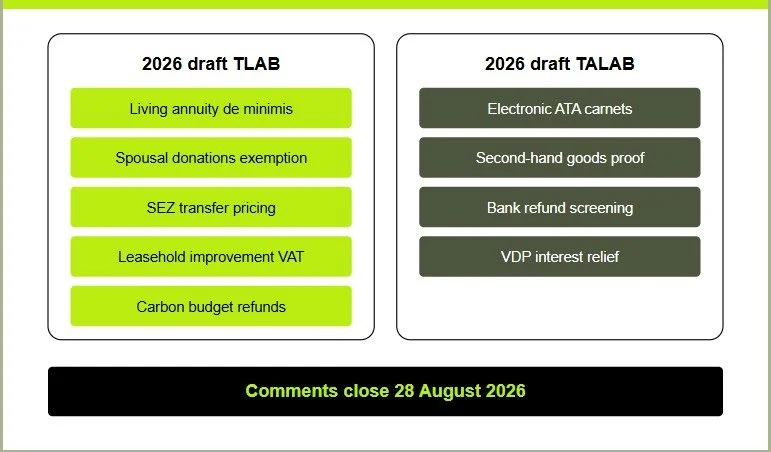
Five things in the draft TLAB
Living annuities. The de minimis limit will be worked out on a cumulative basis where one annuitant holds multiple living annuities with the same insurer or fund.
Donations tax between spouses. The inter-spousal exemption will apply only where the receiving spouse is a South African tax resident. Treasury says the aim is to stop spouses staggering their cessation of residence to sidestep donations tax and capital gains tax.
Special economic zones. The anti-profit-shifting rule is replaced by the arm's length principle for domestic transactions between an SEZ company on the 15% corporate rate and related companies outside the zone.
Leasehold improvements. Leasehold improvements. A new declaration process is introduced where leasehold improvements revert to a lessor who is not a VAT vendor. The amendment ensures the VAT adjustment can still be made even where the landlord is not registered for VAT.
Carbon budget refunds. The reference to the immediately preceding tax period falls away. Refunds for the first two tax periods can be claimed in the third year, and for years three to five in the sixth year.
Four things in the draft TALAB
ATA carnets. An enabling provision so South Africa can issue and process electronic carnets rather than paper ones.
Second-hand goods. Documentary requirements for second-hand goods vendors are extended to align with the Second-Hand Goods Act and its regulations. Treasury's stated reason is fraudulent notional input tax claims. If you act for scrap dealers, motor spares yards or second-hand retail, this changes the file you need to keep.
Refund screening by banks. Banks already hold suspicious refunds for up to two business days. The amendment expressly permits pre-deposit or post-deposit screening to smooth the process.
VDP interest relief. Voluntary disclosure applicants will be able to apply for remission of interest on the disclosed defaults at the same time as the VDP application. Interest has always been payable in full under the programme, so this is a real change for anyone running VDP work. See What Changed in the SARS VDP Guide for the current position.
What was left out
The "supply of gold to banks" proposal from the 2026 Budget Review is not in the draft TLAB. Treasury says it needs further consultation.
What to do this month
Read the two explanatory memoranda before you read the bills. They are shorter and they tell you why each clause exists, which is what your clients will ask. Then do three things:
Pull your client list for non-VAT-registered landlords and second-hand goods vendors. These two changes hit real files.
Flag any client with more than one living annuity at the same insurer, and any client planning to emigrate where a spouse holds assets.
Write your comment. Submissions go to the National Treasury tax policy depository and to SARS by close of business on 28 August 2026. The addresses are in the media statement on gov.za and on the SARS draft documents page.
Comment periods are the cheapest advisory work you will ever do. A short, specific submission that names a practical problem carries weight, because Treasury sees far more objections in principle than it sees workable drafting.
👉 Join CIBA and we'll show you how to turn draft legislation into billable advisory work instead of unpaid client hand-holding.