This article will count 0.25 units (15 minutes) of unverifiable CPD. Remember to log these units under your membership profile.
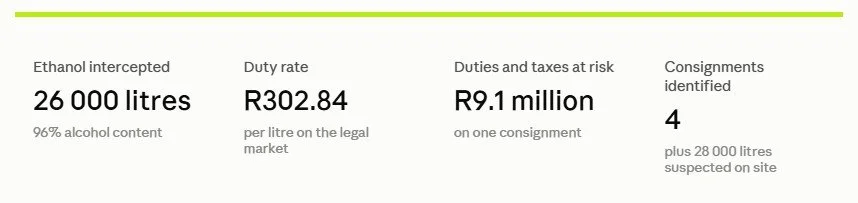
On 29 July 2026, SARS and the SAPS DPCI Serious Commercial Crime unit walked into a Kempton Park warehouse and watched 26 000 litres of it being poured into flow-bins. The paperwork said the cargo was passing through South Africa on its way north. The truck said otherwise.
What SARS found
The consignment was 96% ethanol, imported by sea and declared as in-transit goods bound for a country further north into Africa. Goods declared that way must leave through a South African port of exit. This load never got near one. It ended up at a facility in Kempton Park that held no customs licence and no registration, being decanted into 1 000-litre flow-bins.
Ethanol at that strength can be the base product for making liquor. Undenatured ethanol of this strength falls within a tariff category carrying an excise duty of R302.84 per litre of absolute alcohol (li aa), contributing to SARS's estimate of roughly R9.1 million in duties and taxes on the consignment. The site also held other flow-bins and storage tanks, with a suspected further 28 000 litres awaiting testing.
Commissioner Dr Johnstone Makhubu tied the raid to intelligence-led work against customs fraud, excise duty evasion, smuggling and illegal trade. He said the illicit alcohol trade is not a victimless crime, because it strips the fiscus of revenue, punishes compliant businesses, and funds criminal networks.
Why this lands on your desk
Enforcement of this kind is no longer occasional. As we covered in New Commissioner, Same Pressure: What Makhubu Means for Your Practice, the illicit economy is a named priority, and the sectors SARS flags as high-risk are exactly where many small practices have clients. Fuel, tobacco, alcohol, textiles, logistics, warehousing.
Here is the part that should worry you. Your client does not have to be the smuggler to get caught in this. A client who rents out warehouse space, moves the load, does the customs clearing, or lets a friend use a yard can be sitting inside a customs fraud file without ever seeing the declaration. Goods moving under customs control remain subject to customs obligations until the movement is properly acquitted. If the acquittal never happens, SARS looks for whoever carries the bond and whoever held the goods.
What to do this week
Pull the client list and flag anyone who imports, exports, clears, transports or stores goods for a third party. Then ask four questions.
Is the premises licensed and registered for the goods it holds? Storing dutiable product on an unlicensed site is its own offence, before anyone gets to the fraud question.
Are the customs registrations current? A stale profile is a red flag on its own, as we flagged in the alert on SARS RLA profile suspensions.
Who signed the declaration, and who carries the bond? Get it in writing. Verbal arrangements with a clearing agent are worth nothing when SARS arrives.
Can the client prove goods left the country? Exit acquittals, gate records and transport documents need to be filed, not assumed.
One more thing. Customs and excise still sits outside the general Voluntary Disclosure Programme, and the separate customs VDP has not commenced yet. A client sitting on a customs underpayment today cannot simply file it away and hope. That gap is worth reading up on before you advise.
This is billable work. Not a favour.
Read the SARS media release for more detail.