This article will count 0.25 units (15 minutes) of unverifiable CPD. Remember to log these units under your membership profile.
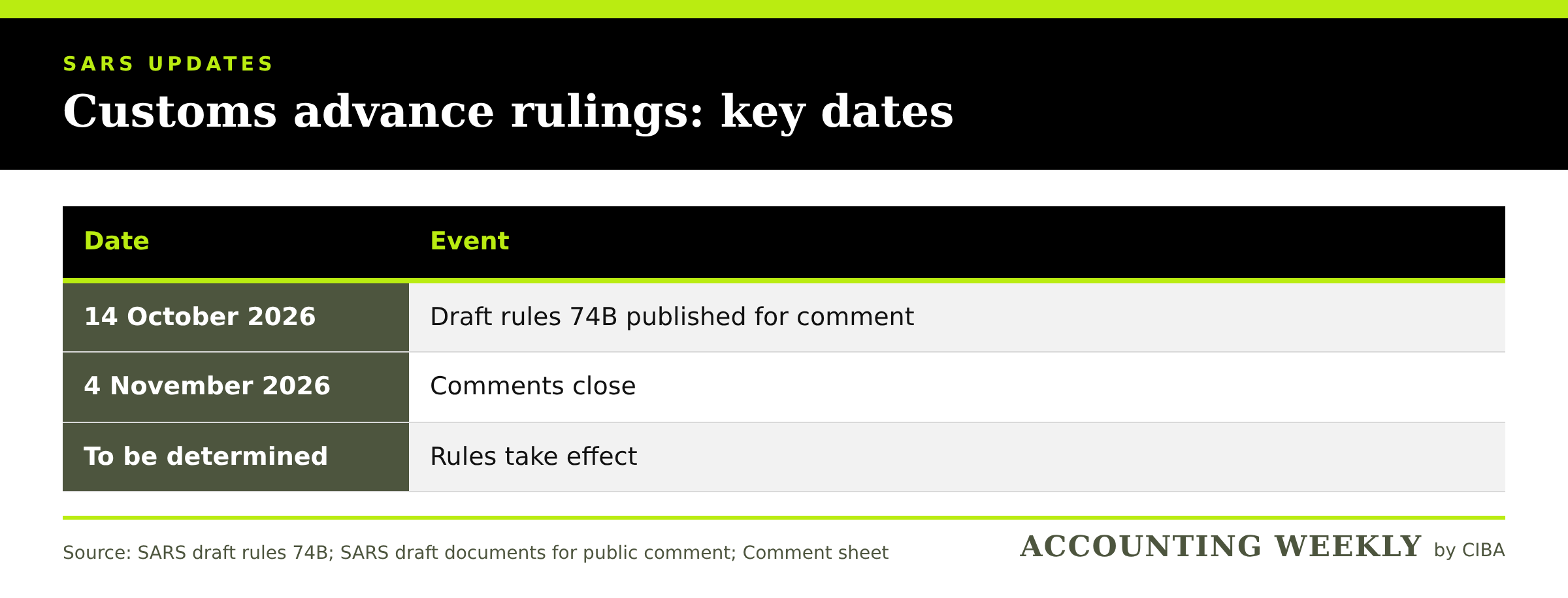
SARS published draft rules for advance rulings under the Customs and Excise Act, 1964 on 14 October 2026. The draft inserts a new Chapter IXA (rules 74B.01 to 74B.13) into the customs rules, made under Chapter IXA and section 120 of the Act. Comments close on 4 November 2026.
What changed
The draft sets out how importers and exporters would apply for a binding view from SARS before goods move. It covers three types of ruling:
advance tariff rulings (rule 74B.06)
advance valuation rulings (rule 74B.07)
advance origin rulings (rule 74B.08)
Other proposed rules:
Applications go in electronically, through eFiling or by BFE capturing at a SARS office (rule 74B.03(a)).
The application fee is R2,500, plus a cost recovery fee of R650 an hour for non-urgent applications or R1,000 an hour for urgent ones, plus direct costs (rule 74B.04).
An applicant has 21 working days to answer a request for more information. SARS can extend this by up to ten working days. After that, the application is rejected (rule 74B.03(c) to (e)).
A clearing agent, registered agent or other authorised representative may submit the application (rule 74B.05).
Ruling holders must keep records for five years (rule 74B.09) and report changes in circumstances within ten working days (rule 74B.11).
SARS may publish rulings that could help others, without confidential information (rule 74B.10).
The draft lists the effective date as “to be determined”.
Who it affects
Importers, exporters, clearing agents and accountants who advise clients on tariff classification, customs value or origin.
Key dates
What this means for accountants and finance professionals
Certainty before goods move. An advance ruling would let an importer know the tariff classification, customs value or origin SARS will accept before the goods arrive. That makes duty easier to budget and price into contracts.
Cost against benefit. At R2,500 plus R650 an hour (R1,000 an hour if urgent), a ruling suits high-value or repeat imports. Practitioners can help clients decide when the fee is worth paying.
Response times are tight. An applicant has 21 working days to answer a SARS request for more information. Supporting documents should be ready before the application goes in.
Record keeping. Ruling holders must keep records for five years and report changes within ten working days. Finance teams should build these into their customs compliance calendar.
What to do
Read the draft on the SARS draft documents page.
Check whether the fees and response times are workable for your clients.
Complete the Customs and Excise rule amendments comment sheet.
Email it to the Customs and Excise address listed on the SARS draft documents page by 4 November 2026.
Sources: SARS draft rules 74B · SARS draft documents for public comment · Comment sheet