Tax Reconciliations in Namibia: A Practical Guide for Accountants
This article will count 0.25 units (15 minutes) of unverifiable CPD. Remember to log these units under your membership profile.
Taxpayers generally only review their tax affairs when NamRA issues an unexpected assessment or when a refund fails to materialise. By then, resolving the problem can be time-consuming and costly. A regular tax reconciliation helps identify discrepancies early, ensures the taxpayer's records agree with NamRA's account and provides confidence that the correct amount of tax has been paid.
What is a tax reconciliation?
A tax reconciliation is a systematic comparison between:
the taxpayer’s accounting, payroll and banking records;
tax returns submitted to NamRA;
assessments issued by NamRA; and
transactions recorded on the taxpayer’s NamRA account.
Its purpose is to confirm whether the balance reflected by NamRA is correct and, if not, to identify the precise transaction or assessment causing the difference.
Namibia operates a self-assessment system. Taxpayers are responsible for calculating taxable income, submitting accurate returns and retaining supporting documentation. NamRA may subsequently verify, adjust or assess the return. You can read more on the NamRA confirms the self-assessment framework here.
A tax reconciliation is a systematic comparison between the taxpayer's accounting records, tax returns, assessments, payments, refunds and the transactions recorded on the NamRA account. A reconciliation should therefore answer two separate questions:
Account reconciliation: Has NamRA correctly recorded and allocated every assessment, payment, refund, credit, penalty and adjustment?
Tax calculation reconciliation: Was the underlying tax return and assessment calculated correctly under Namibian tax legislation?
An account can reconcile mathematically while the assessment itself remains legally or factually incorrect.
These are two different problems with two different remedies. An account can reconcile perfectly while the assessment is still legally incorrect. Missing this distinction is one of the most common and costly mistakes practitioners make.
Namibia operates on a self-assessment system. The taxpayer calculates, files and pays. NamRA may then verify, adjust or re-assess. When they do, that adjustment has to be traced and tested. You cannot accept a number on ITAS without understanding where it came from.
Before You Start: Define the Scope
Every reconciliation should start with a cover sheet that records the basics: the taxpayer's legal name, TIN, tax type, tax period, the date the NamRA statement was downloaded, who prepared the reconciliation and why.
This matters more than it sounds. Keep income tax, VAT and employee tax separate. Do not combine them in one schedule. If multiple years are involved, reconcile each year on its own before preparing a consolidated summary.
Obtain Documents From NamRA or ITAS
Obtain, where applicable:
Full tax account statement from the earliest relevant date.
Original, additional, amended and revised assessments.
Submitted tax returns and all schedules.
ITAS return-status history.
NamRA notifications and correspondence.
Audit findings or verification queries.
Payment-allocation and reallocation records.
Penalty and interest calculations.
Refund approval, reversal and set-off records.
Objection or appeal documents.
Tax registration information and filing obligations.
The Nine Steps That Actually Work
Step 1: Confirm the opening balance
Never accept an unexplained NamRA opening balance. Trace it to its source. It must be supported by an assessment, a penalty or interest charge, an unallocated payment, a refund, a reversal, or a verified earlier closing balance. If the records are not available, classify it as "unverified opening balance" and request a historical transaction statement from NamRA.
Step 2: Build a complete transaction register
List every NamRA transaction in date order. For each line, capture the NamRA reference, the description, what your records show, what NamRA shows and the difference. Flag anything you cannot explain immediately.
Here is a simplified example of what the register looks like:
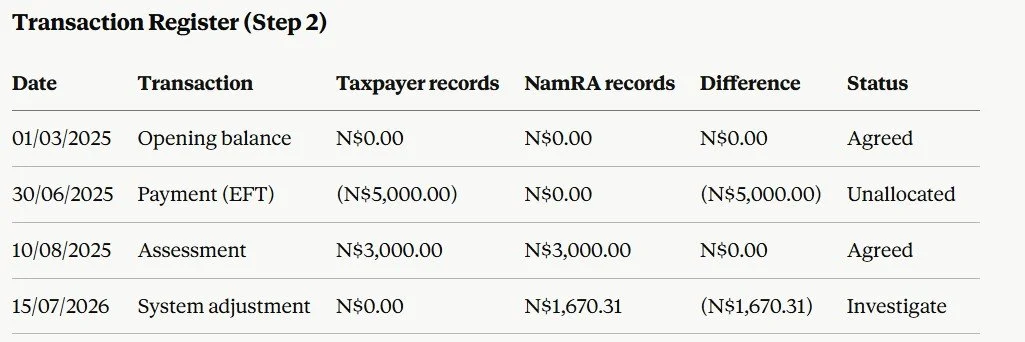
Every difference must have a status. "Investigate" is a starting point, not a conclusion.
Step 3: Match assessments to submitted returns
For each assessment, compare what was declared in the return against what NamRA assessed. Look at taxable income, deductions allowed or disallowed, PAYE and provisional tax credits, assessed losses carried forward, penalties and interest, and the final amount payable or refundable.
A practical example of how this comparison looks:
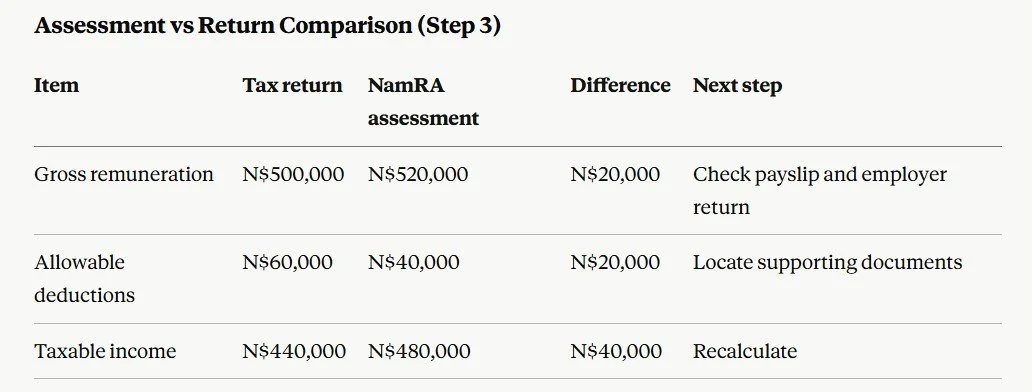
Recalculate the tax using the rates for the specific year under assessment. Do not use current-year rates if you are reconciling an older period.
Step 4: Match every payment
For each payment, agree the bank statement, the payment confirmation, the TIN and payment reference used, the tax type, the intended period and what ITAS shows.
NamRA distinguishes between a tax-account payment and a tax-period payment. An incorrect reference can send a payment to the wrong tax type, period or account. Common problems include:
- Incorrect TIN or tax-type code
- Payment allocated to an older debt instead of the current period
- Payment appearing in the bank but not on ITAS
- Duplicate payment
- Payment recorded under another taxpayer's account
A missing or misallocated payment is dealt with through a payment-allocation or account-correction request. It is not a basis for an objection to the tax calculation.
Step 5: Reconcile refunds, transfers and set-offs
For every refund, confirm which period created the credit, how much was approved, whether it was paid into the bank account, whether it was transferred to another period or set off against another debt, and whether it was later reversed.
A refund appearing in the bank does not prove the assessment was final. NamRA can apply a set-off against other liabilities when the set-off is legally valid. If a refund was reversed, identify the exact transaction and the basis for the reversal.
Step 6: Recalculate penalties and interest
Do not accept a description on ITAS that simply reads "interest" or "penalty." Calculate it yourself. For each charge, you need the statutory basis, the principal amount, the rate, the start date, the number of months or days, and any remission already granted.
Penalty provisions are different for income tax, provisional tax, employee tax and VAT. Each must be tested against the relevant Act.
Step 7: Check returns and filing obligations
Confirm that every required return is on ITAS with the correct status. No return should sit as "pending for submission." Check whether revised returns were actually processed, cancelled returns correctly reversed, and that no estimated assessment was raised because a return appeared outstanding.
Step 8: Classify every unresolved difference
Once you have identified a difference, assign it to a category so you can choose the right remedy:
Step 9: Prove the closing balance
Prepare a final summary that starts with the opening balance, adds assessments, penalties and interest, adds any refunds paid or credits reversed, then deducts payments and credits.
The reconciliation is complete only when the difference is zero, or every remaining difference is separately identified, quantified and supported by a document.
A Real-World Scenario: Refund Followed by an Amount Payable
Take a client who received a refund of N$7,653.98. Three months later, ITAS shows N$1,670.31 payable. The instinct is to call it interest. But that assumption is dangerous.
First, reconstruct the account:
Original credit balance: (N$7,653.98)
Refund paid to taxpayer: N$7,653.98
Balance after refund: N$0.00
Subsequent assessment or adjustment N$1,670.31
Closing balance payable N$1,670.31
The arithmetic is now clear. But the reconciliation is not finished. You still need to find the specific assessment or system adjustment that created the N$1,670.31 and decide whether it is correct.
Was it a revised assessment? A reversed credit? A penalty on a reclassified payment? Each possibility leads to a different remedy.
Watch for This: Bonus vs Termination Gratuity’
One area that creates frequent assessment discrepancies is the classification of bonus payments. NamRA's Schedule 3 separately categorises gratuities received on termination of employment. An ordinary annual performance bonus should not be treated as a termination gratuity simply because the word "bonus" appears on the payslip or in the payroll code.
If this classification is causing a discrepancy, check the employment contract, the payslip, the PAYE5 certificate, and the employer's payroll submission. If the employer's records are wrong, the employer should issue corrected documentation. If the employer's records are right and NamRA's assessment is wrong, the taxpayer should lodge a formal objection supported by those documents.
Choosing the Right Remedy
Getting this wrong wastes time and costs your client money.
Account-correction request - when the problem is administrative: a misallocated payment, a duplicated transaction, an incorrect period.
Revised return - when the taxpayer made a factual error and ITAS permits revision. Confirm the return reaches "Assessed" status. Submission alone does not mean the account was corrected.
Formal objection - when the dispute is about taxable income, a disallowed deduction, an omitted credit, a reclassified amount, or another decision under the relevant Act. For income tax, the objection must ordinarily be lodged within 90 days of the assessment.
Do not assume that an informal correction request or correspondence suspends the objection deadline. It does not.
What This Means for Your Practice
A properly prepared tax reconciliation is a billable service. Clients dealing with NamRA queries, unexpected balances, or stalled refunds need someone who can trace every transaction, find the source of every discrepancy and choose the right remedy. That is specialist work. Charge accordingly.
With NamRA increasing enforcement activity in 2026, the practitioners who can do this well will be in high demand. Build the process. Use working papers. Document everything.



Trending