Namibia’s Key Legislative Updates in 2026
This article will count 0.25 units (15 minutes) of unverifiable CPD. Remember to log these units under your membership profile.
Namibia’s legislative and regulatory environment continues to evolve at a rapid pace. For accountants, business advisors, tax practitioners, auditors, entrepreneurs and governance professionals, 2026 is shaping up to be a significant year of reform. Recent parliamentary discussions, proposed legislative amendments, tax reforms and governance developments signal a stronger national focus on compliance, fiscal sustainability, investment attraction and institutional accountability. Below are some of the most important developments currently affecting the Namibian business and professional environment.
Proposed Income Tax Reforms and the Establishment of a Tax Court
One of the most significant developments is the proposed amendment to the Income Tax Act to establish a dedicated Tax Court for hearing income tax and VAT disputes. If implemented effectively, this could materially improve: taxpayer rights, dispute resolution timelines, procedural fairness, and consistency in tax administration. For years, many taxpayers and practitioners have expressed concerns around delays, administrative complexity and uncertainty in tax appeals. A specialised Tax Court may provide a more structured and technically competent dispute environment. This development should be closely monitored by: tax practitioners, SMEs, corporate taxpayers, accounting officers, and legal professionals involved in tax litigation.
NamRA’s Push Toward Digitalisation and E-Invoicing
The Namibia Revenue Agency (NamRA) continues accelerating digital transformation initiatives. Budget discussions and policy proposals indicate further movement toward: modernised VAT systems, e-invoicing, improved compliance monitoring, and enhanced anti-fraud controls. This aligns with global tax administration trends where governments increasingly rely on real-time or near real-time transaction data. Businesses should begin preparing for: stronger digital record-keeping requirements, more data-driven audits, enhanced reconciliation expectations, and reduced tolerance for manual or incomplete systems. For SMEs in particular, the shift means accounting systems and internal controls can no longer be viewed as optional administrative functions — they are becoming core compliance infrastructure.
Continued Focus on AML, Beneficial Ownership and Governance
Namibia’s continued alignment with international anti-money laundering standards remains a major policy focus. Following previous FATF-related legislative amendments, government institutions are continuing to strengthen: beneficial ownership reporting, financial transparency, compliance monitoring, and governance oversight mechanisms. The professional community should expect increased scrutiny around: source of funds, customer due diligence, suspicious transaction reporting, company structures, and governance accountability. For accounting professionals, this means compliance responsibilities extend far beyond bookkeeping and tax submissions. Ethical conduct, documentation standards and professional scepticism remain essential.
New Regulatory Direction for the Accounting Profession
Parliament has also introduced proposals aimed at restructuring the oversight framework for the accounting and auditing profession. The proposed legislation seeks to continue the existence of the Public Accountants’ and Auditors’ Board under a revised regulatory structure with broader oversight powers and accreditation responsibilities. This may have long-term implications for: professional recognition, accreditation pathways, oversight mechanisms, public accountability, and quality assurance standards. Professional bodies and practitioners should remain actively engaged in these developments as they may shape the future regulatory architecture of the profession in Namibia.
Source: Namibian Parliament Order Paper 26 March26
Investment, Economic Empowerment and SEZ Reform
Government has reaffirmed its commitment to several important economic policy instruments, including: the Namibia Investment Promotion and Facilitation framework, the Special Economic Zones (SEZ) regime, and the National Equitable Economic Empowerment Framework (NEEEF). These reforms aim to stimulate: industrialisation, investment certainty, local participation, enterprise growth, and economic transformation. However, businesses continue to seek clarity regarding implementation details, compliance obligations and long-term policy certainty. Predictability remains one of the most important drivers of investor confidence.
Corporate Governance and Public Accountability Remain Central Themes
Parliamentary debates during 2026 have shown increasing focus on: anti-corruption oversight, public enterprise governance, procurement accountability, public sector efficiency, and constitutional governance. This is particularly relevant in an environment where fiscal pressure continues to place strain on public resources. For professionals operating in governance, risk and compliance environments, the expectation is increasingly clear: Good governance is no longer merely a best practice — it is becoming a public expectation.
Final Thoughts
Namibia is entering a period where regulation, technology, transparency and accountability are becoming deeply interconnected. For business leaders and professionals, the key takeaway is simple: Reactive compliance is no longer sufficient. The organisations and practitioners that will thrive are those that: invest in strong governance, strengthen internal controls, embrace digital transformation, prioritise ethical leadership, and stay informed on legislative developments. As professionals, we have an important role to play in helping build a compliant, transparent and sustainable Namibian economy. The future of the profession will not be defined only by technical competence, but by our ability to navigate complexity with integrity, adaptability and foresight.
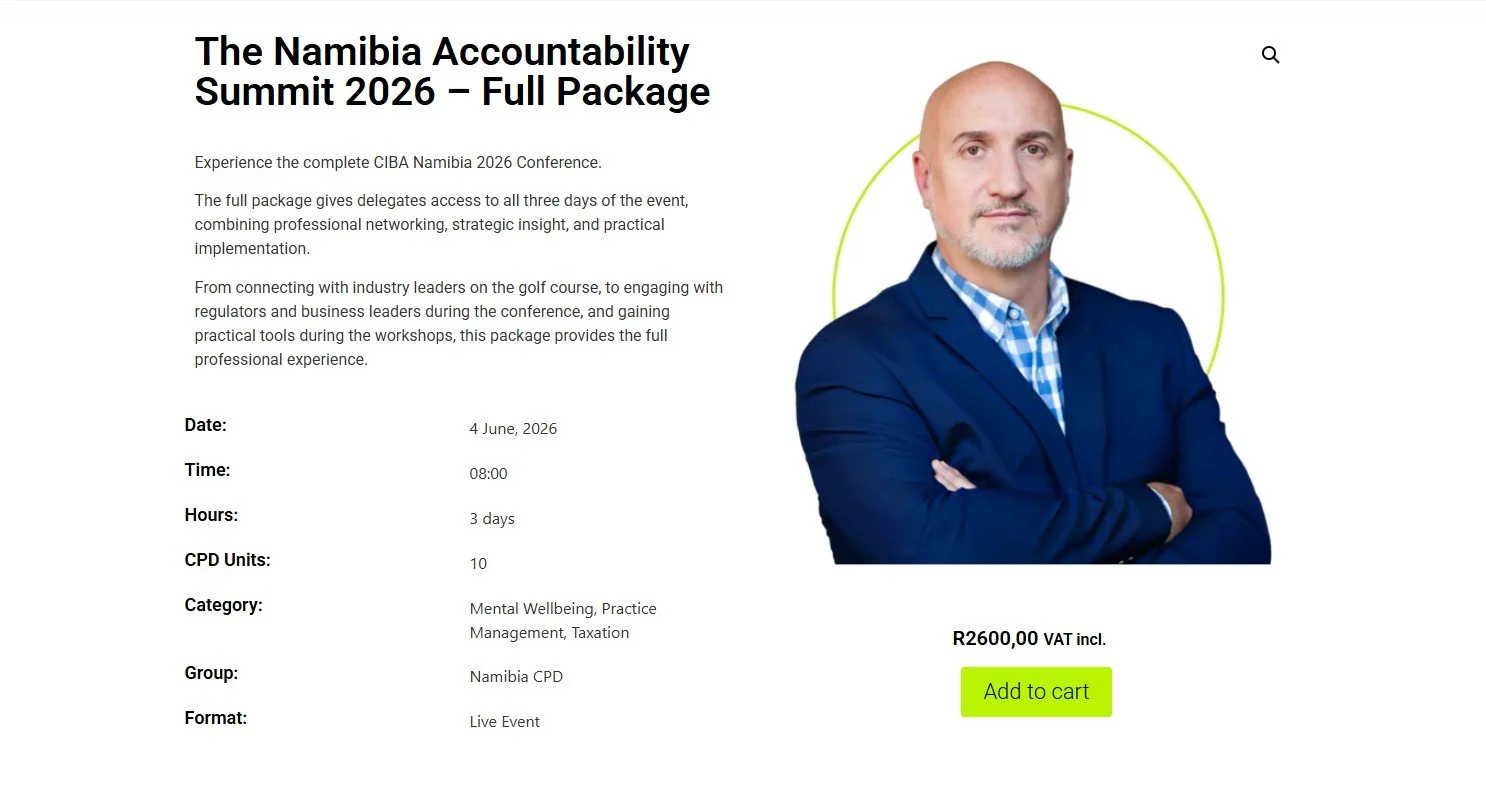
Join CIBA’s Namibia Accountability Summit 2026 on 4 June 2026, giving an opportunity to connect with industry leaders, engage with regulators and business leaders! Click below and find out more!