Sanctions screening for Namibian accountants: a practical guide
This article will count 0.25 units (15 minutes) of unverifiable CPD. Remember to log these units under your membership profile.
Every time the UN changes a sanctions list, the FIC sends a circular and accountable institutions must re-screen. This guide sets out what that involves, from the first check to reporting a match.
Imagine you accept a new client, complete your usual verification checks and start work. Three months later, the UN amends an entry on one of its sanctions lists and adds another name. Would your practice notice? And could you show what you checked and what you did next?
The Financial Intelligence Centre (FIC) circulates every change to the UN Security Council sanctions lists to accountable institutions, reporting institutions and any other person or business the changes may apply to. In 2026 alone, Circular No. 05 (14 April) dealt with the 1988 Sanctions Committee list, Circular No. 07 dealt with changes made to the ISIL (Da'esh) and Al-Qaida list on 21 May, and Circular No. 16 (29 September) dealt with a further amendment to that list on 28 September. Each circular asks the same question of a practice. Accounting Weekly's short circular notices link back to this guide.
How the lists change
The UN adds, amends and removes entries throughout the year. An amendment does not always mean a new person or organisation has been listed. It can add names, aliases or identifiers to an existing entry, so a client who produced no match at onboarding may need a second look after the list changes.
The most recent example is entry QDe.168, Khatiba Jama'at al-Tawhid wal-Jihad (KTJ), an armed group that the UN describes as operating mainly in Syria. It was first listed on 7 March 2022 and was amended on 28 September 2026. It also appears under names including Jannat Oshiklari, Jama'at al-Tawhid wal-Jihad and Katiba al-Tawhid wal-Jihad.
Persons and entities on the ISIL (Da'esh) and Al-Qaida list and the 1988 list are subject to an asset freeze, a travel ban and an arms embargo. For an accounting practice the asset freeze is the measure that counts: no funds, assets or services may be made available, directly or indirectly, to a listed person or entity.
Does this apply to your practice?
Accountants are listed in Schedule 1 to the Financial Intelligence Act, 2012 (FIA) as accountable institutions. Check the Schedule against the services your practice actually provides, and confirm that the practice is registered with the FIC on goAML. Members in commerce should do the same check for their employer, because many businesses that deal with client money, property or vehicles are also accountable or reporting institutions.
Do not assume that falling outside Schedule 1 removes every duty. The FIC's circulars are addressed to "any person, business, entity, organisation", and the prohibition on dealing with the funds of a listed person or entity in the Prevention and Combating of Terrorist and Proliferation Activities Act, 2014 (PACOTPAA) is not limited to accountable institutions.
Why the FIC sends these circulars
FIC circulars are issued under section 9(1)(h) of the FIA, read with sections 23, 24 and 25 of PACOTPAA. The FIC circulates every UN list change it receives, but the circulars make clear that the duty to keep up rests with each recipient: they must "continuously and timeously familiarize themselves" with additions and amendments made by the UN Security Council. In practice, the obligation starts when the UN list changes, whether or not the FIC circular has reached your inbox yet.
Screening does not end at onboarding
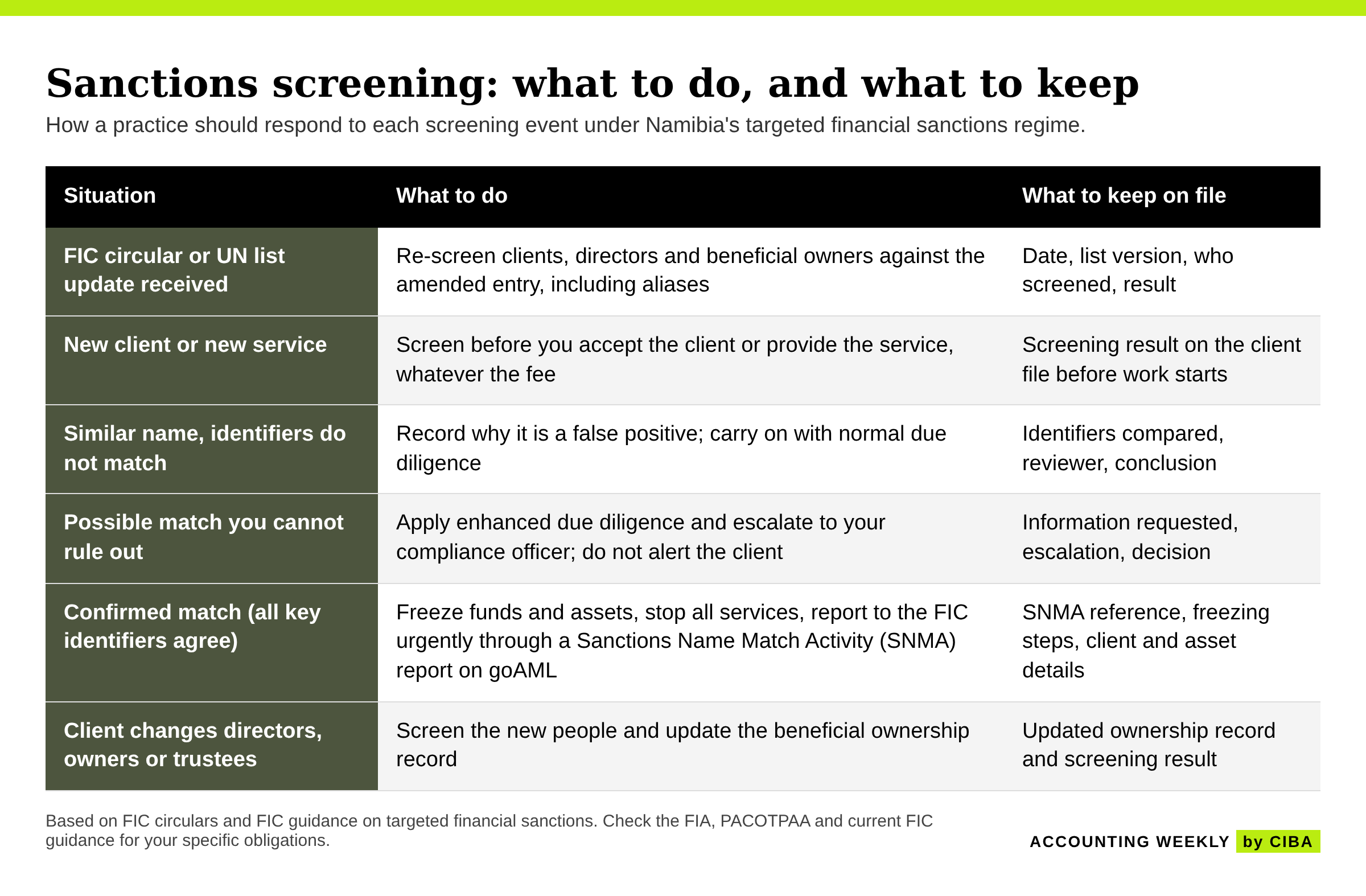
The FIC's guidance on targeted financial sanctions requires accountable institutions to screen clients and prospective clients against the UN lists, and to do so before opening an account or providing a service, whatever the value of the transaction. After that, screen again when:
• a new person or entity is designated;
• an existing entry is amended with new names, aliases or identifiers, as happened with QDe.168 in September 2026; or
• a client's directors, shareholders, trustees or beneficial owners change.
Each time, record the list used, the date, the result, the reviewer and any follow-up.
A practical example: the beneficial owner nobody screened
A small bookkeeping and tax practice serves 150 clients. It screened each company name when the client was accepted, but never identified or checked the people who own or control those companies. One client later changes its shareholding. The practice updates the accounting records but not the compliance file. When a sanctions entry is amended, the practice cannot show whether the new owner was ever checked.
A similar name is rarely a sign of wrongdoing. The weakness here is the process: it screened the company and ignored the people behind it, and nothing in it responded when the ownership changed.
Know who owns and controls the client
Screening is only as good as the names you screen. Since August 2023, companies must keep a register of beneficial owners and file the information with the Business and Intellectual Property Authority (BIPA) under section 122A of the Companies Act, and trusts must give beneficial ownership information to the Master of the High Court. Use those records, check them against what you know about the client, and screen the natural persons behind the entity as well as the entity itself.
When a name looks similar
Step 1: a possible match
A similar name is a starting point for assessment, not proof. Compare the identifiers available, such as date of birth, nationality, identity or registration numbers, addresses and aliases, and record your reasoning. Sanctions entries are sometimes incomplete. If the list is missing a detail, escalate the name; do not clear it on that basis.
If you cannot rule the match out, apply enhanced due diligence and escalate it to the person responsible for compliance. Do not tell the client why you are asking questions: tipping off is an offence under the FIA.
Step 2: a confirmed match
The FIC treats a match as confirmed only when all the key identifiers on the list agree with the client's details. Its guidance on targeted financial sanctions then requires you to freeze all funds and assets linked to the client immediately, stop providing services, and report to the FIC urgently. The report is a Sanctions Name Match Activity (SNMA) report on goAML. It must state the list concerned and the freezing steps taken, with supporting evidence and the client's identity and address details. These steps come from the FIC's standing guidance, and they apply to every list update
Keep the evidence
A policy that says the practice screens clients is not proof that it did. For each screening event, the file should show who was screened, when, against which list and version, what the result was, who reviewed any possible match and what action followed.
FIC circulars warn that failure to comply with their instructions is a violation under section 63 of the FIA. A clear screening log is the simplest way to show the FIC or your supervisory body that the process works.
Stay informed
The FIC encourages recipients to subscribe to the UN Security Council's sanctions list updates by emailing sc-sanctionslists@un.org. Subscription is free and subscribers are notified of additions, amendments and deletions. Name one person in the practice who receives FIC circulars and UN notices, decides whether re-screening is needed and records that decision.
Three questions to ask your practice today
• When did we last screen our existing clients and their beneficial owners?
• Who is responsible for watching for changes to the UN sanctions lists?
• If the FIC asked tomorrow, could we produce evidence of our screening?
Implementation checklist
This week
☐ Confirm whether your practice falls within Schedule 1 to the FIA and is registered on goAML.
☐ Re-screen clients, directors and beneficial owners against the current UN consolidated list.
☐ Subscribe to UN sanctions list updates at sc-sanctionslists@un.org.
☐ Name the person responsible for FIC circulars and UN list changes.
This month
☐ Write down the steps for a possible match: comparing identifiers, enhanced due diligence, escalation and no tipping off.
☐ Write down the steps for a confirmed match: freezing, stopping services and filing an SNMA report on goAML.
☐ Set up a screening log that records who, when, which list, the result, the reviewer and the action.
☐ Check that beneficial ownership information on client files agrees with BIPA and Master's records.
Ongoing
☐ Re-screen whenever the UN list changes and whenever a client's directors, owners or trustees change.
☐ Screen every new client and new service before work starts.
☐ Review the AML/CFT policy and screening log at least once a year.