Beyond the outbreak: how CIBA Namibia members can help farmers build financial resilience during FMD
This article will count 0.25 units (15 minutes) of unverifiable CPD. Remember to log these units under your membership profile.
Foot-and-mouth disease is an animal-health emergency. For the farmer, it quickly becomes a cash flow emergency too, and accountants are among the best-placed advisers to help.
Foot-and-mouth disease (FMD) is first an animal-health emergency. For the farmer it soon becomes something else as well: a cash flow emergency, a risk to business continuity and, for some, a threat to the farm's survival. Accountants often understand a farming client's debt, overdraft and instalments better than anyone outside the family. That puts CIBA Namibia members in a position to help now.
What has happened so far
On 22 September 2026, FMD was confirmed on a commercial farm in the Karasburg State Veterinary District in //Kharas, inside the zone that the World Organisation for Animal Health recognises as free of the disease. On 25 September the government suspended the movement, marketing, slaughter, import and export of cloven-hoofed animals and their raw products across the whole country.
Some restrictions were eased from 29 September. Animals may again move north of the veterinary cordon fence, and some meat and feed may move south of it outside //Kharas, under strict conditions. Animals from approved feedlots may go to slaughter after 30 days in isolation and a negative test. //Kharas remains under the tightest controls.
By 6 October, 129 samples had tested positive on 17 farms, and veterinary teams had inspected 72 of the 81 farms targeted for surveillance. The European Union, which buys more than 80% of Namibia's beef exports, has suspended imports of fresh beef, mutton and goat meat. Simonis Storm estimates that markets in Europe, the UK and Norway earn Namibia about N$3.3 billion a year.
So although infections are concentrated in //Kharas, the financial effects reach farmers, feedlots, transporters, auctioneers, abattoirs and rural businesses across the country. The timing hurts too: agriculture and forestry grew by 17.8% in the second quarter of 2026, with livestock up 7.2%, after a difficult 2025.
Income stops, costs do not
An animal that cannot be sold when planned still has to be fed, watered, managed and financed. Auctions are postponed, animals stay on the farm longer and feed bills keep arriving while income is delayed. For a farm that already carries heavy debt, a few months of disrupted cash flow can do as much damage as the disease itself.
Start with one question
The first conversation with an affected client should ask more than how much has been lost. It should ask: how long can this business survive if normal livestock income stops? Answer it with a short FMD financial impact assessment covering:
normal monthly operating expenditure;
cash and unused overdraft facilities;
livestock sales that have been delayed or lost;
extra feed, veterinary, labour and biosecurity costs;
monthly loan and hire-purchase instalments;
VAT, PAYE and income tax due;
debtors who can realistically pay during the disruption;
insurance cover and possible claims; and
emergency funding available.
Then model three scenarios instead of one: a short disruption, where marketing resumes quickly; an extended disruption lasting several months; and a severe case, with prolonged restrictions, lost export markets and large extra costs. The aim is to see when the farm will run out of cash before it happens.
Talk to the bank early
The worst time to approach a lender is after several instalments have been missed. The Bankers Association of Namibia has urged farmers whose cash flow is affected to contact their banks early, and Agribank has said it will consider alternative repayment arrangements for clients hit by the outbreak. Both stress that relief is assessed case by case and is not automatic.
That is where the accountant's evidence counts. Current management accounts, scenario forecasts and supporting schedules can show a lender that an otherwise viable farm faces a temporary shortage of cash, not a failing business. Options to discuss include rescheduled repayment dates, longer loan terms, a temporary break from capital repayments or a review of overdraft limits.
Keep a separate record of FMD costs
Set up a separate FMD cost centre in the client's records so that outbreak-related costs can be identified: disinfectants and biosecurity materials, veterinary and testing costs, extra feed, changed transport arrangements, access control, extra labour and professional fees. Record cancelled and postponed sales as well.
These records support insurance claims, finance applications and any relief programme that may follow. They also turn anecdotal losses into evidence of what the outbreak has cost Namibian agriculture.
Check the tax position now
Delayed sales can move income from one tax year into the next, and extra costs change the picture for provisional tax. Livestock on hand at year-end is also dealt with under the special rules for farmers in the Income Tax Act. Review provisional tax estimates with affected clients now instead of at year-end, and involve a tax specialist where the amounts are large.
After the outbreak: build for the next shock
Namibian farmers have weathered drought, volatile input costs and market disruptions before. Once the immediate pressure eases, a second question matters: how can the farm be built to survive the next shock?
Many farms rely on one main source of income that is exposed to several linked risks at once: drought, disease, movement restrictions, export bans and feed prices. When that income stops, little else in the business can absorb the blow.
Diversify carefully
Diversification does not mean turning a cattle farmer into ten businesses, and poorly planned projects destroy capital. Look instead for two or three income streams that use what the farm already has: land, water, labour, equipment or location. Options worth testing include fodder production, which can also cut the farm's own feed costs; small-scale horticulture where water allows; bush biomass harvesting where it is environmentally and legally permitted; and solar power to reduce energy costs. Adding value to meat and agritourism may suit some farms later, but both depend on veterinary permits and biosecurity rules, so they belong in post-outbreak planning.
Build the business case
Before a farmer puts N$500,000 into a new venture, help answer these questions:
What will it cost, and how much working capital will it need?
Who will buy, and at what gross margin?
How long before the first cash comes in?
What happens if revenue is 30% lower than planned?
Does it need new debt, and what are the tax and VAT consequences?
Which licences, environmental approvals and veterinary controls apply?
Does it reduce the farm's existing risk, or simply add a new one?
A second income stream helps only if the same event cannot shut down both.
Build a resilience reserve and review insurance
Encourage profitable farming clients to set aside part of each good year's cash as a farm resilience reserve, aiming over time to cover several months of essential operating costs. Treat it as business-continuity capital, not profit available for drawings.
Review insurance at the same time: what is covered, what is excluded and where a gap could threaten the farm. Animal disease and business interruption are often difficult to insure, so an annual review with the farmer and broker is worth the time. The World Bank's 2024 diagnostic of agricultural disaster risk finance and insurance in Namibia is a useful starting point for clients interested in the options.
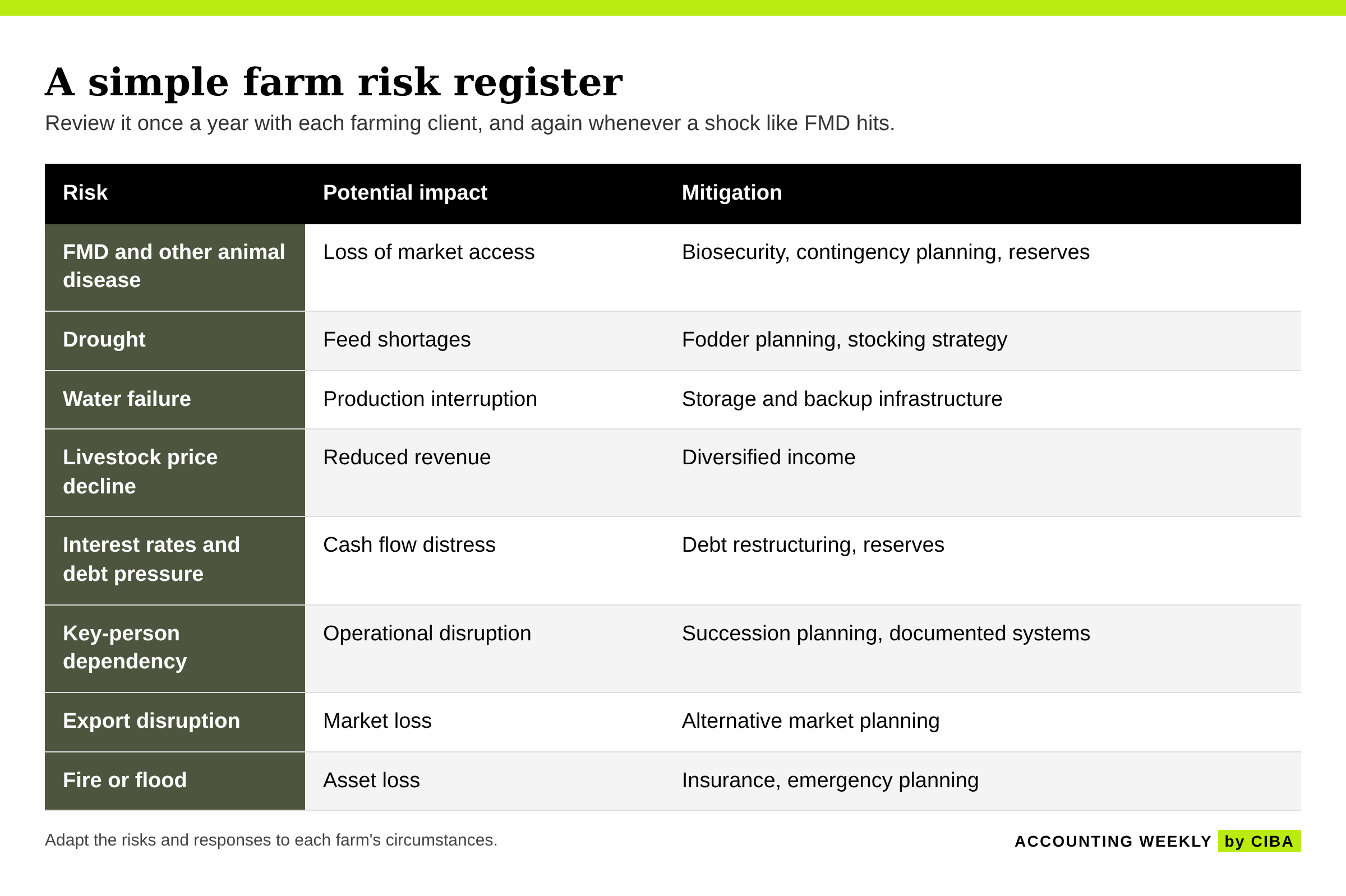
Keep a farm risk register
Companies keep risk registers, and a farm is a business too. A simple register, reviewed once a year with the client, keeps these risks on the agenda:
What to do this week
Phone your farming clients. Ask about their cash flow, work out how long they can last, help them prepare for a conversation with their lender, start the FMD cost record and check their insurance. When the crisis passes, sit down with them again and ask: if livestock income stopped for six months, what part of this farm would still generate cash? If the answer is nothing, that is a business risk, and business risk is where CIBA members can help.