Beyond the Code: Why Your Personal Ethics Could Be the Best Tool You Have
This article will count 0.25 units (15 minutes) of unverifiable CPD. Remember to log these units under your membership profile.
Let’s be honest, in our world, ethics can feel like another compliance checkbox. Tick the Code of Conduct box, attend a CPD, and get back to battling SARS or chasing deadlines.
But here’s the thing: technology can follow the rules better than you ever will.
Automation, AI, and accounting software are taking over routine checks and compliance tasks. So if computers can handle the rulebook, what’s left for you, the professional?
Your judgement. Your moral compass. Your personal ethics.
And that, believe it or not, might be your most valuable business asset.
When the Code Goes Silent, Character Speaks
Every accountant knows the moment. A client leans across the desk and says,
“Everyone does it, it’s not technically wrong.”
It’s not fraud. It’s not illegal. But it doesn’t feel right either.
That’s the grey area, the one your professional code can’t always answer for you.
In The Ethics of Professional Accountants: An Aristotelian Perspective, researcher A. West argues that accountants need to move beyond blind rule-following and build virtue qualities like honesty, courage, and practical wisdom. These aren’t fancy philosophical ideals. They’re the everyday habits that decide whether you stand firm or look away.
Character, like a muscle, builds with practice. It’s in the small things:
Choosing transparency over “creative” accounting.
Questioning an entry that looks off, even when it slows you down.
Saying “no” when silence would be easier.
When the pressure’s on, you won’t suddenly “rise to the occasion”, you’ll fall back on your habits. And if your habits are grounded in ethics, you’ll always land on your feet.
The New Ethical Frontier: Algorithms Don’t Take the Fall — You Do
The profession is changing fast. AI tools now reconcile accounts, detect fraud patterns, and even assess risk with startling precision.
But when those systems make a wrong call, the accountability doesn’t vanish into the cloud. It lands on your desk.
In a recent paper, Professional Ethics and Accountability of Accounting and Finance in the Context of Digital Technologies, researchers Šljivić, Staletović and Rastić warn that automation has blurred the line between human judgement and machine processing. The system might sign off on something that’s technically compliant but ethically grey, and when it does, your reputation, not the algorithm’s, is on the line.
So the question isn’t “Can I trust the software?” it’s “Can I trust myself to question it?”
Your ethics become the human firewall in an automated world, the voice that asks, “Just because we can, should we?”
Technology will keep evolving. But moral discernment, that instinct for right and wrong is still 100% human territory.
Emotional Intelligence: The Missing Ingredient in Ethics
Here’s the part few talk about: good ethics isn’t just about logic, it’s about emotional intelligence.
In her 2024 article Ethical Dilemmas in Accounting: A Comprehensive Analysis of Professional Ethics, researcher W. Zhang explains that truly ethical professionals aren’t the ones who memorise the rules, they’re the ones who understand people.
· They can read the room when a client’s under pressure.
· They sense when a colleague’s “small favour” crosses a moral line.
· They know how to communicate ethical boundaries without killing relationships.
Think of it this way: a spreadsheet can show profit, but it can’t show pain. Emotional intelligence fills that gap. It helps you see the people behind the numbers, the employees, the shareholders, the families depending on your judgement.
Ethics without empathy becomes mechanical. And in a profession already dominated by machines, empathy may be the one thing that keeps us truly human.
Ethics Isn’t About Being Perfect, It’s About Being Prepared
Let’s face it, ethical dilemmas are coming for all of us. The client who wants to “smooth the numbers.” The CFO who says, “Let’s keep this internal.” The temptation to say, “Not my problem.”
No accountant is immune. But the professionals who handle these moments best aren’t more virtuous, they’re more prepared.
Ethical preparation means:
Knowing your red lines before someone tests them.
Practising difficult conversations so you’re not blindsided under pressure.
Building a support network of peers you can talk to honestly when the grey gets darker.
Think of it as ethical muscle memory, like tax season prep, but for your conscience. You don’t train your ethical reflexes in the heat of a crisis; you build them quietly, day after day.
As a mentor once told me:
“You don’t find your ethics in a crisis, you reveal them.”
Putting Ethics into Practice, Every Day
Knowing what’s right is one thing. Living it, every day, in tight deadlines and client pressure, is another.
So how do you make personal ethics part of your daily work life, not just your CPD notes?
Here are five practical steps:
1. Start your day with one ethical question.
Ask yourself: What’s the hardest decision I might face today, and how will I handle it?
Framing your mindset early builds awareness before temptation strikes.
2. Build “pause moments” into your workflow.
Before signing off on a report, pause and ask: If this were published tomorrow, would I still be comfortable with it?
That quick gut check is one of the simplest, and most powerful, ethical safeguards you can create.
3. Keep an “ethical notebook.”
Record moments that made you pause, what happened, how you reacted, and what you learned. Over time, you’ll spot your ethical strengths and blind spots.
4. Find your ethical sounding board.
Every professional needs a peer or mentor who isn’t afraid to say, “I disagree.”
Build your inner circle, someone you can call when the decision feels heavy.
5. Make ethics a business strategy.
Don’t hide it. Talk about it with clients. Position your firm or department as one that leads with integrity.
Ethical transparency doesn’t just protect your reputation, it builds client loyalty.
Bonus Tip: Treat ethics like fitness. You don’t get stronger by reading about push-ups, you get stronger by doing them. The same applies here: small daily acts of integrity build lifelong professional strength.
Why This Matters to You (Yes, You)
Let’s bring this home.
If you’re running a small practice, your ethics are your brand. Clients don’t just pay you to crunch numbers, they pay for trust. And in a profession where everyone’s advertising “integrity,” it’s your consistent behaviour that proves it.
If you work in commerce, your ethics protect your career. When a board decision goes wrong or compliance slips through the cracks, the accountants who can prove ethical consistency are the ones who stay standing. You don’t just survive scrutiny, you earn respect.
And if you’re leading a finance team, your ethics set the tone. Your juniors will mirror your behaviour. If you bend the rules once, you’ve taught them it’s okay. If you stand firm, you’ve built a culture of courage that protects the whole organisation.
In short: your ethics are not just moral guidelines, they’re strategic tools.
They save you time, protect your reputation, and make clients value you more.
Because when trust is scarce, it becomes the most valuable commodity in accounting.
Final Word: Ethics Is the Accountant’s Superpower
Ethics isn’t about being perfect, it’s about being trusted when it matters.
It’s not compliance. It’s not box-ticking. It’s the quiet courage to do what’s right even when no one’s looking.
In the words of A. West from The Ethics of Professional Accountants,
“When the code is silent, character speaks.”
And that’s the kind of voice the profession, and the world, needs now more than ever.
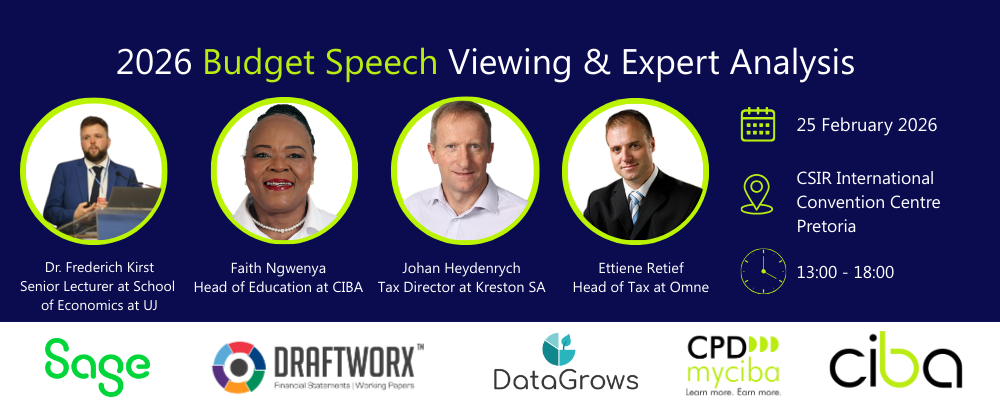
🔴 LIVE: 2026 Budget Speech Viewing & Expert Analysis
Understand the Budget as it happens. Know what to do next.
On 25 February 2026, South Africa’s National Budget Speech will set the tone for tax, compliance, and economic decision-making in the year ahead. CIBA invites you to a live Budget Speech Viewing & Expert Analysis Event, designed specifically for finance professionals who cannot afford to “wait and see” what it means.
Join us for a real-time viewing of the Budget Speech, streamed directly from Parliament, with live expert commentary translating policy announcements into clear, practical implications for your practice and your clients.
You will hear expert insights from Johan Heydenrych, Ettiene Retief, and Dr Frederich Kirst, as the Budget unfolds — not weeks later.
Whether you advise clients, manage tax risk, or lead financial decisions, this session helps you move from policy to action immediately. The event concludes with a cocktail networking session for in-person attendees.
📍 Venue: CSIR International Convention Centre, Pretoria
🕐 Time: 13:00 – 16:00 (Cocktails from 16:00)
💻 Attendance: In-person or Online
🎟️ Limited seats available
IN-PERSON: Register here
ONLINE: Register here
Don’t just hear the Budget. Understand it. Apply it.
#BudgetSpeech2026 #TaxProfessionals #FinanceLeadership #CIBA #SAEconomy