This article will count 0.25 units (15 minutes) of unverifiable CPD. Remember to log these units under your membership profile.
Taking too long for those director changes? Business accountants dealing with company registrations, director changes, or compliance queries, delays can quickly turn into frustrated clients and stalled transactions. What many practitioners don’t realise is that Companies and Intellectual Property Commission (CIPC) has a structured escalation process with defined turnaround times. Following this process correctly can significantly improve your chances of getting a response. Here is how the escalation system works.
Step 1: Lodge the Query Correctly
Before escalating anything, ensure your original query was submitted through the correct CIPC enquiry channel. Many delays occur simply because queries are sent to the wrong email address or without the required supporting documents. You can find a list of emails here: NOTICE-_-ENQUIRY-SYSTEM-v2-002.pdf. Before sending your enquiry, make sure you:
Use the correct email address for the relevant business unit
Send your queries to the correct department, i.e. director change queries to the designated director changes email address
Attach all required supporting documents
Keep a copy of the email and any ticket or reference number received.
If a query is sent to the incorrect email address, the matter may never enter the official process, meaning turnaround times will not apply.
Step 2: Allow 10 Working Days
Once the query has been submitted correctly, CIPC’s service standards require that you allow 10 working days for a response.
Only after this period has elapsed should the matter be escalated.
If no response is received after 10 working days, you can proceed to the formal escalation process.
Understanding the 3-Tier Escalation Process
CIPC operates a structured three-tier escalation framework, with each level having its own response timeframe. It is important to follow the sequence strictly.
First Tier Escalation
Escalate after 10 working days from the original submission following this proces:
Escalate the matter to the first-tier contact person responsible for the relevant service.
The responsible official must attend to the query within 3 working days.
If the matter is not resolved after these 3 days, you may move to the next level.
Second Tier Escalation
When to escalate:
If the first-tier escalation has not been attended to within 3 working days, or the outcome is still unsatisfactory.
Process:
Escalate the matter to the second-tier contact person.
The responsible official again has 3 working days to respond.
If the issue remains unresolved after this period, the final escalation step applies.
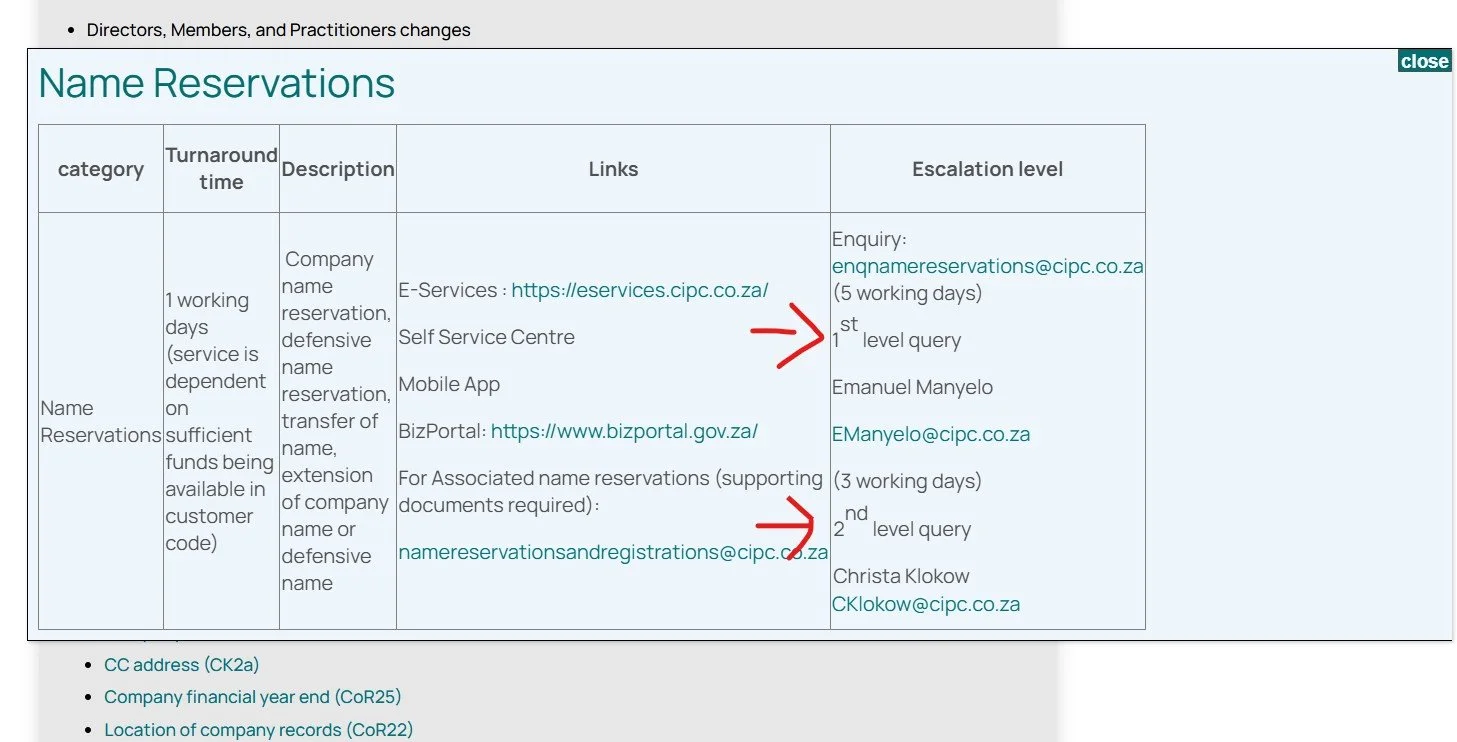
To find the correct contact email addresses and contact persons click on the relevant section in the CIPC Notice as shown below.
Third Tier Escalation
When to escalate:
If there is still no satisfactory resolution after the second-tier escalation.
Process:
Escalate the matter to the senior manager of the relevant business unit.
The senior manager has 5 working days to attend to the query.
Some CIPC business units operate with only two escalation levels. In those cases, the second-tier official has 5 working days to respond.
When to Escalate Through RCB
Escalation through the RCB (Recognised Controlling Bodies) should only take place after the full CIPC escalation process has been exhausted.
This means the following timeframes must have passed:
10 working days (original query) + 3 days (first tier) + 5 days (third tier)
Only once all escalation levels have been attempted should the matter be referred further. After this, submit a support ticket to CIBA technical unit from you member profile - including all the information listed below.
Supporting Documents Required for Escalation
When escalating a matter at any level, always include the following documentation:
A copy of the original enquiry email
Any responses received
The ticket or reference number issued by CIPC
A clear summary of the issue and what remains unresolved
Providing this information ensures the escalated query can be assessed quickly.
The Most Common Cause of Delays
One of the most common reasons CIPC queries stall is incorrect submission.
Before escalating, always confirm the following:
Was the query sent to the correct email address?
Were all required supporting documents attached?
Has the full 10 working day period elapsed?
Ensuring the correct process is followed from the beginning can prevent unnecessary delays and improve response times.
For more, read here: SERVICE TURNAROUND TIME | CIPC