The Labour Law Amendment Bill — what is proposed, and what employers should be doing now
This article will count 0.25 units (15 minutes) of unverifiable CPD. Remember to log these units under your membership profile.
This article first appeared in Heads-Up!, the newsletter of (SA)UEO, the South African United Employers' Organisation, May 2026. Reproduced with permission. All rights remain with (SA)UEO. Learn more at saueo.co.za.
The Labour Law Amendment Bill, 2025 was published in Government Gazette No. 54220 on 26 February 2026 — and it represents the most comprehensive review of South Africa’s employment legislation in more than a decade. The Bill proposes amendments to the Labour Relations Act, the Basic Conditions of Employment Act, the Employment Equity Act, the Unemployment Insurance Act and the National Minimum Wage Act.
The Bill is currently working its way through the pre-parliamentary process. It must still be vetted by the State Law Advisor before being tabled in Parliament, where the Portfolio Committee on Employment and Labour will hold further public hearings. The final Act may differ from the current draft. It is not yet law.
What it is, is a clear statement of direction. More than two years of NEDLAC negotiation between government, organised business and organised labour preceded its publication. The substantive intent of the reforms is unlikely to change materially. Employers who begin preparing now will navigate the transition with far less disruption than those who wait for the President’s signature.
Published: Government Gazette No. 54220 — 26 February 2026
Current status: Awaiting State Law Advisor vetting — not yet tabled in Parliament
NEDLAC background: More than two years of negotiation, April 2022 to October 2024
Legislation affected: LRA, BCEA, EEA, UIA and National Minimum Wage Act
Important note: The Bill is not yet law — provisions may change during the parliamentary process
Source: Department of Employment and Labour — Government Gazette No. 54220, 26 February 2026; Bowmans / Labour Guide South Africa, March 2026
Why prepare now — before the Bill becomes law
South African labour legislation has rarely changed quickly. Bills move through the State Law Advisor, parliamentary committees, the National Assembly, the National Council of Provinces and then to presidential assent. There is time between now and enactment.
That time is not a reason to wait. It is a reason to act — deliberately and without pressure.
Several of the Bill’s provisions, if enacted in their current form, will require changes to employment contracts, workforce cost models, payroll structures and operational practices. Businesses that begin reviewing these areas now will make adjustments gradually and with intention. Those that wait until enactment will be adjusting under time pressure — exactly the conditions that produce reactive decisions with longer-term consequences.
The proposed provisions employers need to understand
The following are the most significant proposed changes from the employer perspective. All remain proposals — the final Act may differ. They are described here as published in the Bill.
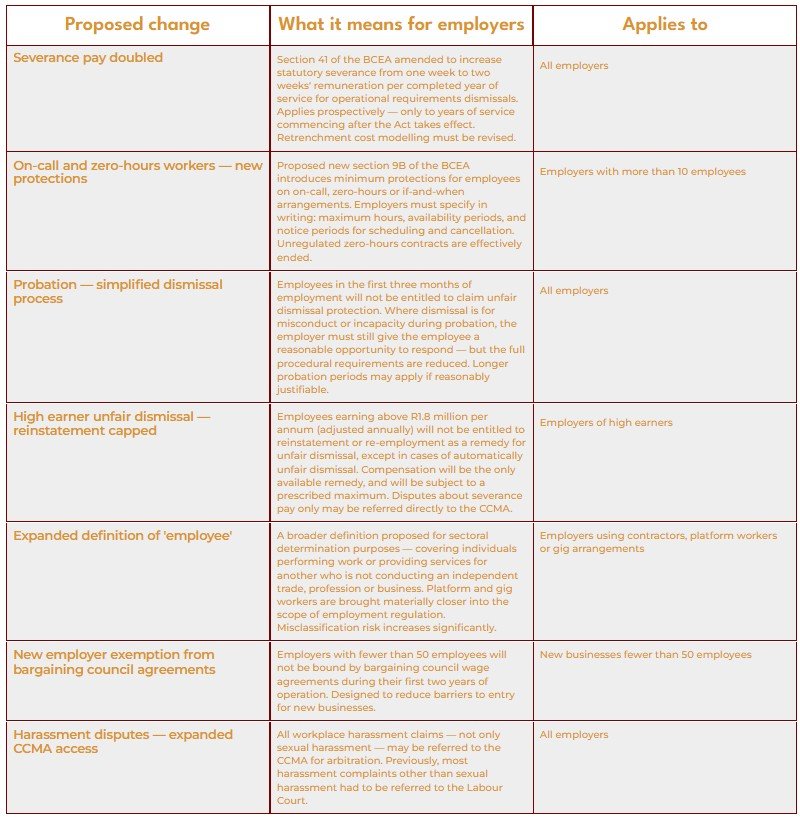
Source: Labour Law Amendment Bill, 2025 — Government Gazette No. 54220; DLA Piper Africa employment alert, March 2026; Global Workplace Insider, March 2026; Labournet — Key Changes Employers Need to Prepare For, February 2026; Compliance Hub, March 2026
The severance provision — a closer look
Of all the proposed changes, the doubling of statutory severance pay is likely to have the most immediate and measurable financial impact on employers across all sectors and sizes.
Under current law, an employer retrenching an employee with ten completed years of service pays a minimum of ten weeks’ remuneration in severance. Under the proposed amendment, for years of service completed after the Act takes effect, the obligation doubles to twenty weeks’ remuneration. For long-serving employees, the exit liability increases substantially.
Two points of precision matter here.
First, the increase is prospective — it applies to years of service commencing after the Act takes effect, not to years already completed. An employee with eight years of service when the Act is signed does not immediately have doubled severance for those eight years. But every year of service after enactment accrues at the higher rate. The longer employers wait to plan, the greater the future exposure becomes.
Second, the Bill also clarifies that disputes solely about the quantum of severance pay — where the fairness of the dismissal itself is not challenged — may be referred directly to the CCMA for arbitration. This is a simplification that removes the need to approach the Labour Court for these narrow disputes.
Practical implication for employers
Begin modelling retrenchment cost scenarios now, using both the current one-week rate and the proposed two-week rate.
Identify long-serving employees and calculate projected future severance exposure under both scenarios.
Review workforce planning assumptions — where periodic restructuring is anticipated, the cost threshold for retrenchment will increase materially.
Consider whether workforce structure, role design or operational planning should be adjusted ahead of enactment.
Source: DLA Piper Africa, March 2026; Compliance Hub — The 2026 Labour Law Bill: Doubling the Stakes on Retrenchment, March 2026
On-call and zero-hours arrangements — what employers need to assess
Many South African employers — particularly in retail, hospitality, security, healthcare and domestic services — rely on on-call or as-and-when-needed arrangements. The proposed section 9B would, if enacted, fundamentally alter how these relationships must be structured and documented.
The requirement is not merely to pay more — it is to formalise what has often been left informal. Employers will need to specify, in writing, the terms under which on-call work is offered and cancelled. This includes minimum pay guarantees and adequate notice for shift cancellations. Where shifts are cancelled without proper notice, compensation will be required.
The practical audit required now is straightforward: identify every arrangement in the business that operates on an on-call, casual, as-and-when or zero-hours basis. Assess whether those arrangements are currently documented. Consider what written terms would need to be introduced to comply with the proposed requirements. This review can be done without waiting for the Act — and is valuable regardless of whether the Bill passes in its current form, given the existing compliance risks around undocumented casual arrangements.
The expanded employee definition — contractor and gig worker exposure
The proposed broadening of the definition of ’employee’ for sectoral determination purposes is a signal, not an isolated technical change. It reflects a sustained regulatory intention to reduce the gap between formal employment and non-standard arrangements.
The legal test is moving away from what is written in a contract — toward how the relationship actually operates. If a business controls when an individual works, directs how the work is performed, specifies the tools or processes to be used, and integrates the individual into the core operation, the likelihood that the relationship will be treated as employment increases — regardless of the label applied to it.
For employers who rely on freelancers, independent contractors, platform workers or labour broker arrangements, this is a material risk that warrants an operational review now. Misclassification claims, if they arise, may trigger backdated obligations including leave pay, overtime, UIF contributions and — under the proposed amendment — severance pay.
What employers should do now — while there is still time
Review retrenchment cost models.
Calculate severance exposure for key employee cohorts under both the current one-week and proposed two-week rates. Incorporate this into workforce planning and financial planning assumptions.
Audit on-call and casual arrangements.
Identify all arrangements that operate on an informal, as-and-when or zero-hours basis. Assess whether they are documented. Begin preparing the framework for written terms that would comply with the proposed section 9B requirements.
Review independent contractor and service provider arrangements.
Assess whether existing contractor relationships would withstand scrutiny under the proposed expanded employee definition. Where the operational reality resembles employment, the risk of misclassification is material.
Review probation documentation.
The proposed probation reforms, while generally more permissive of dismissal during the first three months, still require procedural compliance. Probation terms, performance expectations and dismissal processes during probation should be clearly documented now.
Monitor parliamentary progress.
Once the Bill is tabled in Parliament and Portfolio Committee hearings are scheduled, further public participation will be possible. (SA)UEO will continue to track developments and communicate material changes to members as the process unfolds.
Final consideration
The Labour Law Amendment Bill is described by multiple labour law commentators as the most comprehensive review of South Africa’s employment legislation in more than a decade. The provisions that carry the greatest financial and operational implications are already known. The direction of travel is clear.
Whether the final Act differs in some respects from the current draft, the underlying intent — to formalise, standardise and enforce — is consistent with the broader regulatory direction of the past several years. Employers who begin preparing now will have the advantage of time and intention on their side.
Members are encouraged to engage with their (SA)UEO organiser to discuss the provisions most relevant to their business, and to begin the practical reviews outlined above. Contact info@saueo.co.za for further guidance.
Sources:
Department of Employment and Labour — Labour Law Amendment Bill, 2025, Government Gazette No. 54220, 26 February 2026 (gov.za);
DLA Piper Africa — Proposed amendments to employment laws in South Africa, March 2026 (dlapiperafrica.com);
Global Workplace Insider — Labour Law Amendment Bill published for public comment, March 2026;
Labournet — The Labour Law Amendment Bill 2025: Key Changes Employers Need to Prepare For, February 2026 (labournet.com);
Compliance Hub — The 2026 Labour Law Bill: Doubling the Stakes on Retrenchment, March 2026 (compliancehub.co.za);
GBS / Polity — Labour Law Amendment Bill 2026: Legislative Developments and Economic Implications, March 2026 (polity.org.za);
Bowmans / Labour Guide South Africa — First look at the new 'wave' of labour law amendments (labourguide.co.za);
HJW Attorneys — Reshaping the employment landscape, March 2026 (hjwattorneys.co.za).