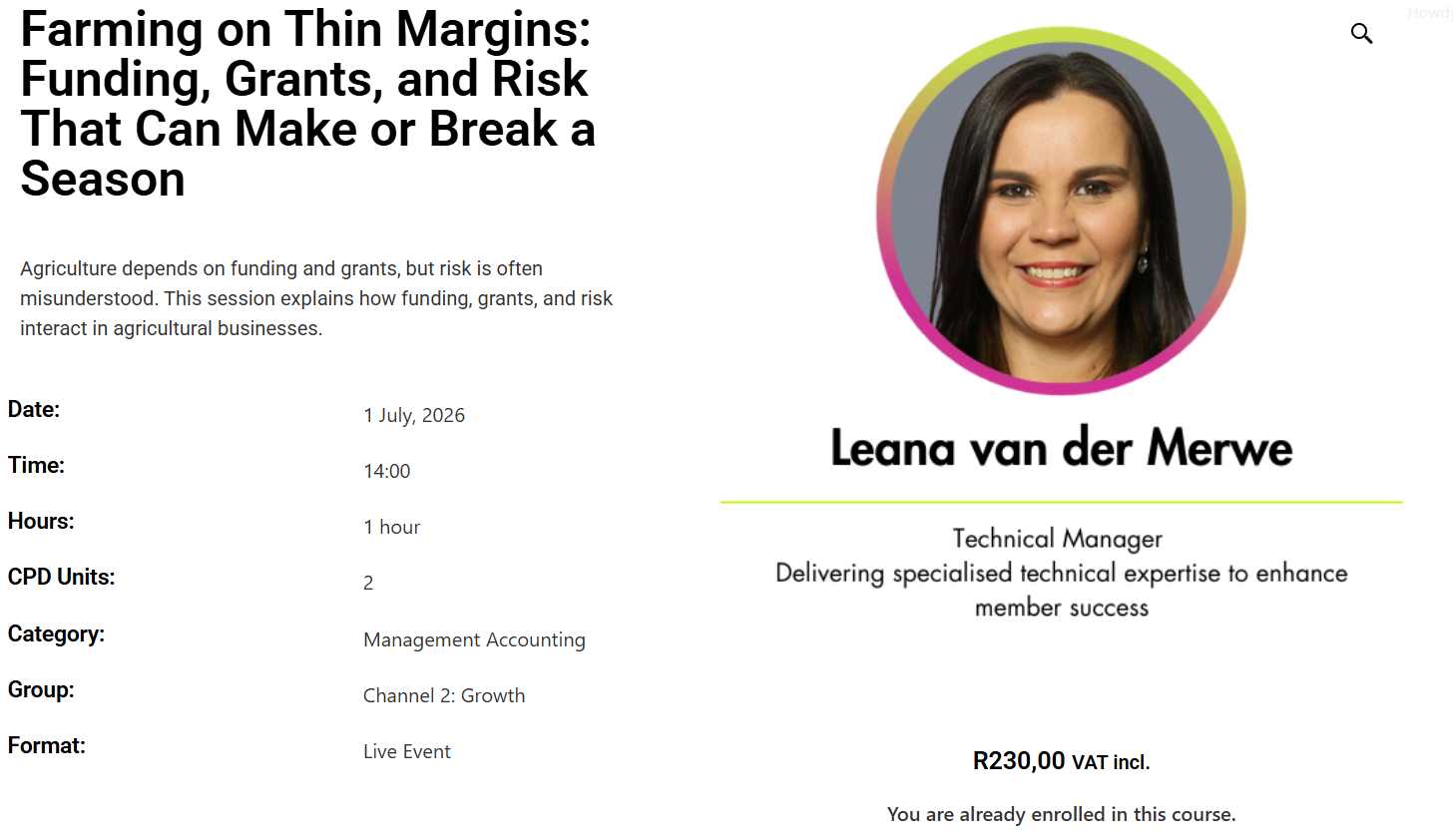
A Practitioner's Guide to Funding, Grants and Risk in Farming
This article will count 0.25 units (15 minutes) of unverifiable CPD. Remember to log these units under your membership profile.
Agriculture contributes more than R300 billion to South Africa's GDP each year and supports over 900,000 jobs directly. It is also one of the most financially demanding sectors an accountant can advise in. A grain farmer typically operates on a net profit margin of only 3 to 8 percent, and more than 60 percent of small farms fail within five years. Behind those numbers sits a simple truth that CIBA's Technical Support Lead, Leana van der Merwe, set out in the recent CPD session "Farming on Thin Margins." A farming operation does not usually fail because of one bad decision. It fails because the accountant advising it, or the farmer running it, did not fully understand how funding, grants and risk interact across a season. This guide walks through that interaction, so members can advise farming clients with the same confidence they bring to any other sector.
Where the money comes from, and what it really costs
Farmers draw on a wider range of funding sources than most other small businesses, and each one carries a different kind of cost. Commercial banks offer short-term seasonal loans and overdraft facilities at rates tied to prime, but they demand strict security. The Land Bank, as a state-owned agricultural development bank, often provides longer terms and better rates, though its approval process is thorough and its conditions are strict. Government grant programmes such as CASP and MAFISA are frequently non-repayable, but the reporting and compliance obligations attached to them are considerable. Agri-businesses such as input suppliers and grain traders will advance funding against a future crop, which is simple to access but often carries hidden costs buried in the price contract. Family and informal funding is fast and flexible, but usually lacks a proper agreement, which creates its own legal and relationship risk. Development finance institutions fund larger infrastructure projects, but only with a detailed business plan and clear impact metrics behind the application.
The lesson for members advising on any of these is that a lower interest rate does not mean a lower risk. A grant at zero percent can end up costing more than a commercial loan once the compliance burden, the reporting obligations and the delay in receiving funds are taken into account. When you sit down with a farming client to choose between funding options, the conversation needs to be about total cost and total risk, not just the number attached to the interest rate.
Why a grant is not the gift it appears to be
Many farmers, and some accountants, treat a grant as free money. It rarely is. A grant is a conditional funding arrangement, and the conditions are legally binding from the moment the farmer accepts them.
The process usually begins with an eligibility check against the programme's criteria for land size, income threshold, B-BBEE status and registration. If the farm qualifies, the application itself is where the accountant's work typically starts, compiling the business plan, financial statements, proof of land and tax clearance. From there the relevant department assesses the application, which can take three to six months and often includes a site visit. Approval, when it comes, is issued with conditions attached, and it is worth remembering that approval is not the same as payment. The farmer must still meet every condition, which might include an own contribution, insurance or training, before any money moves. Payment itself may arrive in tranches, or on a reimbursement basis, meaning the farmer pays first and waits to be repaid. Even once funds are in hand, the obligations continue, through annual reports and the possibility of an audit at any time.
This is why the six to eighteen month timeline from application to payment matters so much in practice. A grant cannot be relied on to fund the season in front of you. It is, at best, a source of funding for the season after next.
The conditions that catch farmers out, and how to guard against them
The conditions attached to a grant are where most of the real risk sits, and they are easy to underestimate because they are written in government language rather than plain English. An own contribution requirement can leave a farmer carrying debt and a grant obligation at the same time, if that contribution itself had to be borrowed. Funds that are spent on something other than what was approved, even a more sensible alternative, can be treated as a breach. Using the wrong entity type, applying as an individual when the programme requires a company or trust, can disqualify an application outright. Time limits mean unspent funds may have to be returned if delivery is delayed. Reporting obligations are treated seriously enough that a missed report can count as a breach regardless of how well the money was actually used, and poor record-keeping at audit stage becomes the accountant's failure with the farmer's money on the line.
The practical response is straightforward, even if it takes discipline to maintain. Read every condition personally rather than relying on a summary. Explain each one to the client in plain language. And keep conditions register that tracks compliance status for every individual condition attached to every grant, rather than treating the grant as a single line item that is either compliant or not.
Why how a farmer borrows matters more than how much
One of the more important ideas from the session is that funding structure shapes risk exposure independently of the amount borrowed. Consider three examples. A farmer who borrows R2 million at 12 percent per annum is already committed to R240,000 in interest before a single seed goes into the ground, which means a large share of income is spoken for before the season even begins, and a missed payment gives the bank grounds to call the loan. A five year loan taken out to finance a tractor, repaid monthly, sits awkwardly against income that only arrives after harvest, and this mismatch between repayment timing and income timing is where a great many farmers run into difficulty. And a grant approved for one purpose, say irrigation, but partly spent on another, say storage, can see the department disallow the spend and demand full repayment, turning a non-repayable grant into a debt overnight.
When you review a client's funding arrangements, the question to ask is not simply how much they owe. It is whether the term of each loan matches the life of the asset it funded, and whether the conditions attached to each grant match what the client is actually doing on the farm.
Why cash flow and profit are not the same thing
Nowhere is the difference between cash flow and profitability more visible than in farming. A grain farm can spend eight to ten months in a cash-negative position before a single rand of income arrives, moving through a planning and input phase, a growing season with no income at all, and a harvest period where grain sits in a silo waiting for payment. It is entirely possible for a farm to show a profit in December and be in a genuine cash crisis by August of the same year.
The pressure that builds during that long gap tends to come from a familiar set of sources. Input costs such as fertiliser and fuel are priced in US dollars, so a weak rand can move a budget by 15 to 20 percent before a seed is planted. Bad weather can delay planting by weeks, extending the period a loan facility must cover before any income arrives. Commodity prices can fall between planting and harvest, cutting expected income while the loan repayment stays fixed. A grant that was meant to reimburse costs within 60 days can take eight months to pay out, leaving the farmer short for the following season. Equipment can break down at the worst possible moment, adding an unbudgeted repair bill while the crop deteriorates in storage. And a bank, reviewing a facility on its own annual cycle, can reduce that facility exactly when the farmer needs it most.
Given all of this, an annual profit and loss statement tells you very little about whether a farming client will survive the year. A monthly cash flow model, ideally rolled forward eighteen months and updated whenever a major cost or income item changes, is the tool that actually protects the client.
The numbers that tell you whether a farm is in trouble
A small set of ratios, reviewed regularly rather than once a year, will tell you most of what you need to know about a farm's financial health. The debt-to-asset ratio, total debt divided by total assets, is healthy below 40 percent and a warning sign above 60 percent, since it shows how much of the farm is effectively owned by the bank. The current ratio, current assets divided by current liabilities, should sit above 1.5, and a figure below 1.0 points to an imminent cash crisis. Debt service coverage, net operating income divided by annual debt payments, should be above 1.25, and below 1.0 signals that default is likely without intervention. Operating profit margin, operating profit divided by revenue, should be above 15 percent, since below 5 percent leaves no room for a single bad season. Working capital, current assets minus current liabilities, should be positive and growing, because a negative figure means long-term funding is being used to cover daily costs. And the input cost ratio, input costs divided by revenue, should stay below 65 percent, with anything above 80 percent considered unsustainable.
None of these ratios is difficult to calculate. The value lies in reviewing them quarterly with every farming client, so that a deteriorating trend is visible long before it becomes a crisis.
Where accountants tend to go wrong
Agriculture has enough specific characteristics that a standard business accounting approach, applied without adjustment, will produce the wrong advice. The most common error is treating grant income as normal revenue, when it may carry conditions that require it to be recognised separately and tracked as a liability until those conditions are met. A closely related error is failing to check whether input costs are rand-denominated, since a currency movement between budgeting and purchase can distort a cost forecast significantly. Using last year's figures as a baseline without adjusting for the season is another common mistake, since a drought year is an outlier rather than a norm. Loan covenants are often left out of financial planning entirely, even though breaching one can let a bank call a loan mid-season. Grants are sometimes advised on without reading the conditions in full, which is simply too great a risk to take on a client's behalf. Cash flow and profitability are frequently treated as interchangeable, when a farm can be profitable on paper and unable to pay its bills at the same time. And sensitivity analysis is often skipped altogether, when modelling a drop in yield, a fall in commodity price, or a delayed grant is exactly what tells you a client's real break-even position.
None of these are complicated to fix once you know to look for them. The point of naming them is simply to make sure they are on your checklist before they show up in a client's financial statements.
Listening for the early warning signs
Financial distress in farming rarely announces itself. It builds quietly, through signals that whisper rather than shout, and by the time they become obvious it is often too late to act. A farmer using an overdraft continuously for more than 60 days, or watching input costs rise faster than commodity prices, is at the early end of that curve, and this is the point at which a conversation can still change the outcome. Negative working capital, borrowing simply to make loan repayments, or a bank requesting updated financials outside its normal cycle, all suggest the situation needs action rather than observation. And when a farmer cannot cover next season's input costs, when a creditor threatens legal action, when a grant application has been pending for over a year, when crop insurance has lapsed due to cost pressure, or when land has been offered as security just to fund operating costs, the situation has moved from warning to critical.
Building a simple checklist from these signals, and reviewing it with every farming client on a quarterly basis, is one of the most valuable things an accountant can do in this sector. Spotting trouble six months early gives a client time to act. Spotting it when the bank calls does not.
What good advice actually looks like in practice
Reducing risk for a farming client comes down to a handful of disciplines applied consistently. Encourage a cash reserve of at least 20 percent of annual operating costs, and be firm that a single season's income should never be relied on to repay long-term debt. Make sure the right insurance is in place, covering crops against multiple perils, covering key assets such as tractors and irrigation systems, and covering revenue where crops are sold under contract. On funding, match loan terms to the life of the asset being financed, and keep seasonal facilities separate from capital finance so that a short-term cash need never gets tangled up with a long-term loan. On grants, maintain a conditions register and set internal deadlines at least 30 days ahead of any official deadline, so nothing is missed at the last minute. On cash flow, build and maintain a rolling eighteen month forecast that models a best case, an expected case and a worst case, rather than a single projection. And review the client's financials quarterly, bringing the bank manager into strategic conversations early rather than only when a problem has already arrived.
The professional opportunity this represents
Agriculture remains one of the most underserved sectors when it comes to quality financial advice, and that gap is a genuine opportunity for members prepared to build the expertise. Grant application support, seasonal cash flow modelling, funding structure reviews, quarterly early warning monitoring, reporting for funders, and specialist agricultural tax knowledge covering Section 26 averaging, trading stock and livestock valuation are all services that farming clients need and are often unable to find. Poor reporting is one of the most common reasons farmers lose access to funding in the first place, which means an accountant who can produce accurate, timely reports is not simply doing compliance work. They are protecting a client's ability to keep operating.
Bringing it together
Funding is never free, and that includes grants, which carry their cost in conditions and compliance rather than in interest. A grant is not a gift, and every condition attached to it needs to be read, explained to the client, tracked, and reported on. The structure of a client's funding, not just the amount, determines how exposed they are to a difficult season. Cash flow and profit are different things, and a client can be profitable and in genuine financial trouble at the same time. Risks in farming tend to stack rather than arrive alone, so that three manageable problems in the same season can end an operation that would have survived any one of them individually. And the accountants who take the time to understand all of this are not just avoiding mistakes. They are positioned to become the advisor a farming client keeps for the life of the business.
To learn more please watch this webinar
Click here