Government Said Sign It. The PFMA Says Otherwise
This article will count 0.25 units (15 minutes) of unverifiable CPD. Remember to log these units under your membership profile.
R120 billion. That is the combined irregular expenditure sitting across national government departments and state-owned entities, according to the latest Auditor-General data. Not a projection. Not a risk assessment. Done. Signed. Processed.
Somewhere in that R120 billion, there are finance professionals who knew something was wrong and processed it anyway. Not because they were corrupt. Because the instruction came from above, the deadline was real, the municipal manager was waiting, and nobody had ever told them clearly what to do when a verbal approval was the only authorisation they were going to get.
This article is about that moment. And what it means for your career, your liability, and your professional standing.
Transparency Does Not Equal Accountability
It is clear that SA does not have a transparency problem. The Auditor-General produces detailed, accurate, publicly available findings every year. Parliament's committees interrogate them. Reports are tabled. The machinery of detection functions. What the system struggles to produce, consistently, is consequence management.
In March 2023, the Auditor-General informed Parliament that the process of issuing the first-ever certificate of debt against an accounting officer was underway. The 2018 amendment to the Public Audit Act created this mechanism specifically to make governance failure personally costly. Eighteen months later, no certificate had been issued. The explanation came. The certificate did not.
This is the central dysfunction. The system can detect failure with precision. What it cannot do, reliably, is punish it. And as long as that gap exists, the pressure lands hard on the finance professionals sitting in the middle.
Why Governance Fails: Sometimes It Is Villains. Sometimes It Is Systems.
When Compliance Theatre Replaces Governance Culture
Eskom did not lack a board during the state capture years. It had five board chairs in four years, audit committee meetings, resolutions, and minutes. What it lacked was a board appointed for competence rather than loyalty. Governance structures existed on paper. The culture had been deliberately hollowed out. This is what King IV tries to capture: ethical leadership is not a set of structures. It is what happens inside those structures when the pressure is on.
The Fraud Triangle operates in plain sight.
Three conditions drive financial misconduct: pressure, opportunity, and rationalisation. In the public sector, pressure is usually political. Opportunity emerges when oversight weakens. Rationalisation does the rest: the regulations allow this, it is an emergency, the Minister approved it verbally. The PPE procurement scandal of 2020 and 2021 illustrates all three simultaneously. Emergency provisions that were lawfully available were progressively redefined until personal benefit became routine. Every step had a rationalisation. That rationalisation made it invisible to the people doing it.
Accountability becomes deliberately diffuse.
Committees decide, minutes are delayed, delegation is ambiguous, and verbal instructions substitute for written authorisations. The Zondo Commission documented this pattern across almost every case: ministers blamed directors-general, directors-general blamed CFOs, CFOs blamed procurement officers. Every person had a rationalisation. Nobody had a decision. As stated in our previous publication Accountants’ Role in Fighting Corruption, accountants are not spectators in this environment. They are at the centre of every financial process, which means they are at the centre of every failure.
You are not a bystander. You are the last checkpoint.
Finance professionals sit at the exact intersection where political instruction meets legal obligation. They cannot avoid the transaction. That is what makes them both useful to those seeking to abuse a system and personally vulnerable when it fails.
The PFMA is clear. Section 38 places personal, non-delegable obligations on accounting officers: effective financial management, prevention of irregular expenditure, and transparent internal controls. These cannot be passed upward. "I was instructed to" is not a defence under the PFMA, and not under PRECCA either. Section 34 of PRECCA obligates persons in positions of authority to report suspected corruption above R100,000 to SAPS. Failure to report is a criminal offence. The instruction does not transfer the risk. It multiplies it.
The VBS scandal makes this concrete. The Motau Report found that 53 municipalities deposited R1.5 billion in public funds at VBS in direct contravention of the MFMA. The CFOs, treasurers, and finance managers who processed those transactions were not junior officials acting in ignorance. Several were named in the report. Criminal referrals and SIU civil recovery proceedings followed. The failures ran through every layer of the finance function, not only the boardroom.
The phrases that should stop you cold
These are not administrative shortcuts. They are invitations into personal liability.
"Just process it, we'll get the documentation later." There is no documentation later. There is only an absent audit trail, and that absence belongs to the person who processed the payment.
"The Minister approved it verbally." The PFMA does not recognise verbal approval. Neither does the AGSA or the Special Tribunal. Even if the approval was given in a meeting it needs to be documented and signed.
"Don't worry, the audit committee won't pick it up." That is a confession, not reassurance.
"This is how it's always been done here." This is how ethical fading works: the gradual disappearance of the ethical dimension of an act because repetition makes it feel normal. Accounting Weekly's examination of ethics in accountancy identifies this pattern across every major South African financial scandal of the past decade. The first act felt wrong. The fifteenth was routine.
What you can actually do
Know your personal exposure
Read PFMA Sections 38 and 45, or MFMA Section 62. Twenty minutes. Know what the legislation says, not just what your organisation's policy says.
Name it when you see it
"This would constitute irregular expenditure" is a sentence. It belongs in writing. It breaks normalisation, creates a record, and is your best protection if the matter is later investigated.
Know your disclosure route
The Protected Disclosures Act protects you. PRECCA Section 34 obligates you when the threshold is met. The Public Protector and AGSA are external routes when internal ones are blocked. Know these before you need them.
In Summary
Governance does not fail because the legislation is weak. It fails because individuals at every level make small choices not to see, not to ask, not to speak. As explored in Ethics After Hours: The Battle No One Sees, the hardest ethical decisions do not happen in boardrooms. They happen alone, at a desk, with a payment to process and a municipal manager waiting for confirmation.
The frameworks exist. The question is what you do when that moment arrives.
Join CIBA’s Webinar on Governance and Ethics in the Public Sector: Where Accountability Breaks Down on 21 April 2026, where we talk about more important aspects of accountability and governance.
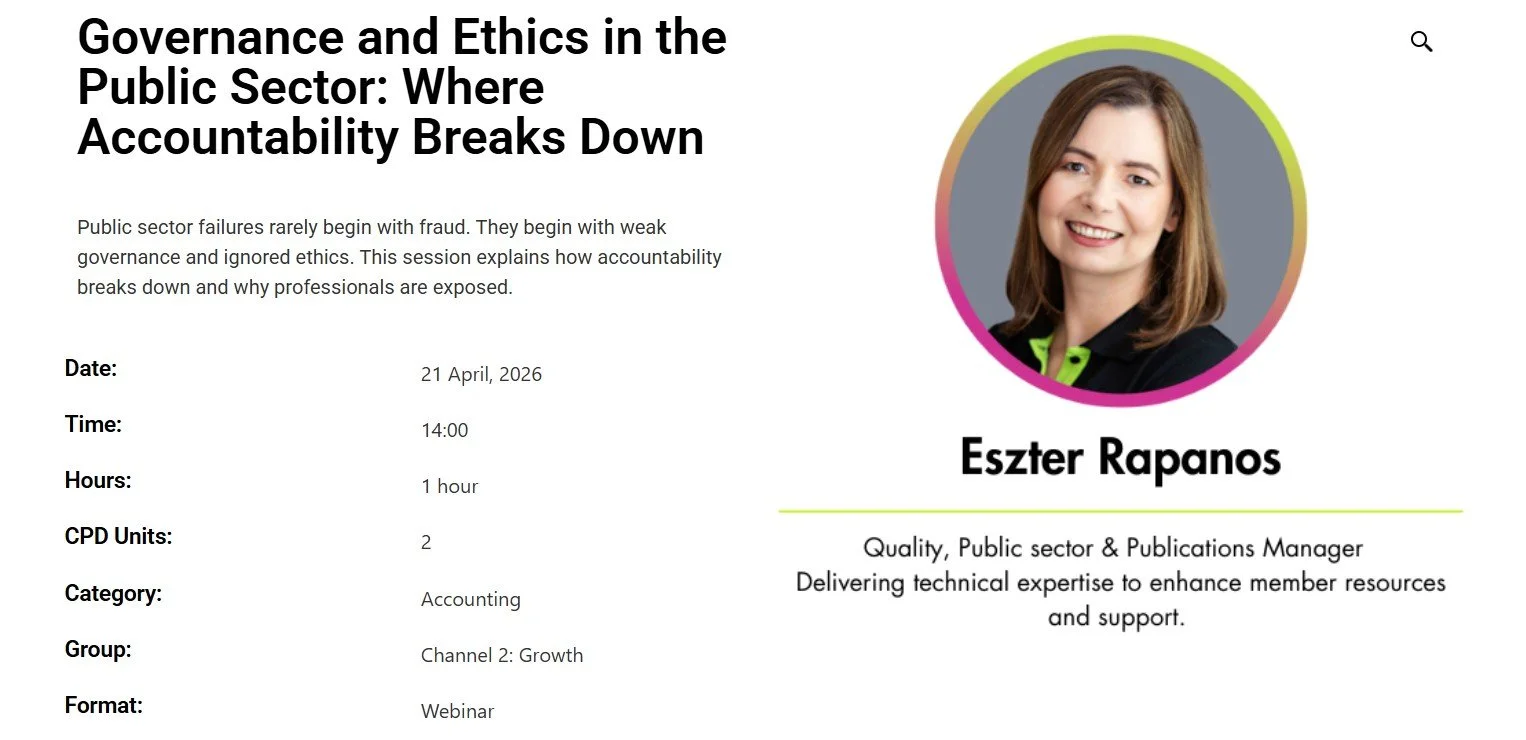
By attending this event, you will learn:
How governance works in the public sector
Why ethical pressure affects judgement
Where accountability becomes unclear
How weak oversight leads to findings
Why finance professionals are drawn into failures
How ethical breakdowns escalate.



Trending