This article will count 0.25 units (15 minutes) of unverifiable CPD. Remember to log these units under your membership profile.
Ask three accountants how they would value a piece of investment property owned by an SME client, and you might get three different answers. Not because they disagree on the property, but because the old IFRS for SMEs Standard gave inconsistent guidance on fair value measurement depending on which section you were reading.
Section 16 had its own version of how fair value worked for investment property. Section 17 had a different approach for revalued assets. The financial instruments sections had their own rules. None of them were formally connected, and the guidance in each section varied in emphasis, terminology, and depth.
The third edition fixes this with something the standard has never had before: a single, dedicated section for fair value measurement that applies consistently across the entire standard. That section is the new Section 12, and it is one of the most practically useful additions in the entire third edition.
What Section 12 Is and What It Is Not
Before going further, it helps to be clear about what Section 12 actually does.
Section 12 does not tell you when to use fair value. That decision is still made by the individual sections of the standard. Section 16 on investment property tells you when fair value applies to a piece of property. Section 11 on financial instruments tells you when fair value applies to an instrument. Section 12 does not change any of that.
What Section 12 does is tell you how to measure fair value once you have already determined that fair value is required. It provides a single, consistent framework that applies every time fair value appears anywhere in the standard. One definition. One hierarchy. One set of disclosure requirements. That consistency is the point.
The Definition of Fair Value
The definition adopted in Section 12 comes directly from IFRS 13, the full IFRS fair value standard:
"The price that would be received to sell an asset or paid to transfer a liability in an orderly transaction between market participants at the measurement date."
Every word in that definition carries weight. Working through them one by one is the fastest way to understand what fair value actually means in practice.
• The price that would be received to sell an asset. Fair value is an exit price. It is what you would get if you sold the asset today, not what you paid for it when you bought it. The historical cost is irrelevant to the fair value measurement.
• Paid to transfer a liability. For liabilities, fair value is the amount another party would require to take on the obligation. It is not necessarily what you would pay to settle it, because settlement might involve a negotiated discount or premium.
• Orderly transaction. This is not a forced sale or a distressed liquidation. It assumes the seller has had adequate time to market the asset and that the buyer is not acting under duress. Emergency sales at rock-bottom prices do not represent fair value.
• Between market participants. The transaction is hypothetical and involves knowledgeable, independent buyers and sellers acting in their own economic interest. Your client's specific circumstances, intentions, or relationship with a particular buyer are not relevant. What matters is what the market would do.
• At the measurement date. Fair value is measured at a specific point in time, usually the balance sheet date. It reflects conditions on that date, not conditions at the time the asset was acquired or at the time the financial statements are signed.
Who Are Market Participants and Why Does It Matter
The concept of market participants sits at the heart of every fair value measurement. Market participants are the hypothetical buyers and sellers who would transact for the asset or liability in the principal market, meaning the market with the greatest volume and activity for that asset.
Market participants are assumed to be independent of the reporting entity, knowledgeable about the asset or liability, able and willing to transact, and acting in their own economic best interest.
The reason this matters is that fair value is not about what your client thinks the asset is worth. It is not about what your client paid for it, what your client could use it for, or what a related party has offered. It is about what an informed, independent buyer would pay in the market today.
This creates a practical challenge for SME practitioners. Many SME assets do not trade in active, observable markets. Unlisted equity investments, private business interests, specialised machinery, and commercial properties in secondary locations are all examples of assets where identifying what market participants would pay requires judgement and estimation rather than a simple price lookup.
Section 12 provides a structured way to approach that judgement through the fair value hierarchy.
The Fair Value Hierarchy: Levels 1, 2 and 3
The fair value hierarchy organises the inputs used to measure fair value into three levels, ranked by reliability. The principle is simple: use the most reliable observable information available, and move to less observable inputs only when necessary.
• Level 1 inputs are quoted prices in active markets for identical assets or liabilities. This is the most reliable category because the price is directly observable. JSE-listed shares are the clearest example. If your client holds shares in a listed company, the closing price on the balance sheet date is the fair value. No estimation required.
• Level 2 inputs are observable inputs other than Level 1 quoted prices. These include quoted prices for similar assets in active markets, quoted prices for identical assets in markets that are not active, observable interest rates, yield curves, credit spreads, and forward exchange rates. Level 2 requires some adjustment and judgement, but it is still grounded in observable market data.
• Level 3 inputs are unobservable inputs. These are the entity's own assumptions about what market participants would use to price the asset or liability, developed using the best available information. Unlisted equity investments, investment property in thin markets, and specialised assets with no comparable market transactions typically fall into Level 3.
The hierarchy is a priority order. If Level 1 inputs are available, you must use them. You cannot choose a Level 2 or Level 3 approach just because you prefer it or because it gives a more favourable result. Move down the hierarchy only when higher-level inputs are genuinely not available.
Highest and Best Use for Non-Financial Assets
For non-financial assets, Section 12 introduces an important concept: highest and best use.
The fair value of a non-financial asset is measured based on the use that would maximise its value from the perspective of market participants. That use must be physically possible, legally permissible, and financially feasible.
The current use of an asset is presumed to be its highest and best use unless there is market or other evidence to suggest that a different use would be more valuable.
Here is a practical example. Your client owns a piece of land currently used as a staff car park on the edge of a commercial district. The land is zoned for commercial development and comparable land in the area is being sold at prices that reflect its development potential. The fair value of that land should reflect its value as a development site, not its value as a car park, even if your client has no intention of developing it.
This is a meaningful shift for clients who hold assets for operational reasons but whose assets have significantly higher values under an alternative use. The fair value disclosed in the financial statements must reflect the market's view of the asset's potential, not the owner's current preference.
The New Disclosure Requirements
Section 12 also introduces structured disclosure requirements that apply whenever fair value is used in the financial statements. These disclosures give users of the financial statements the information they need to assess how reliable and subjective the fair value measurements are.
For each class of asset or liability measured at fair value, the entity must disclose the level of the hierarchy used, the valuation technique applied, and the key inputs used in the measurement.
For Level 3 measurements, where the inputs are unobservable and involve the most judgement, there are additional requirements. The entity must provide a reconciliation of the opening and closing balance for the period, showing how the fair value changed and what drove those changes. It must also describe the sensitivity of the fair value measurement to changes in the key unobservable inputs.
For many SME clients, this means that the notes to the financial statements will need to be significantly more detailed when it comes to unlisted investments, owner-managed investment property, and biological assets. A line that previously said "investment property measured at fair value: R5 million" will now need to be supported by a description of the valuation method, the key inputs, and how sensitive the value is to changes in those inputs.
This is not just a compliance requirement. It is useful information. It helps the reader of the financial statements understand how much of the balance sheet is based on observable evidence and how much depends on the preparer's judgement and assumptions.
The Ageing Analysis and Maturity Disclosure: New Requirements in Section 11
Alongside the Section 12 changes, the updated Section 11 introduces two new disclosure requirements that sit in Part 2 of that section and are worth covering here because they deal with how financial instruments are presented and explained to users.
The first is an ageing analysis of financial assets. Entities must now disclose how old their financial assets are, broken down into amounts not yet due and overdue amounts bucketed by time period. This gives banks, creditors, and other users a clear picture of the quality of the receivables book rather than just its total value.
The second is a maturity analysis of financial liabilities. This shows when the entity's financial obligations fall due, typically bucketed into periods such as within one year, one to two years, two to five years, and beyond five years. This tells users when cash will need to leave the business to meet financial obligations.
Both of these disclosures respond directly to feedback from users of SME financial statements who said the existing notes told them very little about liquidity risk, cash flow timing, or the quality of assets and liabilities on the balance sheet. From the first set of third-edition financial statements, both are required.
Getting Ready in Practice
The practical preparation for Section 12 starts with a review of every item in your client's financial statements that is currently measured at fair value or that could be.
For each item, identify what level of the hierarchy the current measurement sits in. If you are using Level 3 inputs for unlisted investments or investment property, prepare for the additional disclosures that are now required. Document the valuation method, the key inputs, and how sensitive the value is to changes in those inputs.
For clients holding land or property that might have a highest and best use different from its current use, have that conversation now. The fair value that goes into the financial statements needs to reflect the market's view, not the owner's preference.
And for every client with trade receivables and financial liabilities, start building the data structures that will support the ageing analysis and maturity analysis disclosures. These are straightforward to prepare but need to be built into the accounting system and review process rather than assembled at the last minute during the audit.
Fair value has always been in the standard. Now it has a consistent framework, a clear hierarchy, and proper disclosure requirements. That is good for users of the financial statements, and it is good for practitioners who want a defensible basis for every measurement they sign off.
🚨 CPD - SARS IS FLAGGING MORE INDIVIDUAL TAX RETURNS THAN EVER – ARE YOUR CLIENTS AT RISK?
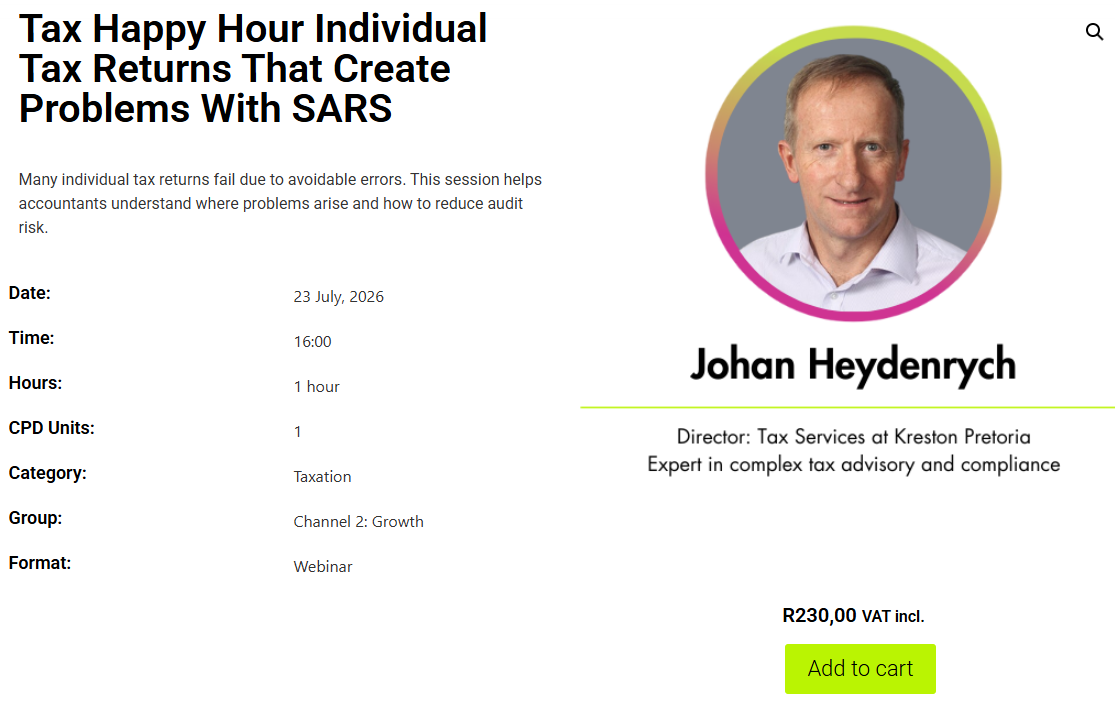
🚨 SARS IS FLAGGING MORE INDIVIDUAL TAX RETURNS THAN EVER – ARE YOUR CLIENTS AT RISK?
Many individual tax returns fail due to avoidable mistakes. Incorrect claims, missing supporting documents, SARS matching discrepancies, and common filing errors can result in queries, audits, penalties, and unnecessary delays.
Join taxation specialist Johan Heydenrych for this practical Tax Happy Hour session and learn how to:
✅ Identify the most common individual tax return errors
✅ Avoid audit-triggering items
✅ Apply best-practice supporting documentation
✅ Manage client claims and expectations
✅ Resolve SARS matching issues
✅ Reduce disputes and improve compliance
✅ Submit more accurate and defensible returns
📅 Date: 23 July 2026
🕓 Time: 16:00
⏱ Duration: 1 Hour
🎓 CPD: 1 Taxation CPD Unit
💻 Format: Live Webinar
👨🏫 Presenter: Johan Heydenrych, Taxation Specialist and Partner at Kreston SA
Don't wait for SARS to identify the problem. Learn how to get it right the first time.
Register here today.



Trending