Business Bought. Champagne Popped. Now Let's Talk About the Accounting
This article will count 0.25 units (15 minutes) of unverifiable CPD. Remember to log these units under your membership profile.
A client calls on a Tuesday afternoon. They have just signed papers to acquire a competitor. The deal is done. Now they want to know what the financial statements are going to look like.
The old Section 19 has been updated to align with the revised IFRS 3. Five changes matter most. Each one affects real numbers. Each one needs to be understood before the next acquisition your client completes.
Change 1: First, Is It Actually a Business?
Before anything else, you need to decide whether your client bought a business or a group of assets. The answer determines everything that follows.
Buy a business: apply the full acquisition method, measure all identifiable assets and liabilities at fair value, and recognise goodwill. Buy a group of assets: allocate the purchase price across those assets in proportion to their fair values. No goodwill.
The new definition of a business requires both inputs (things going into it, like equipment, staff, or contracts) and substantive processes (the systems and methods that turn those inputs into outputs). A warehouse of stock with no staff and no operating procedures is not a business. A manufacturing plant with skilled workers, production systems, and customer relationships almost certainly is.
How to apply it:
Use the concentration test as a quick screen. If substantially all the fair value of the acquired assets is concentrated in a single asset or group of similar assets, it is an asset acquisition, not a business combination. If the test does not give you a clear answer, assess whether genuine inputs and substantive processes exist. Document your conclusion. The auditor will ask for it.
Change 2: Acquisition Costs Are Expensed on Day One
This is the change most likely to surprise a client if you have not warned them in advance.
Under the old rules, direct acquisition costs (legal fees, due diligence, advisory fees) were added to the purchase price and capitalised into goodwill, then written off gradually over time. Under the new rules, those costs are expensed in profit or loss on the date the deal closes. All of them. Immediately.
If your client paid R2.8 million in transaction costs, that full amount hits the income statement in year one. Under the old rules the annual charge was around R280,000 spread over ten years. Under the new rules it is R2.8 million in one go.
How to apply it:
Identify all direct costs of the acquisition: legal fees, advisory fees, due diligence, valuation costs. Expense them in profit or loss on the acquisition date. Do not include them in the purchase price used to calculate goodwill. Costs to issue debt finance go through Section 11. Costs to issue equity go through Section 22. Everything else goes to profit or loss. Have this conversation with your client before the deal closes, especially if they have banking covenants or bonus arrangements tied to reported profit.
Change 3: Earn-Out Payments Must Be Valued on Day One
Many acquisitions include earn-out arrangements, where the seller receives an extra payment if the acquired business hits certain targets after the deal closes.
Under the old rules, you only included contingent consideration in the purchase price if payment was probable and the amount was reliably measurable. If the earn-out was uncertain, you often left it out and waited.
Under the new rules, contingent consideration must be measured at fair value on the acquisition date, regardless of how uncertain the outcome is. You need to estimate what the earn-out is worth on day one and include that estimate in the purchase price.
How to apply it:
Use an expected value calculation. Multiply each possible outcome by its probability and add the results. Example: R1 million earn-out with a 60% chance of being paid = R600,000 fair value on day one. Record R600,000 as part of the purchase price and as a liability. If the estimate changes during the twelve-month measurement period, adjust goodwill. If it changes after the measurement period closes, take the difference to profit or loss, not back to goodwill.
Change 4: Step Acquisitions Require a Remeasurement
A step acquisition is when your client already holds a stake in a company and then buys more shares to cross the control threshold. Perhaps they held 30% as an associate for two years and then bought another 25% to reach 55%.
Under the old rules, many practitioners simply kept the associate investment at its existing carrying amount and built the acquisition accounting from there. The new rules are clear. The previously held stake must be remeasured at its fair value on the acquisition date. The difference between that fair value and the carrying amount goes to profit or loss immediately.
How to apply it:
On the date control is obtained, determine the fair value of the stake your client already held. Compare it to the carrying amount. The difference is a gain or loss in profit or loss. Then treat the whole acquisition as if your client acquired 100% at fair value on that date: fair value of old stake plus cash paid for new shares equals the total purchase price for goodwill purposes. Example: old 30% stake carried at R1.5 million, fair value on acquisition date R2 million, remeasurement gain of R500,000 goes to profit or loss. Add R2 million (restated stake) plus R2 million (cash paid for 25%) to get R4 million total purchase price.
Change 5: Non-Controlling Interests Are Measured One Way Only
When your client acquires less than 100% of a business, the portion not owned by them is the non-controlling interest. Under the new Section 19, there is one measurement method and no choice.
The NCI is measured at its proportionate share of the acquiree's identifiable net assets at the acquisition date. Full IFRS allows an alternative method where NCI is measured at fair value, resulting in higher goodwill. That option does not exist in the SME standard.
How to apply it:
Identify all of the acquiree's assets and liabilities and measure them at fair value. Add them up to get net assets. Multiply by the percentage not owned by your client. That is the NCI. Example: client acquires 70%, identifiable net assets at fair value are R10 million. NCI = 30% x R10 million = R3 million. Goodwill = purchase price paid by client + R3 million NCI, less R10 million net assets. Nothing to decide. The method is fixed.
What Did Not Change: Goodwill Is Still Amortised
Goodwill continues to be amortised over its useful economic life. If a reliable estimate of that life cannot be made, the maximum is ten years. No annual impairment testing in the complex way full IFRS requires. This is a deliberate SME simplification and it stays.
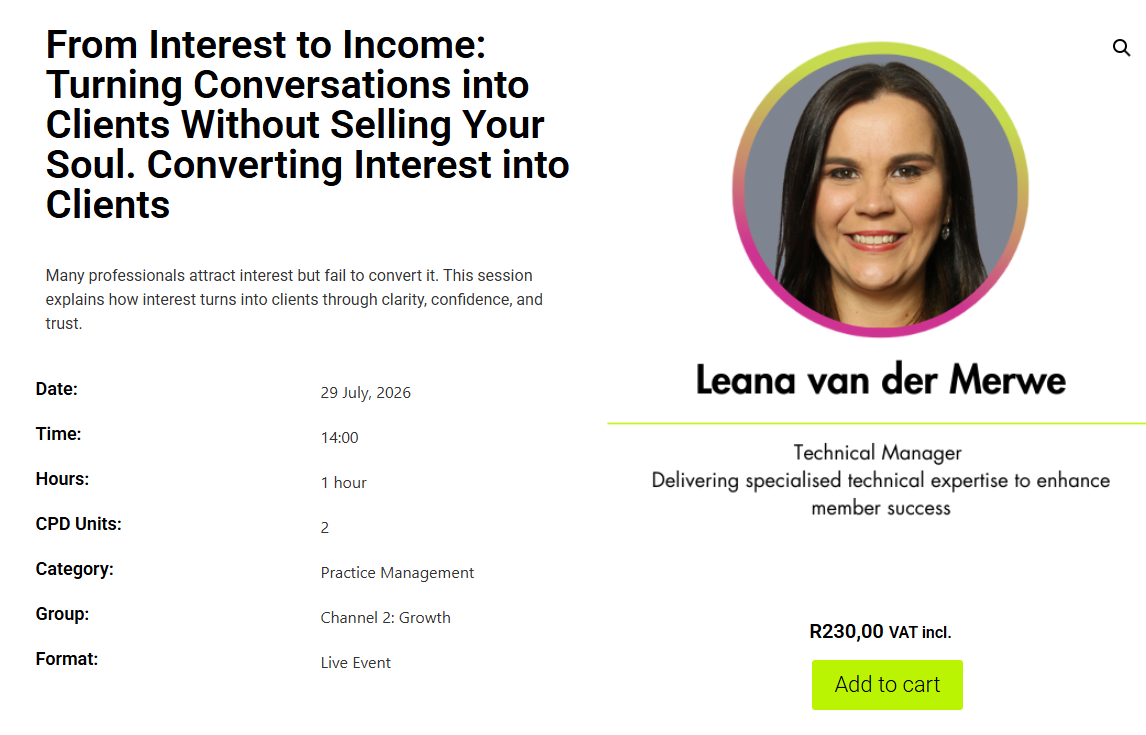
📢 CPD Alert: Stop Losing Potential Clients
Many professionals don't lose clients because they're bad at what they do.
They lose them because conversations end with:
"We'll think about it."
"We'll get back to you."
...and they never do.
The truth is, converting interest into clients isn't about being a salesperson. It's about creating clarity, building trust, and confidently guiding the conversation.
Join me for this practical 1-hour CPD session where we'll unpack:
✅ Why interest doesn't automatically become work
✅ Where client conversations typically stall
✅ How to communicate your value without overselling
✅ Pricing discussions that don't feel awkward
✅ Building trust from the very first interaction
✅ Closing professionally—without feeling pushy
📅 29 July 2026
🕑 14:00
⏱️ 1 Hour | 2 CPD Units
📚 Practice Management | Channel 2: Growth
💻 Live Online
If you've ever wondered why some enquiries become clients while others disappear, this session will give you practical tools you can use immediately.
Because expertise gets attention.
Trust wins clients.


Choose Your Path to Exclusive Insights
Stay ahead in the world of accounting with premium content designed for professionals like you. Access expert articles, industry trends, and essential resources. Become a CIBA member and claim your CPD hours from CIBA.
CIBA Member Access
R250.00 FREE!
100% Discount when you become a CIBA Member. Join now to claim your CPD Hours. Register here: https://accounts.myciba.org/register