Business rescue runs on your numbers: what accountants must have ready
This article will count 0.25 units (15 minutes) of unverifiable CPD. Remember to log these units under your membership profile.
A business rescue practitioner has weeks, not months, to convince creditors that a company can be saved. The figures that make or break that case usually come from the company's accountant.
Once a business rescue practitioner is appointed, the clock is short. Within 10 business days the practitioner must stand before creditors and explain why the company can be saved. Within 25 business days the full rescue plan must be published. Neither is possible without reliable, current financial information, and in most small and medium companies that information sits with the accountant.
So when a managing director asks you to advise the board and support the practitioner they plan to appoint, sending last year's annual financial statements will not be enough. Statements to 28 February are already seven months old by October. For a rescue, they are of little use.
Why practitioners lean on accountants
A good practitioner needs a working knowledge of the Companies Act and tax administration, sound financial analysis and experience of running a business. Few are strong in all three, and the company's accountant fills much of the gap, from accurate, current records to analysis that turns figures into insight.
Take a manufacturer whose statements show a profit while its bank balance keeps falling. Customers take longer to pay, stock moves slowly and the overdraft is funding day-to-day costs. The problem is working capital, not the ability to make a profit, and that distinction changes the whole rescue strategy. Spotting it is accounting work.
Before the company files: six things to have ready
1. Current, realistic management accounts
The practitioner needs management accounts up to the date the company enters business rescue. Adjust them for reality: write off debtors who will never pay and value dead stock at what it will fetch. Inflated assets lead to a plan that cannot work.
Suppose the debtors book stands at R2 million, but R600,000 of it is owed by customers who will never pay. Leave it unadjusted and the plan starts from R600,000 of money that does not exist. Check for unrecorded liabilities too: unpaid suppliers, accrued leave and penalties are easy to miss.
2. An honest first assessment
A practitioner will not take on a company that wants business rescue only to delay liquidation, so expect the case to be tested. Look at the risks outside the financial statements: staff and unions, production bottlenecks, the supply chain, the market, management and compliance. Then look at efficiency (debtor and stock days), break-even and sensitivity, liquidity, solvency and profitability.
Next, apply the legal test. Under section 128 of the Companies Act, a company is financially distressed if it is reasonably unlikely to pay its debts as they fall due in the next six months, or reasonably likely to become insolvent in that time; either one is enough. The solvency and liquidity test in section 4 exists for a different purpose, mainly to decide whether a company may pay dividends, but a company that fails it is clearly in trouble. Scoring models such as the Altman Z-score add a warning signal. No single test settles the question, and an asset-rich business can still lack the cash to pay staff and suppliers.
3. A creditor's view of the balance sheet
Rewrite the balance sheet the way creditors see it. Split the assets into those pledged as security and those that are free. Split the liabilities into secured creditors, statutory preferent creditors such as SARS, and concurrent creditors. The free assets, after secured debts are covered, show the practitioner how much there is to work with. Machinery recorded at R5 million offers little room if it already secures R5 million of bank debt.
4. A map of who holds the debt
Creditors vote on the plan, and each creditor's vote is weighted by the amount the company owes it. The plan passes only with the support of more than 75% of the creditors' voting interests that were voted, including at least half of the independent creditors' votes. In practice, any creditor holding more than a quarter of the votes cast can block it.
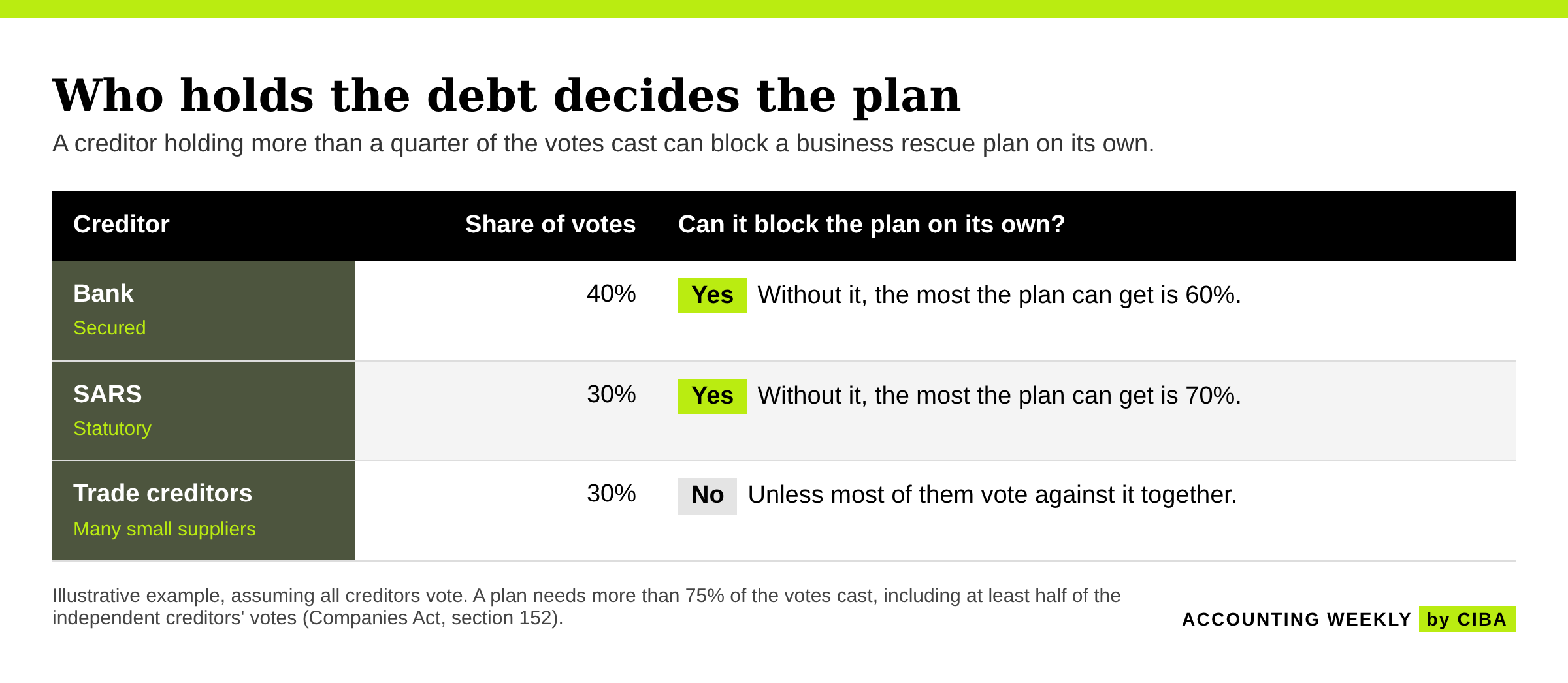
The plan has to work for every creditor who can block it. Banks generally prefer a short repayment period; a plan that pays them over 12 to 24 months is easier to sell than one over four years. SARS will look closely at what it recovers. Knowing this before filing shapes the whole plan.
5. A deal on the table
The practitioner needs a realistic rescue proposal before the process starts: converting debt to equity, bringing in a new investor or selling assets that earn nothing. Negotiating any of these takes weeks and needs current figures. No investor will commit on the strength of old accounts, and assets sold in a hurry during the rescue fetch a fraction of their value.
Test every option against its side effects. Selling a delivery vehicle raises cash, but outsourced deliveries may cost more each month. Cutting staff saves salaries, but may also cut the capacity to earn revenue.
6. Clean SARS compliance
Make sure every tax return is submitted and every audit or dispute is resolved before the company files, where you can. An open tax matter does not prevent business rescue, and the company may still owe SARS money. The aim is a clear, settled tax position. Tax owed before business rescue began ranks as an ordinary unsecured claim (CSARS v Beginsel, 2013). Tax assessed only after rescue begins, even for earlier periods, risks being treated as a post-commencement claim that ranks ahead of other unsecured creditors.
The timetable once the company files
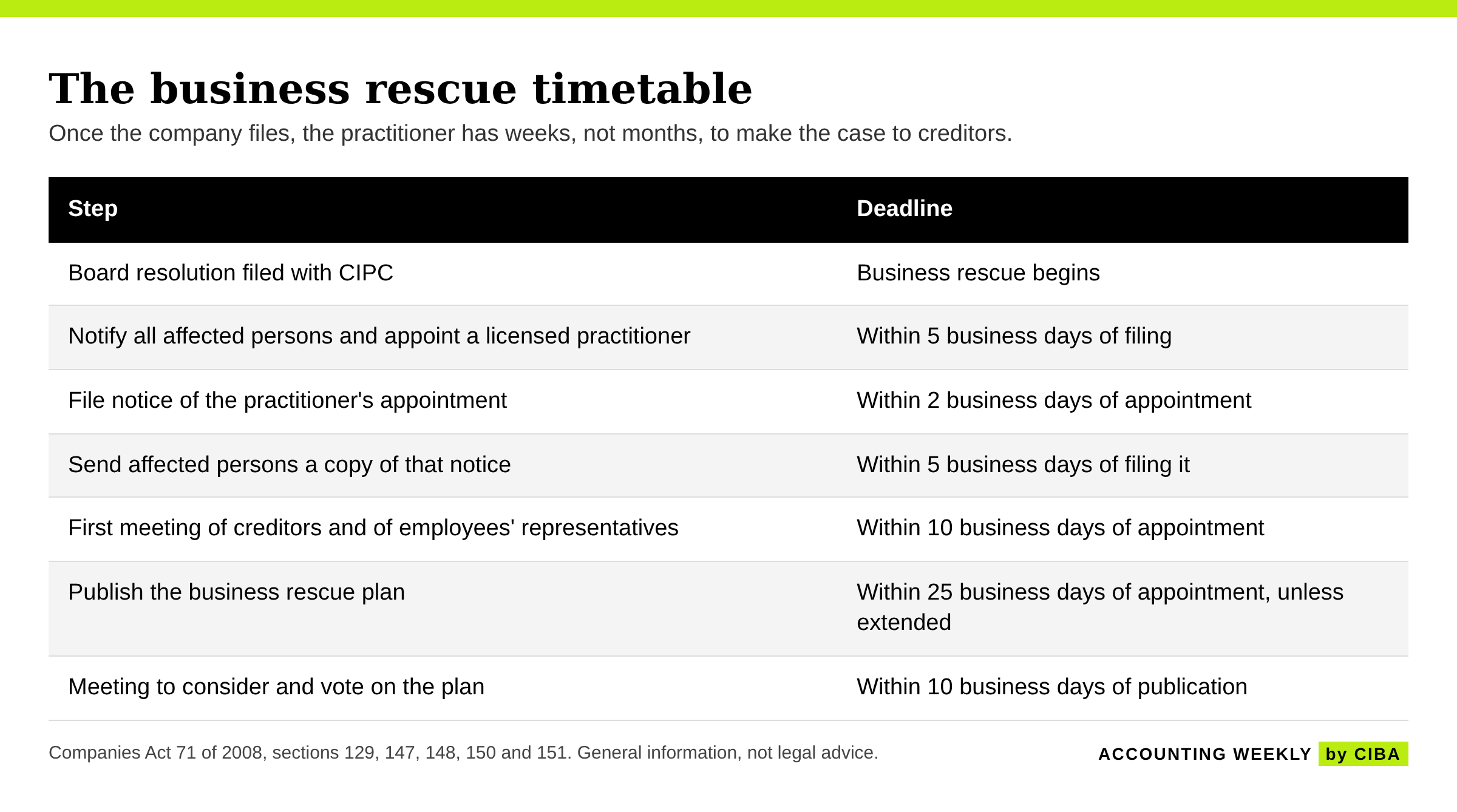
Every step needs proof that notices went to every affected person, so keep a register of each email and notice sent.
What goes into the rescue plan, and where you come in
Section 150 of the Companies Act requires the plan to give affected persons all the information they reasonably need to accept or reject it, in three parts. Much of it is accounting work.
Part A sets out the background: a list of the material assets and which are held as security, a list of creditors classified as secured, statutory preferent or concurrent under insolvency law, the holders of the company's shares, and the probable dividend each class of creditor would receive if the company were liquidated. Use realistic values here, not book values. A machine recorded at R3 million may fetch far less at a liquidation auction, so get an independent valuation where the amount matters. Practitioners often ask a liquidator to estimate the dividend, including liquidator's, auctioneer's and Master's fees and the cost of the liquidation application.
Part B sets out the proposals: any moratorium on payments, how much debt is written off or converted to equity, which property is available to pay creditors, the order of payment and why the plan is better for creditors than liquidation. Payments work best when they follow the business's cash cycle. A farming business, for example, may need to pay creditors from harvest receipts instead of in equal monthly amounts.
Part C sets out the conditions, the effect on employees and a projected balance sheet and income statement for the next three years, with the material assumptions stated. The Act does not require a cash flow projection, but creditors will trust the plan more with one. Any assumption that departs from history needs a reason. If the business has always made a 25% gross margin, a forecast of 40% needs an explanation: better prices, cheaper supply, a different product mix or real efficiency gains. A credible forecast shows how the business will get there, as well as where it expects to end up.
The comparison with liquidation is about more than cents in the rand. Even where creditors would be paid in full either way, liquidation ends the business and its jobs.
After the plan is adopted
The practitioner has full management control of the company in place of the board, and the company must take all the steps needed to carry out the plan. Keep tax, payroll and CIPC compliance current. Make sure creditors are paid exactly as the plan sets out, because missed payments give creditors grounds to go back to court. Produce accurate monthly management accounts so the practitioner can see whether the plan is working.
Keep a simple action log (date, instruction, owner, budget, spending and progress) and compare actual results with the plan every month. If the plan assumed revenue would rise by 15% over six months and it has risen by 3% after three, the practitioner needs to know now, while there is still time to adjust.
Know where your own fees stand
Fees the company owed you before rescue began are ordinary unsecured claims, near the back of the queue. Work the practitioner engages you to do after rescue begins is usually claimed as a cost of the rescue proceedings, which section 135 pays first, alongside the practitioner's own fees. Do not assume every post-commencement fee qualifies. Get every instruction in writing and agree in your engagement letter what you will do, how you will be paid and how your fees will be treated. Payment still depends on the rescue producing the money.
If a client refuses to act on clear evidence of distress, put your assessment in writing. Directors who keep trading recklessly can be held personally liable for the company's debts.
What this means for you
If you work in practice, you are likely to be pulled into a business rescue sooner or later. Accountants who can produce current figures, classify creditors and build credible projections quickly become the practitioner's most useful ally. If you work in commerce, the same preparation lets you support your board from the first day, while there is still time to shape the plan.
Implementation checklist: when a client heads for business rescue
Before filing
☐ Prepare management accounts to the expected filing date.
☐ Write off irrecoverable debtors, revalue dead stock and look for unrecorded liabilities.
☐ Apply the section 128 financial distress test and check liquidity and cash flow.
☐ Rewrite the balance sheet: pledged and free assets; secured, preferent and concurrent creditors.
☐ List creditors by size and work out who can block a plan.
☐ Submit all outstanding tax returns and resolve open SARS audits or disputes.
While the plan is prepared
☐ Agree your scope and fees with the practitioner in writing.
☐ Provide the asset and creditor lists in the form section 150 requires.
☐ Build three-year projections, including cash flow, with every assumption stated.
☐ Support the liquidation comparison with realistic, independently valued assets.
During implementation
☐ Keep tax, payroll and CIPC compliance up to date.
☐ Pay creditors exactly as the plan sets out.
☐ Deliver accurate monthly management accounts and compare results with the plan.
☐ Keep an action log of instructions, owners, budgets and progress.
This article is general information, not legal advice. Clients considering business rescue should consult a licensed business rescue practitioner or an insolvency attorney
For more practical sessions on business rescue please watch the Where Accountants Get Pulled In: The Accountant’s Role in Business Rescue webinar on cpd.myciba