School Financial Statements: What Gets SGBs Into Trouble
This article will count 0.25 units (15 minutes) of unverifiable CPD. Remember to log these units under your membership profile.
A school hands you a file in February. One bank statement, a box of invoices, and minutes where the finance committee approved last year's numbers in a single line. The chairperson wants your signature by Friday.
Sign it as presented and you have not just accepted a client with poor records. You have put your name on a report that can cost a principal part of their salary, get a governing body dissolved, and put your own judgment on the record when the department comes asking who examined this.
There are 23,381 public schools in South Africa. Every one of them needs this work done properly, and very few of the files are ready for it.
A client base of 23,381, and almost none of them can read their own statements
Add another 2,469 independent schools to that number. Every public school runs a financial year from 1 January to 31 December. Every one must produce financial statements. Every one must have those statements examined or audited and submitted within three months of year end.
Now look at who is signing them off.
An SGB is mostly parents. Enthusiastic, committed, and in many cases with no financial training at all. Many of these schools sit in peri-urban and rural areas where the nearest accounting practitioner is the only finance professional for kilometres. In that room, you are not the bookkeeper. You are the only person who knows what Chapter 4 of the Schools Act actually says.
Most practitioners assume this work is closed to them. It is not. Section 43 of the Schools Act allows an SGB to appoint a registered auditor, or an accounting officer qualified under Section 60 of the Close Corporations Act, or a practitioner approved by the provincial MEC. CIBA members in practice are eligible. We set out the full eligibility position in Claim Your Spot as a School Examiner.
So the work is available. The risk is that most school files are not ready for it.
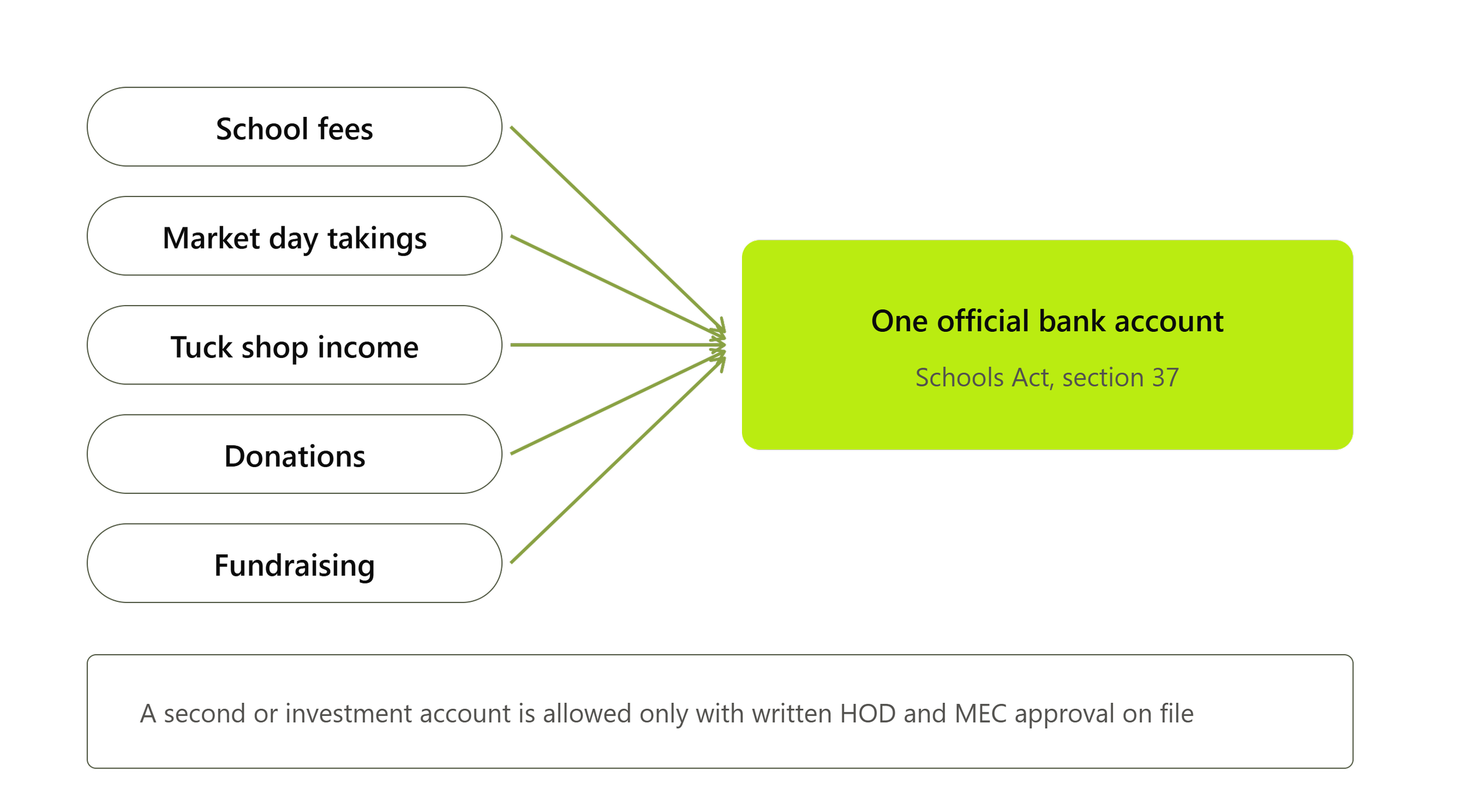
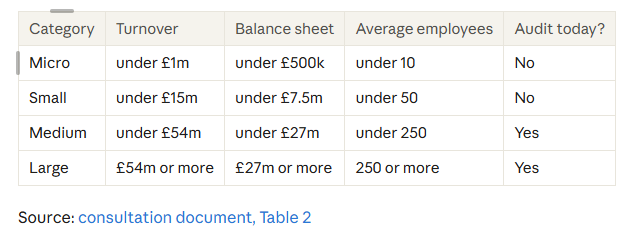
Image 1. The single-account rule
The five failures that make a school report inadequate
1. The second bank account
Section 37 requires the SGB to maintain the school's banking arrangements in accordance with the Act. Additional investment accounts generally require the prescribed approvals and should never be used as unofficial operating accounts. If you are compiling, and you find two accounts, you have to raise it. If you are examining, you raise a finding and qualify the report when appropriate. There is no version of this where you quietly consolidate and move on.
The first illustrative case shows where this ends. School fees collected outside the official account over two years, roughly R420,000. The MEC dissolved the SGB under Section 23. Three members were charged.
A school may open a second account to earn interest. But only with the approval of the provincial head of department and the MEC, in writing, on file. No approval, no second account.
2. No three quotations
A school buys R15,000 of stationery from a supplier it has always used. No competing quotes. The price was fair. The stationery arrived. Everyone is happy.
The full R15,000 is irregular expenditure if 3 quotes are necessary in terms of the provincial policy or circulars.
This is the point practitioners consistently underestimate. Irregular expenditure is not about value for money. It is about whether the process was followed. Goods delivered at a fair price do not cure a procurement breach.
Typical provincial thresholds can be something like this:
Up to R2,000, one verbal or written quotation, recorded with a date and a name.
R2,000 to R10,000, three written quotations.
R10,000 to R500,000, a formal process with SGB approval.
Above R500,000, a full tender through the department.
Check your own province, because these vary.
Then watch for the splitting of orders. A R750,000 order that appears as three payments of R250,000 on three different dates is not clever. It is the easiest thing in the file to find.
3. Three expenditure categories that nobody separates
Most SGBs, and a surprising number of accountants, use these three terms interchangeably. They are three different statutory failures with three different consequences. These PFMA concepts are widely used as governance benchmarks and are reflected in Department of Basic Education guidance.
Unauthorised is spending outside or above the approved budget. The SGB votes R50,000 for maintenance. The principal approves R75,000 of work. The extra R25,000 is unauthorised, even if the work genuinely needed doing.
Irregular is spending in contravention of any law or policy, not only the Schools Act. The missing quotations sit here.
Fruitless and wasteful is spending that bought nothing. A R5,000 venue deposit forfeited when the function was cancelled. A penalty for paying an account late.
None of these are optional disclosures. Each must appear in the statements and be investigated. CIBA breaks the distinctions down properly in Irregular, Unauthorised, Fruitless: Three Different Disasters.
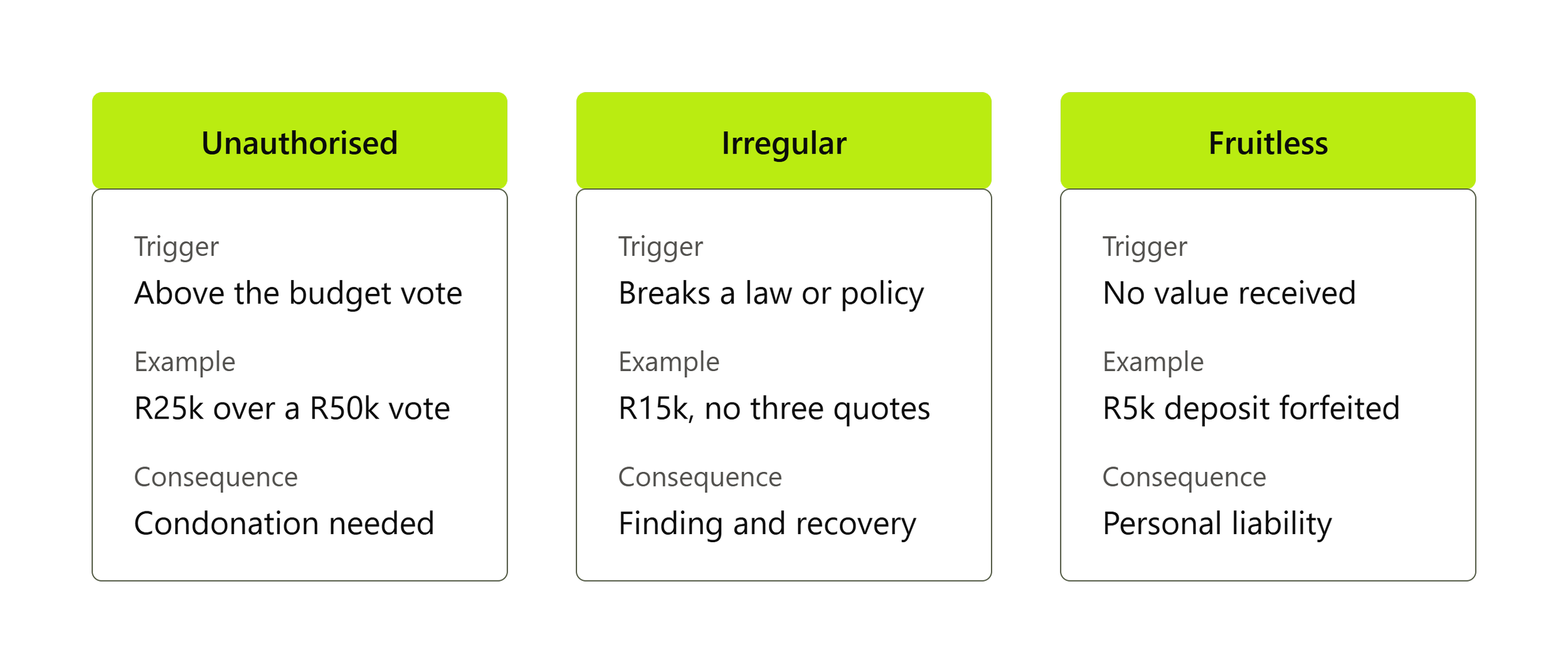
Image 2: Three Different Disasters
4. Statements that arrive late, or never
Three months from 31 December. That is the deadline. Late, incomplete, or absent statements trigger a departmental investigation on their own, without anyone needing to find a rand missing.
A second illustrative case: no financial statements for two consecutive years, the school placed under administration, the principal suspended, and R65,000 of petty cash that nobody could account for.
5. Nobody signed anything
No finance committee minutes approving expenditure. No monthly bank reconciliation signed off. No asset register, and disposals nobody authorised. No delegation register setting out who may approve what amount. No chairperson signature on the annual financial statements.
Every one of those is a control that exists only if it is written down. An unwritten control is not a control. It is a memory.
The consequence ladder
Set out from the mildest outcome to the worst, this is worth showing to any principal who thinks financial reporting is paperwork.
Your name in an audit report, and the reputational damage that follows. A disclaimer that triggers a departmental investigation. Serious misconduct may result in disciplinary action, civil recovery proceedings and, where criminal offences are committed, prosecution under the applicable legislation.
This is not theoretical in South Africa. Irregular expenditure across government amounts to many billions of rand, and the underlying governance failures are often the same. We covered how personal liability actually attaches in Government Said Sign It. The PFMA Says Otherwise.
A school is that same failure in miniature. Smaller numbers, same statute, same personal exposure.
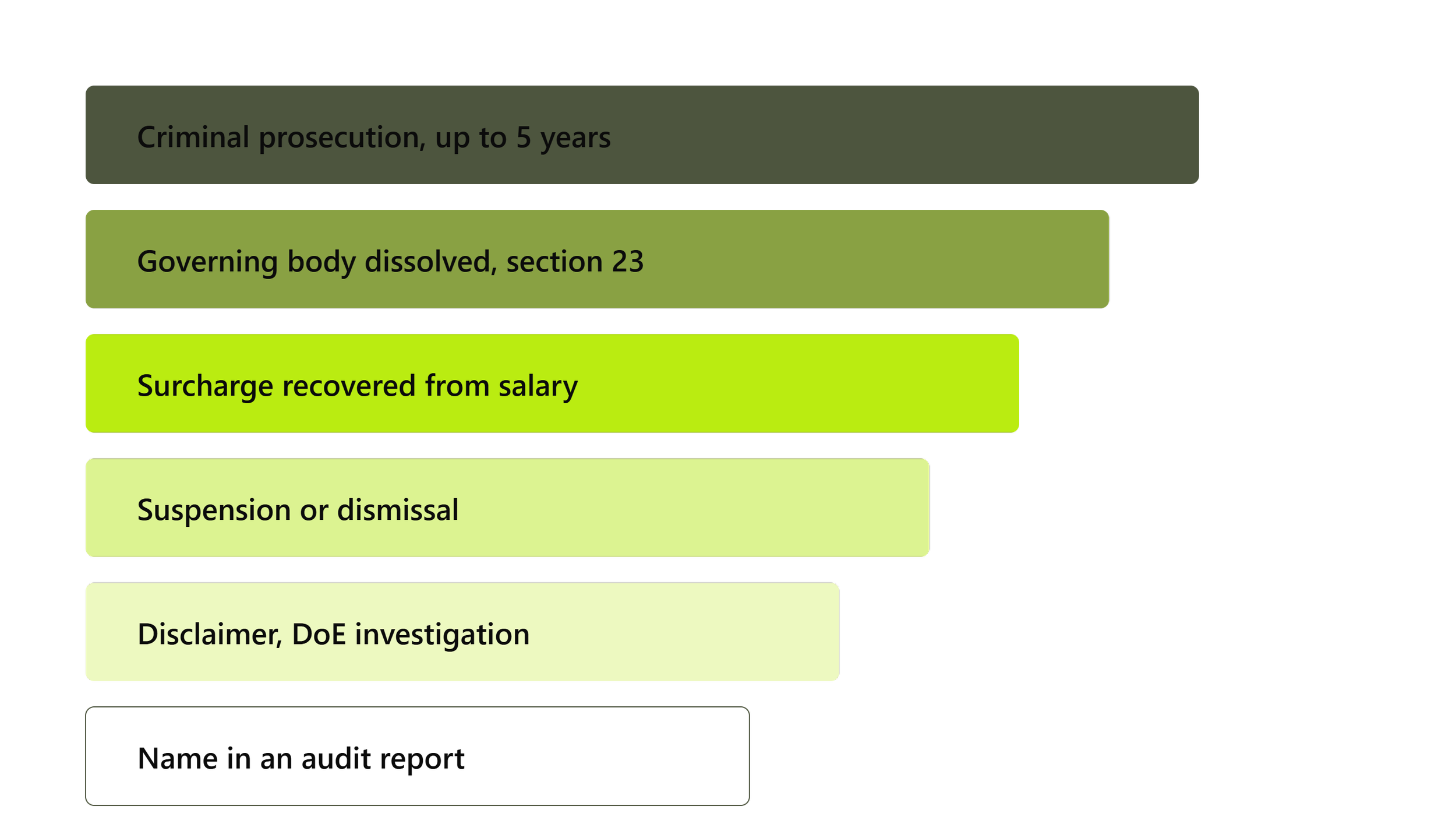
Image 3: The Consequence Ladder
The trick most accountants miss: disclose it
Here is the single piece of advice that will save your clients the most pain. Disclose the mistake.
Fruitless expenditure that is properly disclosed in the notes is a disclosure. The same amount hidden is a qualification, and then an investigation. If the school forfeited a deposit, write it down, put it in the notes, and let the finance committee minute the reason. You have converted a finding into a fact.
Your job is not to make the numbers look clean. It is to make them true, and to make the school's own governance visible in them. The PFMA concepts are widely used as governance benchmarks and are reflected in Department of Basic Education guidance.
Before you sign off on a school file, check these eight things
One bank account. MEC and provincial head of department approval on file for any second or investment account.
Budget approved by the full SGB in writing before 1 January. Not the finance committee. The full body.
A governance calendar for the year, dated and signed, showing budget approval, monthly reporting, AFS submission and the AGM.
A delegation register setting out who may approve what amount, reviewed and signed annually.
Monthly bank reconciliations, signed and dated. In a school collecting large fee volumes in January and July more frequent reconciliations may be appropriate.
Quotations attached to every payment above the applicable threshold, on the file, not promised.
An asset register covering computers, equipment and furniture, with authorised disposals.
Separate disclosure notes for unauthorised, irregular, and fruitless and wasteful expenditure. Even where the amount is nil, say so.
Two documents to read before you touch a school file.
Chapter 4 of the Schools Act, which defines what the governing body may and may not do, and the
Department of Basic Education's Guideline for the Preparation of Financial Statements by Public Schools (May 2022), which sets the modified cash basis of accounting used by public schools and points you to the statement formats.
One more appointment rule worth knowing. If a member of the SGB is an auditor, that person cannot examine the school's statements. A personal relationship with the school disqualifies them. Somebody else does the work, which is exactly why this market has room in it.
Why this is worth your time commercially
School work has three things a small practice rarely gets together. It recurs every single year, on a fixed statutory calendar. It sits in a sector with more than 23,000 potential clients, most of them underserved. And it is work where the professional who documents properly is protected, while the one who does not carries the exposure personally.
There is a wider point too. A school that cannot account for its money loses funding, loses standing, and eventually loses the ability to deliver. Education is where economic capacity is built or lost. Getting a school's financial governance right is not administration. It is the accountant keeping an institution alive.
Watch CIBA’s webinar on School Financial Reports That Get Governing Bodies and Principals Into Trouble and learn more about public schools.

Choose Your Path to Exclusive Insights
Stay ahead in the world of accounting with premium content designed for professionals like you. Access expert articles, industry trends, and essential resources. Become a CIBA member and claim your CPD hours from CIBA.
CIBA Member Access
R250.00 FREE!
100% Discount when you become a CIBA Member. Join now to claim your CPD Hours. Register here: https://accounts.myciba.org/register
Premium
R250.00
Every month

Trending