This article will count 0.25 units (15 minutes) of unverifiable CPD. Remember to log these units under your membership profile.
Your business made a profit. So where is the money?
Imagine telling a business owner that their company made R500,000 profit this year. They smile, open their banking app and find only R40,000 in the account.
Their first question? "Where did all the money go?"
This is a question accountants hear regularly.
The problem is that profit and cash are not the same thing. A business can report a healthy profit while struggling to pay suppliers, salaries or SARS.
Sometimes the reason is stock that costs more to replace. Sometimes it is customers who have not paid, equipment that has lost value or expenses that were not recorded during the year.
Let's look at how these problems happen, what they do to the numbers and, most importantly, what accountants can do about them.
1. Inventory profits: Making money but standing still
Let's say a hardware store buys 100 bags of cement for R100 each.
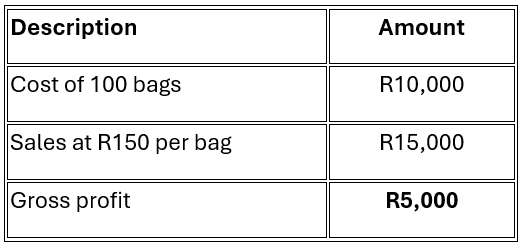
A R5,000 profit looks good.
But there is a problem.
The supplier has increased the price to R130 per bag. Replacing those same 100 bags now costs R13,000.
That means R3,000 of the reported profit is needed simply to replace the stock at today's prices. Only R2,000 remains before other expenses and tax.
This is commonly called inventory profit or stock holding gain.
The R5,000 accounting profit is correct. The problem is that it does not tell the owner how much money can safely be taken out of the business.
What about tax?
Assuming the store operates through a company taxed at 27%, the R5,000 taxable profit would result in R1,350 tax, before considering other deductions or adjustments.
The owner has R2,000 left after replacing the stock, but must still pay R1,350 in tax.
That leaves just R650.
This is why a business can make a profit and still struggle financially.
Under IFRS and IFRS for SMEs, businesses generally use FIFO or weighted average cost for interchangeable inventory. They cannot simply increase the recorded cost of stock to today's replacement price to reduce profit.
What should accountants do?
Show clients two figures every month: their accounting gross profit and what it would cost to replace the stock sold.
This helps owners decide whether they can afford dividends, additional salaries or major purchases.
2. Inventory write-downs: Stock that is no longer worth its cost
Now consider a clothing shop with R80,000 worth of winter jackets.
Winter ends. The jackets are still on the shelves, and customers are no longer interested.
The owner decides to sell them on clearance for R30,000, with no additional selling costs.
The accounting records still show stock worth R80,000, but the business expects to recover only R30,000.
The difference is R50,000.
That R50,000 must be written off against profit.
Inventory must be measured at the lower of cost and net realisable value. In simple terms, stock cannot remain in the accounts at R80,000 when the business realistically expects to recover only R30,000.
The money was spent months ago, but the loss is only being recognised now.
What should accountants do?
Ask clients to review slow-moving stock every month, not only at year-end.
Identify old products, damaged goods and items that are no longer selling. Encourage early discounts rather than waiting until stock becomes worthless.
A small loss identified early is often better than a large surprise at year-end.
3. Bad debts: Sales that never become cash
A business sells R200,000 worth of goods to a customer on credit.
The sales are recorded, revenue increases and the income statement reflects the transaction.
Three months later, the customer has still not paid.
Six months later, the customer closes their business.
The R200,000 is now unlikely to be recovered.
The business may have reported a profit on the sale, but the cash never arrived. An appropriate bad debt allowance or write-off will reduce profit.
Under IFRS 9, expected credit losses must also be considered before customers default. IFRS for SMEs has its own impairment requirements.
What should accountants do?
Review debtors monthly. Separate balances into current, 30 days, 60 days and 90 days overdue.
Ask the client three simple questions:
Who owes us money?
Why have they not paid?
What are we doing to collect it?
The sale is not the same as money in the bank.
4. Asset impairments: When equipment loses its value
A manufacturing company buys a machine for R500,000.
After several years, its carrying value in the accounting records is R300,000.
Then the company loses a major customer. The machine is hardly used, and its recoverable amount is estimated at only R120,000.
The company may need to recognise an impairment loss of R180,000.
That R180,000 reduces accounting profit, even though no cash leaves the bank when the impairment is recorded.
The machine was paid for years ago. The accounting records are now reflecting its reduced value.
What should accountants do?
Review assets when circumstances change, especially after losing contracts, closing departments or replacing equipment.
Do not wait until the auditor asks whether an asset is still worth its recorded value.
5. Other silent killers of profit
Not every surprise comes from stock or equipment. Several everyday accounting items can also affect results.
Provisions: Expenses nobody planned for
Employees have unused leave worth R120,000.
If the company has not recorded the leave obligation during the year, recognising it at year-end could reduce profit by R120,000.
The same principle applies to qualifying warranty obligations and legal claims.
Review these obligations regularly instead of leaving everything until year-end.
Exchange losses: The rand changes the bill
An importer owes a supplier US$10,000.
At R17 to the dollar, the amount is R170,000.
Before payment, the exchange rate moves to R19.
The amount payable is R190,000.
That is an additional R20,000 cost, even though the business purchased exactly the same goods.
Accountants should monitor foreign currency balances and discuss exchange rate risks with clients.
Working capital: Profit trapped in the business
A company makes R300,000 profit.
But during the year:
Inventory increases by R150,000.
Debtors increase by R100,000.
Supplier balances remain unchanged.
That means R250,000 more cash is tied up in stock and customers.
The business may be profitable, but much of its cash is unavailable.
This is why accountants must review cash flow alongside profit.
Deferred tax: A different timing of tax
Accounting rules and tax rules sometimes recognise expenses in different years.
For example, SARS may allow a machine to be deducted for tax purposes faster than it is depreciated in the financial statements.
This can create deferred tax, affecting the reported tax expense without creating an immediate cash payment.
Explain the difference between current tax payable and deferred tax to clients.
6. What accountants should do differently
Clients do not need complicated accounting explanations. They need answers they can use.
Every month, accountants should help clients understand:
Profit versus cash: Why does the bank balance differ from the reported profit?
Stock: What will it cost to replace inventory, and what stock is no longer selling?
Debtors: Which customers are overdue, and how much might never be collected?
Assets: Are the recorded values of equipment and other assets still reasonable?
Tax: Has enough cash been reserved for tax payments?
Cash flow: Can the business meet its obligations over the next three months?
These discussions should happen throughout the year, not only when annual financial statements are prepared.
The bottom line
A profitable business is not automatically a financially healthy business.
Inventory profits can make results look stronger than the cash position suggests. Impairments, bad debts and provisions can reduce reported profit. Exchange rate movements can increase costs, while working capital can absorb cash even when sales are growing.
The accountant's job is not simply to report what happened. It is to help the business owner understand what the numbers mean and what to do next.
Because at the end of the day, a business cannot pay salaries, suppliers or SARS with profit on paper.
It needs cash.


Trending