This article will count 0.25 units (15 minutes) of unverifiable CPD. Remember to log these units under your membership profile.
A business can make a profit and still struggle to pay salaries, rent and suppliers. This often happens when customers take too long to pay, large expenses fall due at the same time, or the business spends money before it receives payment for work already done.
Cash flow forecasting helps business owners avoid these problems. It shows how much money is expected to come into the business, how much needs to be paid out, and what will be left in the bank over the coming weeks or months.
For small and medium businesses, a cash flow forecast is one of the most useful financial planning tools. It does not need to be complicated, and a simple spreadsheet is often enough to get started.
Why a Profitable Business Can Still Run Out of Cash
One of the biggest mistakes business owners make is assuming that a profitable business will always have enough money in the bank.
Consider a business that invoices a customer R200,000 in March. The sale is recorded as income in March, but the customer only pays in May. During March and April, the business still needs to pay salaries, rent, suppliers and other operating expenses.
The business has made the sale, but it cannot use that money until the customer pays.
This is why cash flow forecasting is important. It helps the business owner see whether enough money will be available when payments are due, rather than simply looking at how much profit the business expects to make.
It also gives the business time to act. If the forecast shows that there will not be enough cash to cover expenses in two months, the owner can start collecting outstanding payments, reduce spending or arrange additional funding before the problem becomes serious.
Start With the Money You Have in the Bank
The first step in preparing a cash flow forecast is to establish how much money the business has available today.
Use the actual bank balance and check whether there are any outstanding payments that have not yet gone through the account. These could include supplier payments, debit orders or salaries that have already been processed but have not yet cleared.
Once the opening balance is confirmed, the next step is to estimate the money that will come into the business.
This includes payments from customers, cash sales, deposits received for future work, loan proceeds and any money the owners plan to contribute to the business.
The important part is to record the money in the month when it is expected to reach the bank account.
For example, if a business invoices R100,000 in October but the customer normally takes 60 days to pay, that money should be included in December's forecast, not October's.
Business owners should look at how customers have paid in the past. A customer who regularly pays 30 days late should not suddenly be treated as someone who will pay on time simply because the invoice says payment is due within 30 days.
Make Sure Every Payment Is Included
Once the expected money coming in has been recorded, the business needs to list everything it expects to pay.
Regular expenses are usually easy to identify. These include salaries, rent, electricity, internet, insurance, supplier payments and loan repayments.
The payments that cause problems are often those that do not happen every month.
A business might have an annual insurance premium due in November, an equipment purchase planned for January or a large supplier payment due in February. If these amounts are left out of the forecast, the business may appear to have more cash available than it actually does.
Tax payments also need careful attention.
In South Africa, PAYE, UIF and SDL payments are generally due to SARS by the 7th of the following month, subject to the applicable payment rules. VAT payments depend on the business's VAT category and filing method, while provisional tax payments generally fall at the end of August and February for businesses with a February year-end.
These payments can place considerable pressure on cash flow, especially when they fall in the same month as salaries and large supplier payments.
Business owners should also include money withdrawn for personal use, dividends, bonuses and any planned equipment purchases.
Depreciation should not be included because it is an accounting expense and does not involve money leaving the bank account.
How to Prepare a Simple Cash Flow Forecast
A cash flow forecast does not need expensive software. Most small businesses can prepare one using Excel.
A business that needs to manage its cash carefully can prepare a forecast for the next 13 weeks, with a separate column for each week. This makes it easier to see exactly when money is expected to arrive and when payments need to be made.
For longer-term planning, a 12-month forecast with a column for each month is useful.
Each month starts with an opening bank balance. Expected customer payments and other receipts are added, and all expected payments are deducted. The amount remaining becomes the closing balance for that month and the opening balance for the following month.
Consider the following example of a small business preparing its forecast for January, February and March.
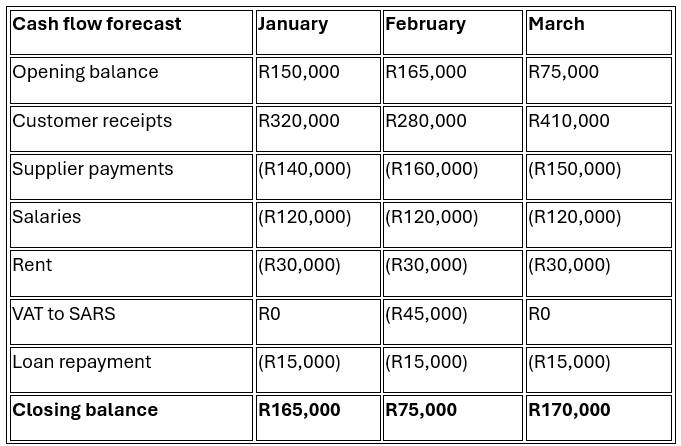
At first glance, the business appears to be doing well. It starts January with R150,000 and ends March with R170,000.
However, February tells a different story.
The business expects to have only R75,000 left at the end of February. If the owner wants to maintain at least R100,000 in the bank to cover unexpected expenses, February presents a problem.
Without a forecast, the owner might only discover the shortage when payments start falling due.
With a forecast, the problem is visible in January. The owner can contact customers with outstanding invoices, negotiate payment arrangements with suppliers or delay purchases that are not urgent.
The forecast gives the business time to make decisions before cash becomes a problem.
What to Do When the Forecast Shows a Cash Shortage
A forecast is only useful if the business acts on the information.
If the forecast shows that there will not be enough money to cover expenses, the first place to look is outstanding customer payments.
Business owners should review their debtors' age analysis to identify overdue accounts. Customers with large outstanding balances should be contacted, and payment dates should be confirmed.
Invoices should also be issued as soon as work is completed. Waiting until the end of the month to invoice for work completed earlier delays the date on which the business can expect payment.
For larger projects, asking customers to pay a deposit before work begins can reduce the amount of money the business needs to fund upfront.
The business should also review its planned spending. A new vehicle, additional equipment or a large stock purchase might be necessary, but the forecast can help determine whether the business can afford it now or whether it would be better to wait.
Supplier payment terms can sometimes be renegotiated to spread payments over a longer period.
If the business needs additional finance, the forecast can help support an application for an overdraft or short-term credit facility. It is generally better to discuss funding with the bank before the business runs out of money.
Do Not Assume Customers Will Always Pay on Time
A common problem with cash flow forecasts is that they are too optimistic.
Business owners often prepare forecasts based on when they hope customers will pay rather than when those customers normally pay.
If a customer regularly takes 60 days to settle an invoice, forecasting payment after 30 days will make the business's cash position look better than it is likely to be.
The same applies to expected sales. A business might anticipate a large order next month, but until that order is confirmed, relying on the expected payment to cover salaries or rent can be risky.
A practical approach is to prepare a forecast using realistic payment dates and then consider what would happen if some customers paid later than expected.
For example, if the business's largest customer pays R150,000 a month, the owner should calculate what would happen if that payment arrived 30 days late.
Would the business still have enough money to pay salaries and suppliers?
If the answer is no, the business needs to plan how it would manage that situation.
Update the Forecast Regularly
A cash flow forecast should not be prepared once and then forgotten.
Actual payments will rarely happen exactly as expected. Customers may pay earlier or later, supplier costs may change, and unexpected expenses may arise.
For this reason, businesses should compare their forecast with what actually happened.
If the forecast showed customer receipts of R300,000 for September but only R240,000 was received, the owner needs to understand why.
Were customers late in paying? Were sales lower than expected? Were invoices issued later than planned?
The answers should be used to improve the next forecast.
For businesses experiencing cash pressure, reviewing the forecast every week is a good practice. Businesses with more stable cash flow may find that a monthly review is sufficient.
Each time the forecast is updated, another week or month should be added so that the business continues planning ahead.
The Accountant's Role in Cash Flow Planning
Accountants can play an important role in helping business owners understand and manage their cash flow.
Many small business owners focus on their bank balance and monthly sales figures. They may not have the time or financial knowledge to assess how outstanding debtors, upcoming tax payments and planned purchases will affect the business over the next few months.
An accountant can help prepare a realistic forecast using information from the accounting records, bank statements, debtors' age analysis and supplier accounts.
The accountant can also identify months when the business is likely to experience cash pressure and discuss possible solutions with the owner.
For example, an accountant might notice that a large VAT payment and annual insurance premium are both due in the same month. By identifying this early, the accountant can help the owner plan for those payments rather than being surprised when they become due.
Cash flow forecasting also creates an opportunity for accountants to provide regular financial advice instead of only preparing financial statements and tax returns after the financial period has ended.
Make Cash Flow Forecasting Part of Running the Business
Cash flow forecasting should be part of the normal financial management of every small and medium business.
It does not have to be complicated. A spreadsheet showing the opening bank balance, expected customer payments, planned expenses and closing balance can provide valuable information.
The most important thing is to use realistic figures, include all expected payments and update the forecast regularly.
A business owner who knows that cash will be tight in six weeks has time to make a plan. An owner who only discovers the problem when salaries or suppliers need to be paid has far fewer options.
A cash flow forecast will not put more money into the bank, but it will help the business owner make better decisions about the money that is available.

Trending