Agreed-Upon Procedures: When You Need the Facts, Not an Audit
This article will count 0.25 units (15 minutes) of unverifiable CPD. Remember to log these units under your membership profile.
Accountants are often asked to “check” or “confirm” something.
A client may need an accountant to confirm information used for a B-BBEE affidavit. A funder may want to know whether grant money was spent on the right items. A bank may want a financial ratio recalculated. A landlord may want a tenant’s turnover checked because the rental is based on sales.
In situations like these, the client may not need a full audit or independent review. They may simply need an accountant to perform specific procedures and report exactly what was found.
This is where an agreed-upon procedures engagement, usually shortened to AUP, can be useful.
What is an AUP?
An AUP is an engagement where the accountant and the client agree beforehand on exactly what procedures the accountant will perform.
The accountant then performs those procedures and reports the factual findings.
The important point is that the accountant does not give an audit opinion or an assurance conclusion.
Think about it this way.
If you go to a doctor for a full medical examination, you expect the doctor to perform different tests and then give you a professional view on your overall health.
That is similar to an audit. The auditor performs the work considered necessary and then gives an opinion.
An AUP is different.
Imagine asking the doctor to do only three things:
Take your blood pressure.
Check your weight.
Measure your blood sugar.
The doctor performs those three procedures and writes down the results. The doctor does not give an overall opinion on whether you are healthy.
That is much closer to an AUP.
The accountant is basically saying:
“You asked me to perform these specific procedures. I performed them. Here is what I found.”
The person using the report then decides what those findings mean.
A practical example
Suppose a non-profit organisation receives R500,000 from a donor to run a training programme.
The donor does not require the organisation’s entire financial statements to be audited. Instead, the donor wants to know whether its R500,000 was spent on the agreed items.
The donor and the organisation could agree with an accountant that the accountant will:
Select 30 expenses charged to the project.
Compare each expense to an invoice.
Compare the invoice amount to the accounting records.
Check whether the expense falls within an approved budget category.
Compare the payment to the organisation’s bank statement.
The accountant performs those procedures.
The AUP report could then state:
Procedure: We selected 30 expenses recorded against the project and compared the amounts to the supporting invoices.
Finding: For 28 of the 30 expenses, the amount recorded agreed to the invoice. For two expenses, there were differences. An expense recorded as R4,500 had a supporting invoice for R4,050, while an expense recorded as R7,200 had a supporting invoice for R6,900.
Notice what the accountant did not say.
The accountant did not say that the project expenses were “fairly stated”. The accountant also did not conclude that all the grant money had been used correctly.
The accountant simply reported what was done and what was found.
That distinction is at the heart of an AUP.
Which standard applies?
AUP engagements are governed by ISRS 4400 (Revised), Agreed-Upon Procedures Engagements.
ISRS stands for International Standard on Related Services.
The standard was issued by the International Auditing and Assurance Standards Board (IAASB). The revised version applies to AUP engagements where the terms were agreed on or after 1 January 2022.
The words “related services” are important because an AUP is not an assurance engagement.
It is therefore different from an audit or a review.
In an audit, the auditor provides reasonable assurance and expresses an opinion.
In a review, the practitioner provides limited assurance and expresses a conclusion.
In an AUP, the practitioner provides no assurance. The report simply contains the procedures performed and the factual findings.
The procedures must be clear
One of the most important parts of an AUP happens before the accountant starts working.
The procedures need to be specific.
For example, saying:
“Check the company’s debtors.”
is too vague.
What does “check” mean? Does the accountant need to check every debtor? Confirm balances? Look at payments received after year-end? Inspect invoices?
A better procedure would be:
“Select the 20 largest debtor balances at 31 December 2026 and compare each balance to the amount recorded in the debtor’s account in the sales ledger.”
Now everyone understands exactly what the accountant is going to do.
This is also important because it manages the client’s expectations.
The client cannot later assume that the accountant tested every debtor when the agreed procedure only covered the 20 largest balances.
Words such as “review”, “verify” and “check” should therefore be used carefully. It is better to describe exactly what the accountant will do.
The findings must be factual
The findings in an AUP report must also be objective and factual.
For example:
“Three of the 25 payments selected did not contain evidence of approval.”
That is a factual finding.
Compare that with:
“The company’s payment controls are weak.”
That is different. The accountant is now making a judgement and giving a conclusion about the controls.
In an AUP, the accountant should report what was found rather than tell the reader what conclusion to reach.
The users of the report consider the findings and draw their own conclusions.
Professional judgement still matters
An AUP involves agreed procedures, but this does not mean the accountant simply follows a checklist without thinking.
Professional judgement is still important.
Before accepting the engagement, the accountant needs to consider whether the procedures are suitable and whether they can produce factual findings.
Professional and ethical responsibilities also continue to apply during the engagement.
For example, suppose the accountant is testing 20 supplier payments and notices that several payments were made to the personal bank account of an employee.
That is clearly something that may require further consideration.
An accountant cannot simply ignore important information because it was not one of the original items on the checklist.
The scope of an AUP may be narrow, but professional judgement and ethical responsibilities still matter.
Does the accountant have to be independent?
Independence is not automatically required for every AUP engagement.
However, the accountant must consider the ethical requirements that apply and the requirements of ISRS 4400 (Revised).
There may also be another requirement that specifically says the person performing the work must be independent.
For example, a funder, bank, regulator, contract or other party may require an independent practitioner.
If independence is required, the accountant must comply with that requirement.
This is why it is important to read the original request, contract or regulation before accepting the engagement.
AUPs are not only about financial information
AUP engagements are not limited to financial information.
They can also cover non-financial information where the procedures can be performed objectively.
For example, an accountant could perform agreed procedures relating to:
Employee numbers.
Training attendance.
Production quantities.
Stock quantities.
Delivery records.
Project milestones.
Environmental information.
Suppose a business receives funding on condition that it trains 500 people.
An agreed procedure could require the accountant to inspect the attendance records and count the number of unique participants.
If the records contain 472 unique participants, the accountant reports 472.
The accountant does not need to conclude whether the training programme was successful. The accountant simply reports the factual result.
A practical South African example: B-BBEE affidavits
One area where accountants may come across this type of work in South Africa is when confirming information relating to a client’s B-BBEE affidavit.
A client may approach their accountant because certain information used for the affidavit needs to be confirmed.
For example, the accountant may be asked to confirm the client’s annual turnover by agreeing the amount to the accounting records or annual financial statements.
This is a good example of where an AUP approach can be useful.
Suppose a client states that its annual turnover for purposes of its B-BBEE affidavit is R7,850,000.
The agreed procedure could be:
Procedure: Agree the annual turnover stated by the client for purposes of its B-BBEE affidavit to the turnover reflected in the client’s annual financial statements for the same financial period.
The finding could then be:
Finding: The annual turnover stated for purposes of the B-BBEE affidavit was R7,850,000. This agreed to the turnover of R7,850,000 reflected in the annual financial statements for the year ended 28 February 2026.
Again, look carefully at what the accountant is doing.
The accountant is not issuing a B-BBEE certificate and is not giving an audit opinion on the client’s B-BBEE status.
The accountant is performing a specific procedure and reporting the factual result.
Before accepting this type of engagement, however, the accountant should always check the exact B-BBEE requirement involved and understand who is requesting the confirmation and what they require. Do not assume that an AUP is automatically appropriate simply because someone has asked an accountant to “confirm” information.
Where else are AUPs commonly used?
There are many other situations where an AUP can be useful.
Grant and donor funding is a common example. A funder may want certain expenses traced to invoices, bank payments and approved budgets.
Loan agreements are another example. A bank may ask an accountant to recalculate a particular financial ratio used in a loan covenant.
Turnover-based rentals can also involve AUPs. If a tenant pays rent based partly on turnover, the landlord may request specific procedures over the sales figure.
Franchise and royalty arrangements may require sales figures to be tested because the franchise fee or royalty is calculated using those figures.
An AUP may also be useful when someone is considering buying a business. Instead of requesting another full audit, the buyer may want specific procedures performed on debtors, stock or certain contracts.
Management and boards can also use AUPs internally.
For example, a board may ask an outside accountant to select 50 employee expense claims and report whether each claim had supporting documents and the required approval.
The common feature in all these examples is that there is a specific question that can be answered by performing specific procedures.
When is an AUP the wrong tool?
An AUP is useful, but it is not a cheaper substitute for every other engagement.
If legislation requires an audit or an independent review, an AUP cannot simply be used instead.
An AUP is also the wrong engagement when the client actually wants an overall opinion.
For example, a client may say:
“We don’t want an audit. Just do an AUP and tell us whether our financial statements are correct.”
That does not work.
The client is asking the accountant to reach an overall conclusion on the financial statements. That goes beyond simply reporting factual findings.
The accountant must first understand what the client actually needs and then decide which type of engagement is appropriate.
Audit, review, AUP or compilation?
A simple comparison helps to show the difference:
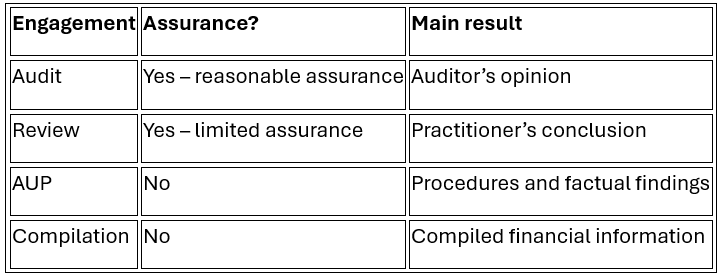
The important point is that performing procedures does not automatically mean the accountant has provided assurance.
With an AUP, the accountant performs the procedures that were agreed and reports the findings. The users decide what those findings mean.
A South African perspective
In South Africa, it is particularly important to understand that an AUP is different from an audit.
An AUP itself is not an audit, and accountants should not use audit language in an AUP report that could make a client or another reader believe that assurance has been provided.
It is also important to check the source of the requirement.
A client may say, “The bank wants my accountant to sign this,” or “The funder wants this confirmed.”
That does not necessarily tell the accountant what type of engagement is required.
Ask for the actual document.
Read the funding agreement, bank requirement, B-BBEE requirement, contract, tender document or regulation.
Check exactly what must be done and who is allowed to do it.
Some requirements may specifically call for a registered auditor, an independent practitioner or another particular type of professional.
The correct engagement should be determined from the actual requirement, not simply from what the client calls it.
The bottom line
Agreed-upon procedures can be extremely useful because they allow accountants to perform focused and practical work without turning every request for confirmation into a full audit.
But the purpose of the engagement must be clear.
The accountant and the engaging party agree on the procedures.
The accountant performs those procedures.
The accountant reports exactly what was found.
There is no audit opinion and no assurance conclusion.
For accountants, the key is to make sure the procedures are specific, the findings are factual and the report does not accidentally suggest that assurance has been provided.
This can apply to anything from grant expenditure and loan covenants to expense claims and the confirmation of information relating to a B-BBEE affidavit.
So, the next time a client asks you to “just check this and confirm it”, the first question should not be, “How much work will this take?”
The first question should be:
“What exactly do you need me to confirm, and what will you use my report for?”
The answer may tell you that an agreed-upon procedures engagement is exactly what is needed.


Trending