This article will count 0.25 units (15 minutes) of unverifiable CPD. Remember to log these units under your membership profile.
One client earns millions, another earns almost nothing. Both are in the audit queue. The client sitting comfortably in the middle sails straight through. That is the picture coming out of new US data, and it should look familiar to anyone who has ever explained a SARS verification letter to a confused client.
What the data shows
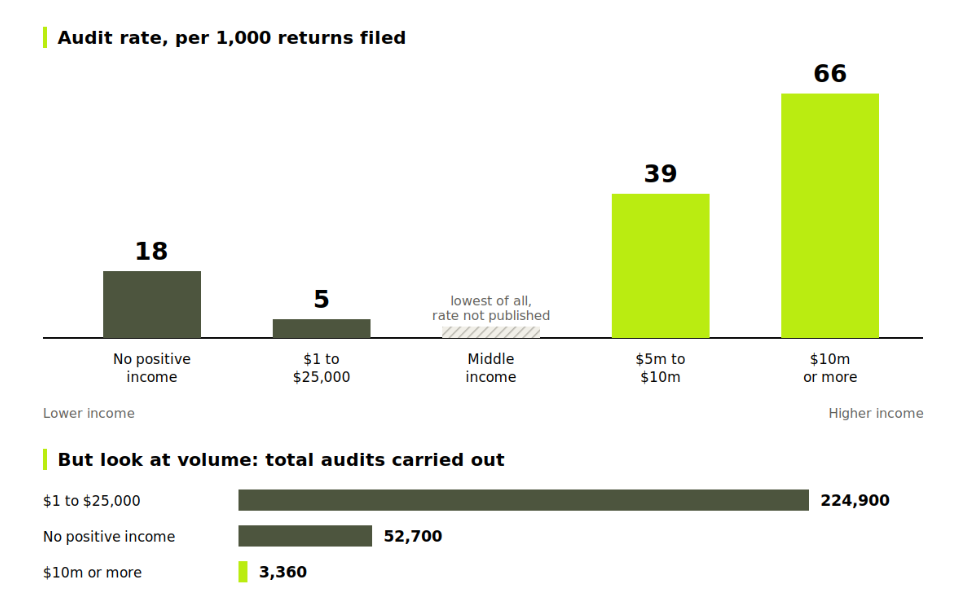
Tax law firm J. David Tax Law analysed Internal Revenue Service (IRS) audit data and found that audits cluster at both ends of the income scale. Taxpayers earning $10 million or more were audited at 66 returns per 1,000, the highest rate of any group. Those earning $5 million to $10 million came in second at 39 per 1,000. Third on the list, sitting at the opposite end of the income scale, were taxpayers with no positive income at all, audited at 18 per 1,000. Middle income earners were the least likely group to be audited.
The reason the bottom of the scale is so heavily represented is largely mechanical. The IRS examines a bigger share of returns claiming the Earned Income Tax Credit, partly because Congress requires it and partly because those returns carry higher error rates.
Rates, though, are not volumes. Audits of taxpayers earning $10 million or more came to roughly 3,360 cases out of 51,250 returns filed. Taxpayers with no positive income filed 2.93 million returns and generated around 52,700 audits. Those earning between $1 and $25,000 filed 44.98 million returns and picked up almost 225,000 audits.
So the wealthy carry the highest risk per return. Low income taxpayers absorb the highest number of actual audits.
Location mattered too, though less dramatically. Nine of the ten states with the highest audit exposure were in the Southeast or Southwest, led by New Mexico, Louisiana and Mississippi. J. David Tax Law CEO Jonathan Sooriash said audit risk is driven by more than income, pointing to where a return is filed, the deductions claimed, and regional enforcement priorities.
Why this matters
SARS runs on the same logic: risk rules, third party data, and error rates decide who gets stopped. That is why ordinary salaried clients keep landing in verification queues over medical aid contributions and bank details, while refunds sit for 21 days or longer. CIBA has already put a number on that cost in The Hidden Cost of SARS Verifications.
The lesson from the US data is simple. Audit selection is not a judgement about wealth or honesty. It is a judgement about data quality. Returns with mismatched or thin supporting information get pulled, whatever the income level.
What to do this week
Pull your client list check third party data first: employer certificates, medical aid statements, retirement fund contributions, banking details. Then check the claims that carry the highest error rates in your own practice, usually travel, home office and rental deductions.
Fix the mismatches before filing, not after the letter arrives. The 2026 filing season changes include a Declaration Alert Questionnaire designed to keep clients out of verification queues, so use it. Then bill for it. A pre-filing data review is advisory work, and it is a lot cheaper for your client than six hours of document hunting after the fact.
👉 Join CIBA and we'll show you how to turn verification risk into billable advisory work.
Article Source: Accounting Today, Daniel Hood, "IRS audits hit the richest and the poorest"