This article will count 0.25 units (15 minutes) of unverifiable CPD. Remember to log these units under your membership profile.
In many close corporations, the appointment of an Accounting Officer is treated as a routine compliance step. A form is completed, a letter is signed, and the requirement is filed away for another year. But for the Chartered Business Accountant in Practice, this role represents something far more powerful. It is a position of trust, a statutory responsibility, and a meaningful opportunity to strengthen governance in the small business sector.
When approached correctly, the Accounting Officer function moves beyond compliance and becomes a strategic service offering that reinforces your professional standing.
The Legal Requirement Every Close Corporation Must Meet
Section 15 of the Close Corporations Act requires every close corporation to appoint an Accounting Officer who meets prescribed professional criteria. This is not optional. It is a legal requirement that supports financial transparency and accountability within the entity.
The Companies and Intellectual Property Commission has provided clear procedural guidance on how the appointment must be made. For a valid CK2A appointment, the following must be submitted:
A completed CK2A form signed by or on behalf of every member
A Power of Attorney if signed on behalf of members
A consent letter from the Accounting Officer accepting the appointment, including the practice number and professional body
The consent letter must be dated not older than three months
Certified ID or passport copies of members not older than three months
Certified ID copy of the applicant or customer code owner not older than three months
All applications must be submitted via email to manualck2@cipc.co.za.
Many clients are unaware of these technical requirements. As a CBAP, guiding them through this process immediately positions you as a professional who understands both the law and the practical realities of compliance.
Who May Act as an Accounting Officer
An Accounting Officer must be a member in good standing of a recognised professional body. CIBA members who meet the required criteria are eligible to perform this function.
However, eligibility is only the starting point. Acting as Accounting Officer requires professional judgement, objectivity, and a clear understanding of statutory duties.
What the Accounting Officer Actually Does
There is often confusion about the scope of the Accounting Officer role. It is not an audit, and it is not simply a compilation of financial statements.
The Accounting Officer must:
Determine whether the annual financial statements are in agreement with the accounting records
Confirm that appropriate accounting policies have been applied consistently
Consider whether the financial statements fairly present the financial position of the corporation
Identify any apparent contraventions of the Close Corporations Act
Report material matters to members where necessary
The role requires active engagement with the records and the exercise of professional scepticism. It is not a passive sign off.
For many small owner managed close corporations, the Accounting Officer may be the only independent financial oversight in place. That responsibility should never be underestimated.
Risk Awareness for the CBAP
Professional opportunity always comes with professional risk. CBAPs must approach the Accounting Officer function with discipline and structure.
Independence is critical. If you are heavily involved in preparing the accounting records, you must carefully consider whether you can perform the Accounting Officer duties objectively.
Documentation is essential. Although the Act does not prescribe detailed working paper standards, your conclusions must be defensible. Properly documented review procedures protect both you and your client.
Client expectations must be managed. Some members believe the Accounting Officer guarantees the business is financially sound. Clear engagement letters and upfront communication prevent misunderstandings.
A Structured Approach That Protects Your Practice
To perform the Accounting Officer function confidently and professionally, implement a consistent process:
First, perform client acceptance procedures. Ensure you are independent and that the quality of records allows you to fulfil your duties properly.
Second, issue a clear engagement letter defining scope, responsibilities, and limitations.
Third, perform structured review procedures. Reconcile key balances. Perform analytical review. Assess consistency of accounting policies. Consider compliance with statutory requirements.
Fourth, prepare a properly drafted Accounting Officer report addressed to members.
Fifth, guide the client through the CIPC submission process and confirm that documentation meets the prescribed requirements before submission to manualck2@cipc.co.za.
A structured approach reduces risk and elevates service quality.
Turning Compliance Into Strategic Value
The Accounting Officer function should not be priced or positioned as a signature exercise. It is a governance service.
Each annual review creates an opportunity to discuss:
Cash flow sustainability
Profitability trends
Internal control weaknesses
Member disputes
Compliance exposure
Tax risks
When positioned correctly, the Accounting Officer engagement becomes part of an ongoing advisory relationship rather than a once off compliance event.
Ethical Leadership in Practice
As a Chartered Business Accountant in Practice, your work is grounded in integrity, objectivity, professional competence, confidentiality, and professional behavior.
The Accounting Officer role tests all of these principles. When irregularities arise, professional judgement is required. When records are inadequate, difficult conversations must be held. When independence is threatened, boundaries must be enforced.
This is where professionalism becomes visible.
A Professional Standard Worth Elevating
Close corporations may no longer be the default entity of choice, but thousands remain active in South Africa. Each one requires an Accounting Officer.
For the CBAP, this is more than a statutory obligation. It is a recurring revenue stream, a governance safeguard for small businesses, and a platform to demonstrate professional excellence.
The real question is not whether you can sign the CK2A form.
The real question is whether you are using the Accounting Officer role to strengthen your client relationships, protect your practice, and elevate the standard of financial reporting in the SME sector.
When approached with structure, integrity, and confidence, the Accounting Officer function becomes exactly what it should be. Not just compliance. Professional leadership.
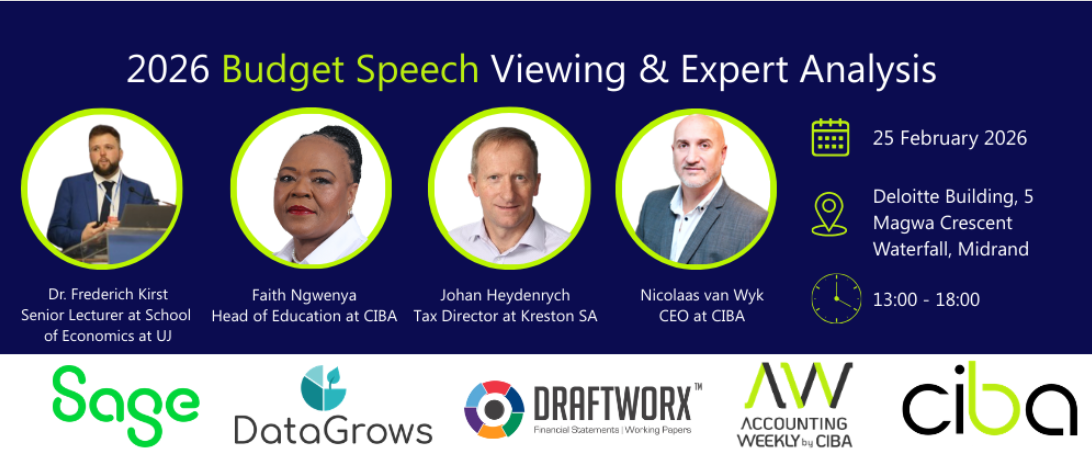
South Africa’s 2026 National Budget Speech will set the tone for the country’s economic direction, tax landscape, and fiscal priorities. With potential tax increases and key policy shifts on the horizon, finance professionals cannot afford to simply watch the speech, you need to interpret it.
That’s why CIBA is hosting a live Budget Speech Viewing & Expert Analysis Event designed to unpack the announcements as they happen. Join us in Midrand for an afternoon of insight, analysis, and meaningful professional connection.
🎙️ Our expert panel includes:
Johan Heydenrych, Tax Director at Kreston SA
Dr. Frederich Kirst -Senior Lecturer at School of Economics at UJ
Together, they will translate policy into practical takeaways for your clients, your advisory role, and your strategic planning.
🍸 After the session, enjoy a cocktail networking event to engage with peers and discuss the road ahead for South Africa’s economy.
📅 Date: Tuesday, 25 February 2026
📍 Venue: Deloitte Building, Johannesburg. 5 Magwa Cres, Midrand
⏰ Time: 13:00 – 16:00 (Networking 16:00 – 17:30)
💼 CPD: 3 Units (Taxation)
💰 In-person ticket: R350
💻 Prefer online? Book the virtual option for R250.
Why attend?
✔ Understand real-time tax implications from top experts
✔ Gain clarity on anticipated tax changes
✔ Learn how fiscal decisions will affect SMEs, compliance, and advisory
✔ Strengthen your strategic insights for 2026
✔ Connect with other finance professionals and leaders
➡️ Secure your seat for the in-person event here