When Culture Speaks Louder Than Strategy
This article will count 0.25 units (15 minutes) of unverifiable CPD. Remember to log these units under your membership profile.
Why performance, risk and trust are shaped long before the numbers reflect it
Corporate culture is often discussed as a “people issue”, something linked to morale, engagement, or internal climate. For finance leaders and executives, this framing is misleading.
In practice, corporate culture is a material business risk. It influences decision quality, information integrity, risk escalation, compliance effectiveness, and ultimately the sustainability of earnings. Long before culture becomes visible in financial results, it is already shaping behaviour across the organisation.
Culture is not what is written in policies or articulated in values statements. It is the pattern of behaviour that is reinforced over time. It reflects what leadership rewards, what it tolerates, and what it quietly allows to continue.
When pressure is high, targets are tight, or trade-offs arise, culture determines how decisions are made often more decisively than formal governance structures.
How culture forms beneath formal controls
Most organisations do not deliberately design a poor culture. Instead, culture develops incrementally through repeated decisions under pressure.
Temporary exceptions become precedents. Informal norms begin to override formal rules. Over time, these precedents evolve into “how things are done here”.
For executives, this often appears in subtle ways: delayed escalation of issues to protect delivery timelines, softened risk reporting to avoid friction, or acceptance of workarounds because “the business needs to move”.
For smaller firms, the same dynamic emerges through deferred documentation, compressed review processes, or blurred lines between commercial urgency and compliance discipline.
In both cases, culture forms not through intention, but through repetition.
When strong performance becomes a blind spot
One of the most dangerous periods for cultural erosion is sustained success. Strong results can suppress challenge. Confidence may be rewarded over accuracy. Pressure becomes normalised. Over time, success narratives discourage scrutiny, creating environments where questioning is perceived as unnecessary or disruptive.
This is why high performance should not be confused with healthy culture.
Many of the most damaging corporate failures did not arise from weak strategy or poor technical capability. They emerged from cultures that discouraged challenge when things appeared to be working.
For finance leaders, this presents a critical insight: culture often deteriorates during periods of growth and not decline.
Leadership signals matter more than statements
Culture is shaped far less by what leaders say and far more by what they prioritise when trade-offs arise.
Executives and senior managers influence culture through:
how they respond to bad news,
whether challenge is welcomed or resisted,
how consistently consequences are applied,
and what behaviour is excused in the name of performance.
Silence is itself a cultural signal. Inconsistency erodes credibility faster than poor communication. Culture reveals itself most clearly under pressure.
For CFOs and finance leaders, credibility depends not only on technical competence, but on the consistency between stated expectations and observed behaviour.
Ethical drift is rarely dramatic, it is incremental
Ethical failure is seldom the result of a single major decision. More often, it develops gradually through small compromises that feel justified in isolation.
Under pressure, individuals rationalise behaviour: “just this once”, “the numbers will catch up next month”, or “this is immaterial in the bigger picture”. Over time, these rationalisations accumulate into accepted practice.
Ethical behaviour, therefore, is shaped as much by context as by character. Culture determines whether professionals pause or proceed.
For accountants, CFOs, and senior finance professionals who exercise judgement daily, this dynamic represents both organisational and personal risk.
Culture as the invisible control layer
Controls, frameworks, and policies rely on human judgement to function effectively.
In strong cultures, controls are respected and embedded into decision-making. In weak cultures, they are bypassed, complied with symbolically, or applied retrospectively. Workarounds become normal. Escalation occurs too late.
Risk frameworks assume honest information flow and early escalation. Culture determines whether these assumptions hold in practice.
Where trust is low, people manage impressions rather than risks. Silence becomes rational. Internal trust erosion almost always precedes external failure.
The financial cost of weak culture
The impact of culture is rarely visible immediately in headline profit figures. Instead, it appears in the quality of earnings.
Weak culture drives hidden costs through inefficiency, rework, poor decision quality, and delayed risk recognition. It increases audit intensity, compliance costs, oversight burden, and commercial friction with regulators, investors, and partners.
Over time, weak culture raises the cost of doing business and often the cost of capital. For finance leaders, culture therefore represents a tangible economic variable, not an abstract concept.
The professional obligation of finance leaders
Culture is not shaped only at board level. It is shaped through daily professional behaviour. Every judgement call, escalation decision, and reporting choice sends a signal. Consistent standards reduce personal exposure and organisational risk. Professional scepticism itself becomes a cultural indicator.
Influence does not require formal authority, but it does require consistency.
For CFOs and senior finance professionals, this represents both responsibility and protection. Culture, when disciplined, works as a stabilising force in periods of volatility and pressure.
Culture, accountability, and credibility
Values matter only when tested under pressure. Accountability requires consistency, fairness, and follow-through.
Selective accountability where standards apply differently depending on seniority or performance, destroys trust rapidly. Incentives, promotion decisions, and consequences ultimately define culture more clearly than any code of conduct.
Language, tone, and framing used in executive discussions further shape what behaviour becomes acceptable.
Culture is therefore continuously reinforced intentionally or otherwise.
In conclusion
Corporate culture is not a soft issue. It is a governance issue, a risk issue, and a performance issue.
Cultural erosion is gradual and often invisible. Integrity tends to fail quietly before it fails publicly. Trust remains one of the earliest indicators of organisational health.
For finance leaders, the challenge is not whether culture exists, but whether it is aligned with sustainable performance, credible governance, and long-term value creation.
Culture will work either for the organisation or against it, whether it is deliberately managed or allowed to develop by default.
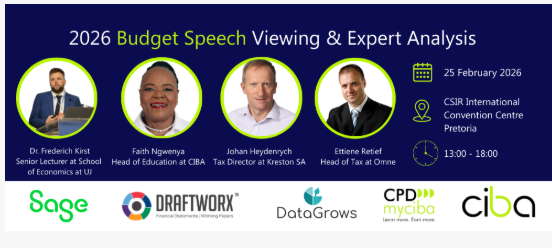
🔴 LIVE: 2026 Budget Speech Viewing & Expert Analysis
Understand the Budget as it happens. Know what to do next.
On 25 February 2026, South Africa’s National Budget Speech will set the tone for tax, compliance, and economic decision-making in the year ahead. CIBA invites you to a live Budget Speech Viewing & Expert Analysis Event, designed specifically for finance professionals who cannot afford to “wait and see” what it means.
Join us for a real-time viewing of the Budget Speech, streamed directly from Parliament, with live expert commentary translating policy announcements into clear, practical implications for your practice and your clients.
You will hear expert insights from Johan Heydenrych, Ettiene Retief, and Dr Frederich Kirst, as the Budget unfolds — not weeks later.
Whether you advise clients, manage tax risk, or lead financial decisions, this session helps you move from policy to action immediately. The event concludes with a cocktail networking session for in-person attendees.
📍 Venue: CSIR International Convention Centre, Pretoria
🕐 Time: 13:00 – 16:00 (Cocktails from 16:00)
💻 Attendance: In-person or Online
🎟️ Limited seats available
IN-PERSON: Register here
ONLINE: Register here
Don’t just hear the Budget. Understand it. Apply it.
#BudgetSpeech2026 #TaxProfessionals #FinanceLeadership #CIBA #SAEconomy



Trending