
There is a quiet but dangerous assumption that often creeps into professional practice. If a client asks for it, I should be able to do it. In reality, this mindset is one of the fastest ways to expose yourself to regulatory penalties, reputational damage, and professional liability. In today’s tightly regulated environment, the modern accountant is not just a service provider. You are a regulated professional operating within clearly defined legal and competency boundaries.
Understanding where those boundaries lie is not optional. It is fundamental to protecting both your client and your practice.
The Legal Line: Services You Simply May Not Offer
Certain services are not a matter of preference or confidence. They are governed by legislation. Performing them without the required registration is not just risky. It is unlawful.
Take tax services as a clear example. In South Africa, if you are not registered as a tax practitioner with a recognised controlling body and with SARS, you are not permitted to provide tax services. This includes submitting returns, offering tax advice, or representing clients in tax matters. Many practitioners underestimate this requirement and assume that experience is enough. It is not. Without the correct registration, you are operating outside the law.
The same principle applies to independent reviews. Conducting an independent review engagement without holding the appropriate licence is a direct breach of professional and regulatory requirements. Independent reviews are assurance engagements governed by specific standards and frameworks. They require not only technical knowledge but also the appropriate authority to perform the work. Without that authority, the report you issue has no standing and may expose both you and your client to significant consequences.
Audit work carries even stricter requirements. Signing an audit report without being registered as an auditor with the Independent Regulatory Board for Auditors is a serious offence. It undermines the credibility of financial reporting and places the public interest at risk. The regulatory environment is clear on this point. Only registered auditors may perform audits and sign audit reports.
These are not grey areas. They are clearly defined legal boundaries. Crossing them, even unintentionally, can result in fines, disciplinary action, and in severe cases, criminal consequences.
The Competence Line: Services You Should Not Offer
Equally important, but often overlooked, is the second boundary. Competence.
Just because you are allowed to perform a service does not mean you are equipped to do so.
Professional standards, including those aligned with the International Ethics Standards Board for Accountants, require accountants to maintain professional competence and due care. This means you should only undertake work that you have the knowledge, skill, and experience to perform effectively and responsibly.
Consider business valuations. While many accountants are permitted to perform valuations, it is a specialised field. It requires a strong understanding of valuation methodologies, cash flow modelling, discount rates, industry analysis, and assumptions that can significantly influence the outcome. A poorly performed valuation can mislead stakeholders, affect transactions, and result in financial loss.
The same applies to areas such as complex tax planning, financial instruments, group restructures, and forensic investigations. These are not services that can be approached with partial knowledge. Clients rely on your expertise to make decisions that have real financial and legal implications. Getting it wrong can have lasting consequences.
Competence is not static. It must be developed, maintained, and continuously updated. Taking on work beyond your current ability does not demonstrate ambition. It demonstrates risk.
The Risk of Getting It Wrong
When you operate outside your legal scope or your competence, the risks extend far beyond a dissatisfied client.
You may face regulatory sanctions, fines, or disciplinary proceedings from your professional body. You may lose your designation or licence. There is also the very real possibility of legal claims for negligence if a client suffers a loss due to your work.
Reputational damage is often the most difficult to repair. In a profession built on trust, a single incident can undermine years of credibility.
It is also important to consider your professional indemnity insurance. Many policies exclude cover for work performed outside your authorised scope or beyond your competence. This means that the financial consequences of a mistake could be borne personally.
The Right Approach: Build Before You Bill
The solution is not to limit your growth. It is to approach it responsibly and strategically.
If a client requests a service that falls outside your current capabilities or legal scope, you have clear and professional options.
You can refer the work to a qualified and appropriately registered professional. This protects the client and strengthens your professional network.
You can collaborate with a specialist, remaining transparent about your role and ensuring that the work is performed by someone with the required expertise and authority.
Or you can upskill yourself before offering the service. This may involve formal training, mentorship, supervised experience, and obtaining the necessary registrations or licences.
Upskilling is not a weakness. It is a professional obligation. Continuous professional development exists to ensure that as your service offering expands, your competence expands with it.
A Matter of Integrity
At its core, this is not only about compliance. It is about integrity.
There will be moments in practice where saying yes feels easier. You want to assist the client. You do not want to lose the work. You may feel confident that you can manage. However, true professionalism lies in knowing when to say no or not yet.
Clients rely on accountants not only for technical expertise but for ethical judgement. Knowing your limits, and respecting them, is one of the clearest demonstrations of that judgement.
Final Thought
Your licence, your designation, and your reputation are among your most valuable professional assets. Every service you offer either strengthens or weakens that foundation.
Operate within the law. Work within your competence. And when you want to grow, do so deliberately by building the skills and obtaining the authorisations required.
Because in professional practice, what you choose not to do is just as important as what you do.
CPD | Letting & Hiring Agreements: Avoid Costly Disputes | Join here
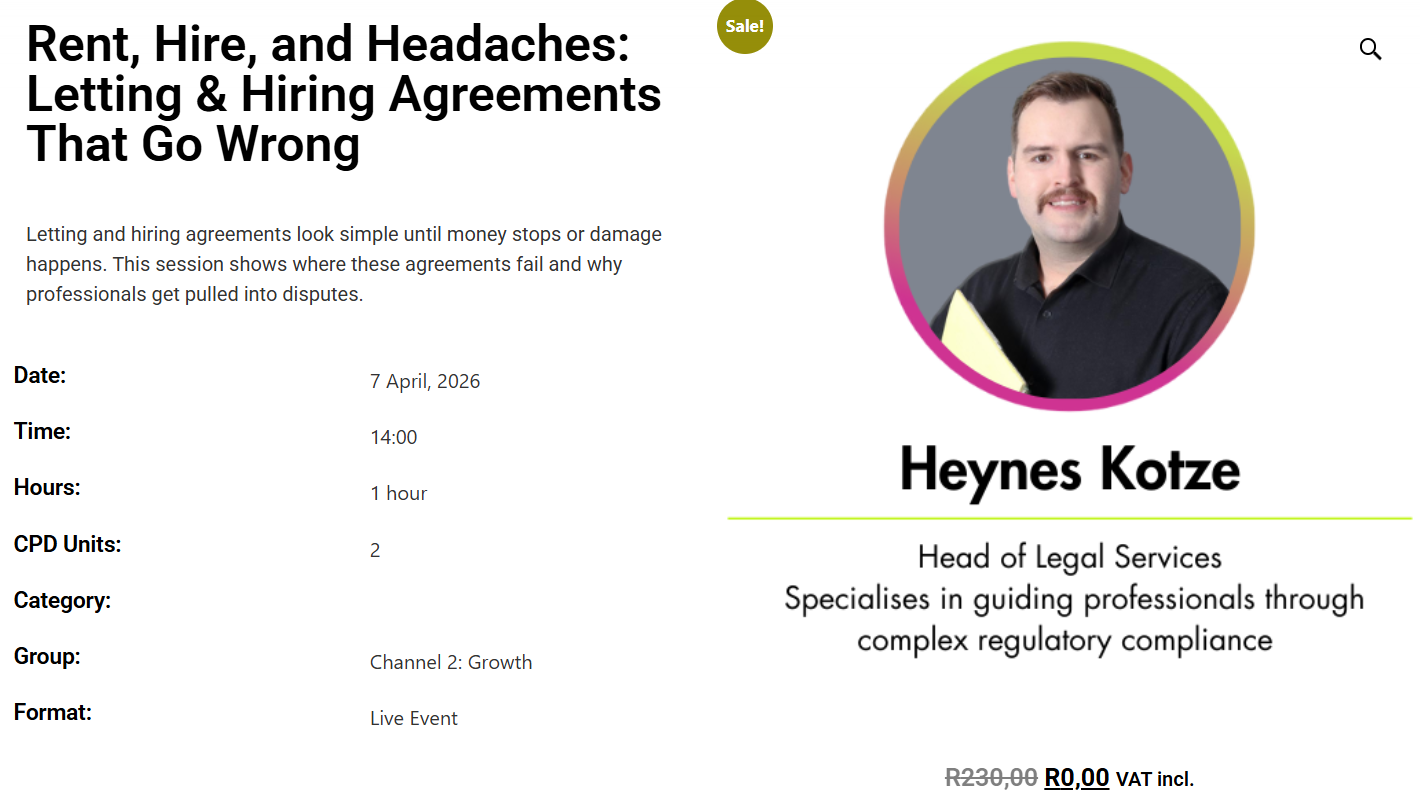
Most agreements don’t fail on paper. They fail in real life.
A client stops paying. An asset is returned damaged. An agreement ends earlier than expected. Suddenly, everyone is arguing about what was “meant” instead of what was agreed.
Letting and hiring agreements are used daily, yet they are one of the most common sources of disputes, losses, and professional risk. The real issue is not the contract itself. It is understanding who carries the risk when things go wrong.
Join us for a practical session that focuses on consequences, not theory.
📅 7 April 2026
⏰ 14:00
🎓 2 CPD Units
💻 Live Event
💰 FREE (R0,00)
Presented by Heynes Kotze, Head of Legal Services at Chartered Institute for Business Accountants, this session will help you:
• Understand the real legal difference between letting and hiring
• Identify who carries risk at each stage
• Spot weak clauses before they become costly problems
• Recognise high-risk agreements early
• Strengthen your professional judgement
This is not about drafting perfect agreements. It is about avoiding expensive mistakes.
Secure your place and strengthen how you assess risk in everyday agreements.