This article will count 0.25 units (15 minutes) of unverifiable CPD. Remember to log these units under your membership profile.
Let me start with a confession, because it is the only honest way into an article about business communication for accountants.
Earlier this month I presented a CPD session on business communication and etiquette. Sitting in my inbox while I did it was a message from a colleague that had been waiting eleven days for a reply.
I knew it was there. I had thought about it several times, usually around half past eleven at night, and done nothing about it.
I am not telling you that to be self-effacing. I am telling you because I only really understood what my silence was costing once I started looking more closely at professional communication - and at my own habits.
What I realised is that we are communicating even when we think we are not. An unanswered email communicates something. A rushed two-line response communicates something. “I’ll revert soon” communicates something. So does arriving at a meeting without an agenda, guessing at an answer we do not have, or sending a complicated response from bed at 22:14.
The problem is that the message received is not always the message we intended to send.
My colleague Leana van der Merwe made the case in these pages in April, in a piece called “Say What You Mean, Mean What You Say”, that communication is a core business skill rather than a soft one. She is right.
This is the other half of that argument: what it looks like when somebody who agrees with her entirely does it badly anyway.
Meeting fatigue changes how we communicate
Let me tell you about a Tuesday.
By half past four I had been in six meetings. Not one was pointless. Every one needed somebody from education in the room, and that somebody was me.
By meeting five I had developed the particular facial expression of a person listening intently to nothing at all.
Here is the part that bothers me. I could not have told you what was decided in the second meeting. My notes say “follow up” and nothing else. Follow up on what? With whom?
Meeting fatigue is real, but what it does to your communication is the actual problem. You do not necessarily become rude when you are exhausted. Rude takes effort. Your replies just get shorter. You stop adding context. You assume people know what you mean. You answer the question in your head rather than the one they actually asked.
And a short reply is rarely read simply as a short reply.
Research into email communication suggests that senders regularly overestimate how clearly tone and intention will be understood. The words that sound neutral in our own heads can land very differently with the person reading them.
There is another complication for those of us in senior or management roles. When I fire off a two-line reply between meetings, I may mean “busy”. A colleague earlier in her career may read “disappointed”, “irritated” or even “you should have known this already”.
I supplied the brevity. The relationship supplied the rest.
For accountants, that matters. We communicate technical information every day: financial results, tax matters, compliance requirements, deadlines, audit findings, outstanding documentation, budgets, risks and professional judgements. The technical answer may be completely correct and still create a problem if the person receiving it misunderstands our tone, urgency or intention.
Email etiquette: what silence actually communicates
Now the part I am less comfortable writing.
I have gone through stretches of not answering emails. Not refusing. Just not answering.
The message arrives. I read it on my phone. I decide it deserves a proper reply, so I put the phone down and tell myself I will get to it later. Then a week goes past. Then it becomes awkward, which somehow makes it easier to leave. That is how a week becomes a fortnight.
I used to file this under time management. I do not anymore. It is a communication decision, and it sends a message whether I intend one or not.
I learnt that when a colleague stopped bringing me a problem because, in her words, she did not want to “add to my pile”. She worked around me for the better part of a month and I had no idea.
That is what silence buys you. Not neutrality.
People do not always conclude that you are busy. They conclude something about where they sit on your list of priorities - and eventually they stop asking.
In an accounting environment, that can become more than an etiquette problem. You want the person who notices a discrepancy to tell you. You want the junior accountant who is uncertain about a treatment to ask. You want the client to raise the issue before the deadline. You want a colleague to tell you that something has gone wrong while the problem is still small enough to fix.
If your communication habits teach people that approaching you is difficult, they start solving problems around you instead of with you.
And silence compounds. The longer the email sits there, the bigger I feel the reply has to be. The bigger the reply becomes in my head, the less likely I am to write it.
Meanwhile, nobody is sitting there thinking, “Well, she is clearly swamped.” They are quietly rearranging their work around me.
The late-night email reply I regret
One more confession, and then I will get to the useful part.
A contact at one of our university partners emailed me at nine one evening, unhappy about an accreditation query that had been going round in circles for a fortnight. She was entirely correct to be unhappy.
I replied at 22:14. From bed. On a phone. Which is probably the worst available combination of circumstances for thoughtful professional communication.
What I wrote was roughly this:
Not sure what happened here. I will have to check. It looks like it may be an IT problem. I will revert.
Four sentences, four mistakes.
I told her I did not understand her problem, so she knew less than before she wrote. I hinted that somebody else was responsible before checking whether they were. I offered a theory I could not support, meaning that if I turned out to be wrong, I would now have two problems instead of one. And “I will revert” gave her absolutely no idea when she could expect an answer.
She replied at 06:40. Repairing that exchange took far longer than answering properly at eight the next morning would have.
The lesson was not that we should never respond after hours. Sometimes our work requires it. The lesson was that urgency and immediacy are not the same thing.
Some messages deserve a quick acknowledgement. Others deserve a rested brain, a proper keyboard and ten uninterrupted minutes. Knowing the difference is part of professional judgement.
The wrong message, through the wrong channel
A much more extreme example of this happened in December 2021, when the chief executive of Better.com dismissed around 900 employees during a single Zoom call.
The incident became infamous not only because people lost their jobs, but because of how the message was delivered. A deeply personal and consequential message was delivered through a channel that left little room for individual response, context or dignity.
I have never dismissed 900 people on a Zoom call, and I would like that on the record.
But I recognise something uncomfortable in that example. Sometimes the communication failure is not the decision itself. It is choosing the wrong channel, the wrong moment or the wrong focus for the message.
I did a much smaller version of that in my 22:14 email. Different scale. Same lesson.
Before asking, “What should I say?”, it is sometimes worth asking, “Is this the right way to say it?”
Six business communication habits that actually helped me
None of what I changed required a personality transplant, new software or an elaborate productivity system. It came down to six habits, and most take less than a minute.
1. Answer, or say when you will answer.
For an email that needs something from me, I now try to allow only two states: answered, or acknowledged with a date by which I will answer. “I have seen this. I need to check something before I answer properly. I will come back to you by Thursday.” It takes seconds. More importantly, it removes the silence. It is also a promise, which is rather the point.
2. Give a date, not a word.
“Soon”, “shortly”, “as soon as possible” and “as a matter of urgency” cannot be diarised. A date can. A date can also be missed, which is exactly why it is worth giving. It creates accountability for the person writing it and certainty for the person receiving it.
3. Read the email back in the most hostile voice you can manage.
We hear our own tone when we write. The recipient does not. That “quick question” may sound like irritation. The full stop you did not think about may suddenly feel rather final. The sentence you intended as efficient may sound dismissive. So before sending an important email, particularly when I am tired or frustrated, I try to read it as if I already believe the sender is annoyed with me. It is surprising what you notice.
4. Write agendas as questions.
Not “Discuss the submission timeline.” Rather: “What date do we submit, and what has to be signed off before we can?” A question tells you why the meeting exists, who needs to be there and when the discussion is finished. If I cannot turn an agenda item into a question, I ask whether it needs to be a meeting at all. Twice this month that has meant deleting the whole meeting. Nobody has complained yet.
5. Book fifty minutes, not sixty.
Meetings have an extraordinary ability to expand to fill whatever time you give them. Those ten minutes between meetings are now where I write down what was actually decided, who owns the next action and when it needs to happen. It solves my Tuesday problem at source.
6. Say what you do not know.
My favourite sentence of the past six months is: “I do not yet know why, and I would rather tell you that than guess.” For years, I had this backwards. I thought admitting uncertainty made me sound less competent, so I would offer a possible explanation while I investigated. Now I think the opposite. Stated uncertainty, followed by a clear commitment to investigate, demonstrates judgement. Uncertainty dressed up as a theory can sound like evasion.
Why communication is a professional skill for accountants
Accounting professionals spend years developing technical competence. We learn standards, legislation, tax, financial reporting, controls, governance, analysis and professional judgement.
But our clients and colleagues cannot see most of that.
Your financial director cannot audit the reasoning happening inside your head. The junior accountant reporting to you cannot see your intentions. The client waiting for an answer cannot see the twenty other matters sitting in your inbox. All they have is what you send, when you send it, and how it reads when it reaches them.
That is a very thin channel through which to carry an entire professional reputation. And most of us are careless with it because we are busy, not because we do not care.
That is perhaps the biggest thing I have learnt.
Communication etiquette is not really about whether you write “Dear” or “Hi”, whether you use an emoji, or whether you end an email with “Regards” or “Kind regards”. It is about whether the people who depend on your judgement know where they stand.
Good communication should help them understand:
whether you have received their message;
what happens next;
when they can expect a response;
what you need from them; and
whether they can approach you when something has gone wrong.
Here is what I did not expect: these have turned out to be some of the cheapest professional improvements I have made in years.
There was no new software, elaborate productivity system or major reorganisation involved. In most cases, the change was small: acknowledging an email, giving a date instead of saying “soon”, framing a meeting around a clear question, leaving a few minutes between meetings to record decisions, or simply being willing to say, “I do not know yet.”
The return has been completely out of proportion to the effort. My diary is calmer, problems reach me while they are still small enough to fix, and colleagues and partner institutions hear from me before they have to chase me.
More importantly, I have started to understand that professional communication is not separate from the work. It is part of how people experience the work.
You may already be technically excellent at what you do. Good communication simply makes it easier for the people who depend on you to see that.
So pick one habit and use it this week. Start with the email you have been meaning to answer.
I probably have one too.
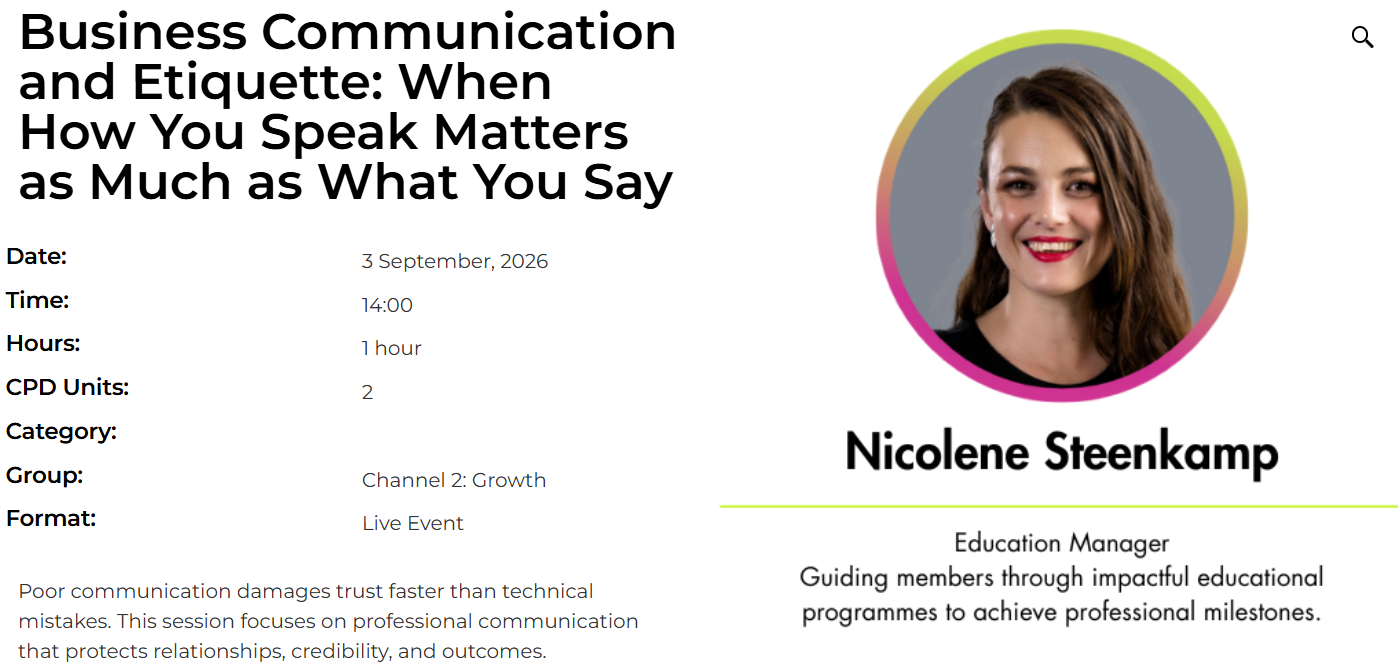
Join our CPD on Business Communication and Etiquette: When How You Speak Matters as Much as What You Say
Choose Your Path to Exclusive Insights
Stay ahead in the world of accounting with premium content designed for professionals like you. Access expert articles, industry trends, and essential resources. Become a CIBA member and claim your CPD hours from CIBA.
CIBA Member Access
R250.00 FREE!
100% Discount when you become a CIBA Member. Join now to claim your CPD Hours. Register here: https://accounts.myciba.org/register
Premium
R250.00
Every month


Trending