
Former Bosasa COO Angelo Agrizzi has been ordered to pay the state R1.67bn plus interest in connection with the company's extensive corruption scheme.
In its judgment delivered on 29 October 2026, the Gauteng High Court rejected Agrizzi's argument that he should only be liable for the money he personally received. Instead, it held him responsible for the proceeds of the entire corruption scheme.
Heynes Kotze, CIBA's head of legal services, says the court applied the “doctrine of common purpose” because Agrizzi acted alongside other executives.
Under South African common law, this means that people who agree to commit a crime or actively participate in a shared criminal scheme can be held responsible for crimes committed by others as part of that scheme.
Kotze warns that, just as Agrizzi was convicted for his involvement in Bosasa's corruption, accountants and bookkeepers who participate in similar schemes risk being considered complicit in the offence.
From arrest to confiscation
The case dates back to 2019, when Agrizzi testified before the State Capture Commission about Bosasa's bribery and corrupt government contracts. He was arrested by the Hawks in February that year and appeared in the Pretoria Specialised Commercial Crimes Court.
On 6 November 2025, Agrizzi pleaded guilty to three counts of corruption and one of money laundering, receiving a fully suspended prison sentence.
However, his plea agreement didn't settle how much money the state could recover. A separate confiscation inquiry was heard in July 2026, leading to the latest judgment.
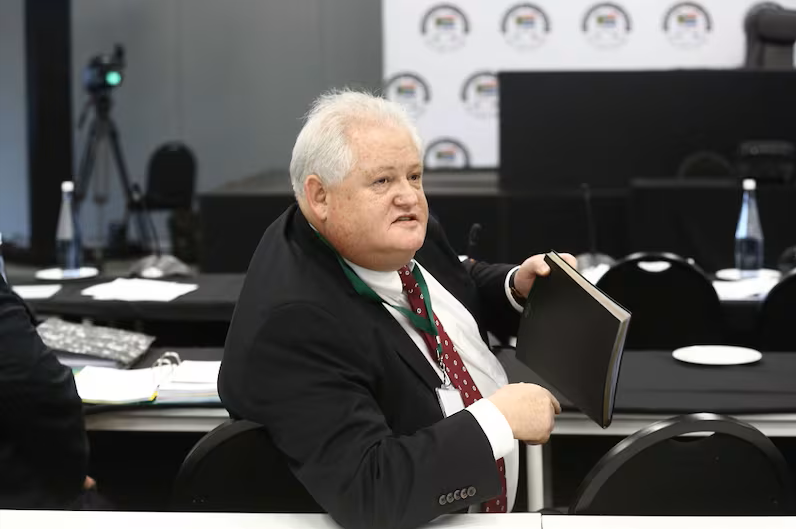
Picture: Thapelo Morebudi/Sunday Times
A similar case arose in the UK in 2014, when company director Shakeel Ahmad was held liable for the full proceeds of VAT fraud he carried out with others. The Supreme Court ruled that he and his fellow director could each be held responsible for the entire amount.
Fake invoices and ghost employees should prompt questions
Bosasa generated cash for bribes through methods including fictitious and inflated invoices, cash diverted from operations such as canteens and mine hostels, and ghost employees.
Kotze says accountants shouldn’t ignore signs like these. “If you identify an irregularity, you should immediately raise it with your client,” he explains.
“If their explanation doesn't satisfy you, follow the NOCLAR framework and assess whether you have a duty to report the matter to the FIC. If you suspect fraud or corruption involving R100,000 or more, you may also have a duty to report it to the police,” he says.
NOCLAR is an international ethics framework that guides you on what to do when you discover or suspect that a client or employer has broken the law.
If you want to learn more about this, our guide explains the steps you should follow, from discussing a suspected breach with management to deciding whether to report it to an authority.
Incomplete disclosure cost Agrizzi a lower order
The court-appointed curator valued Agrizzi’s realisable property at R26.7m, a fraction of the R1.67bn he was ordered to pay.
However, the court refused to limit the order to that amount after finding that Agrizzi hadn't fully disclosed his financial affairs. Among the omissions were a 50% stake in Spilacraft CC, investments and annuities, and a R1.75m loan to his brother.
Kotze says accountants involved in court proceedings should take this seriously. “Agrizzi’s non-disclosure didn’t only hurt his credibility. It cost him the chance to have the order limited to what he actually owned.”
“Accountants who help clients prepare statements of their assets for court must be thorough and upfront and take the court into their confidence. Anything left out can be held against the client, and possibly against the accountant too,” he explains.
Agrizzi plans to appeal
Agrizzi has said he will seek leave to appeal. He argues that the R1.67bn reflects the value of Bosasa’s contracts with the Department of Correctional Services rather than money he received.
The National Prosecuting Authority has stressed that the order creates a legal obligation to pay and doesn’t mean the state has recovered R1.67bn. Agrizzi was also ordered to pay the costs of the proceedings, including the costs of two counsel.