You Can’t Run a Business Without a Proper Chart of Accounts — How to get it right
This article will count 0.25 units (15 minutes) of unverifiable CPD. Remember to log these units under your membership profile.
Every invoice, every payment, every Rand that moves through a business tells a financial story.
But if your chart of accounts (COA) is a mess, that story becomes unreadable, and that’s when SARS queries, audit headaches, and bad decisions start creeping in.
Whether you’re running a private practice, managing a finance department, or advising clients, a well-designed Chart of Accounts is one of the most profitable tools you can control.
This article shows you how to build one that:
Makes you look like a pro to clients and boards
Reduces rework and audit adjustments
Supports compliance without creating admin
Turns raw data into business intelligence
What Is a Chart of Accounts (COA)?
A Chart of Accounts is the master index of every account your business uses to record transactions.
It tells your accounting system where to store every Rand so that you can easily produce:
Accurate monthly reports
Tax-ready financial statements
Cash flow insights
Management dashboards
Think of it as the Google Maps of your accounting system, if it’s badly structured, nothing flows properly.
A strong COA is not an admin document. It is the foundation of financial decision-making and accountability.
Many accountants lose hours fixing data that a proper COA would have prevented.
The Five Core Account Groups
Every Chart of Accounts must be built around five pillars:
Assets – What the company owns
Liabilities – What it owes
Equity – Owners’ interest / retained earnings
Income – Revenue streams
Expenses – Costs of operations
This structure is universal — whether you run a law firm, manufacturing plant, creative agency or audit practice.
Why a Chart of Accounts Matters for Profitability
A powerful COA delivers three strategic wins:
1.Faster, cleaner reporting
If your general ledger is inconsistent, month-end reporting becomes a forensic investigation.
A well-designed COA means:
Less time spent reclassifying expenses
No confusion around account names
Faster board packs and trial balances
2. Better insight = better advisory services
Want to sell business advisory?
You cannot provide value if transactions are dumped under “Miscellaneous” and “General Expenses”.
A clean COA lets you say:
“Your marketing spend jumped 17% this quarter while revenue stayed flat, let’s talk.”
That’s how you charge more.
3. Compliance protection
SARS and auditors love structured ledgers.
A sloppy COA = unnecessary risk and avoidable adjustments.
How to Design a Chart of Accounts That Works in the Real World
Step 1: Start with the business model
List the major revenue streams and cost drivers.
Example for a small accounting practice:
Monthly client retainers
Payroll processing fees
Statutory returns revenue (e.g., VAT, PAYE)
Outsourced CFO services
If it earns money, it gets its own line.
Step 2: Assign logical numbering
The global best practice format:
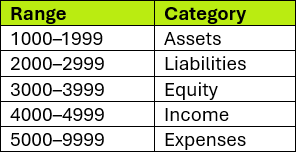
This structure keeps everything clean and software-friendly.
Step 3: Create meaningful sub-accounts
Your COA should allow you to answer questions like:
How much do we spend on salaries for billable staff vs admin staff?
What portion of revenue comes from recurring billing vs once-off projects?
Examples:
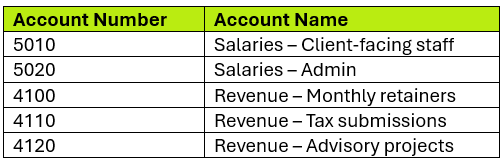
Tip: If the account name requires explanation, it needs rewriting.
Step 4: Build in future scalability
Your business will grow.
Leave account "gaps" for expansion:
Instead of:
5010 — Salaries (general)
5011 — Salaries – Business Unit A
5012 — Salaries – Business Unit B
Use:
5100 — Salaries (general)
5110 — Salaries – Business Unit A
5120 — Salaries – Business Unit B
This ensures you don’t have to restructure later.
Step 5: Document the rules
This is where most SMEs fail.
For every account, include a short description:
5300 – Legal Fees
Use this account for all external legal services, including contract drafting, litigation support, or consultations.
You avoid the #1 error in small business accounting:
Different users coding the same transaction in different places.
Real-World Examples of Great COA Design
For a Manufacturing Business
4100 — Sales: Local
4110 — Sales: Export
5100 — Raw Materials – Steel
5110 — Raw Materials – Plastics
5200 — Electricity – Production
5300 — Machine Maintenance
This lets the CFO see true production cost per unit.
For a Medical Practice
4100 — Consultations – Cash Patients
4110 — Consultations – Medical Aid
5100 — Consumables – Gloves & PPE
5200 — Medical Equipment Depreciation
5300 — Locum Fees
This supports practice profitability analysis per patient type.
Common Mistakes That Destroy Chart of Accounts Integrity
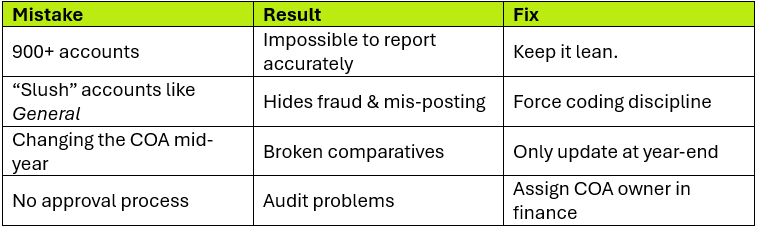
The CIBA Viewpoint: A Chart of Accounts Is a Nation-Building Tool
The CIBA Intellectual Policy Framework reminds us: Accountants are economic architects, not compliance clerks.
The systems you build determine whether businesses grow, hire people, and contribute to GDP.
A clean COA means:
Government reporting is easier
Business decisions are smarter
Financial transparency is stronger
That’s not admin. That’s economic freedom in action.
The Bottom Line
A Chart of Accounts is NOT just an internal document.
It is:
A data strategy tool
A profit driver
A compliance shield
A career differentiator
Whether you manage your own books or advise 100 clients. If you control the COA, you control the financial story. If the financial story is clear, you become indispensable.
Join CIBA here for a CPD on Building the Backbone: How to Set Up the Perfect Chart of Accounts for Every Sector

💡 Building the Backbone: How to Set Up the Perfect Chart of Accounts for Every Sector
🗓 14 November 2025 | 09:00 | 2 hours | 3 CPD Units (Financial Reporting)
A well-designed chart of accounts is the heart of accurate reporting — yet most are copied, cluttered, or completely mismatched to the business. This session shows you how to design and implement a chart of accounts that fits your client’s industry, improves reporting accuracy, and makes month-end close a breeze.
✅ Understand how different industries structure their accounts for better analysis
✅ Design a chart of accounts (COA) that supports management reporting and compliance
✅ Know which accounts to include, merge, or split for clarity and control
✅ Avoid the most common setup mistakes that cause messy financials
✅Apply sector-based examples for retail, manufacturing, construction, NPOs, and service firms
✅Create a scalable structure that supports growth, consolidation, and audit readiness
🔗 Register here
💰 R345,00 VAT incl. | Live Event | Category: Financial Reporting| Group: Channel 2: Growth


Choose Your Path to Exclusive Insights
Stay ahead in the world of accounting with premium content designed for professionals like you. Access expert articles, industry trends, and essential resources. Become a CIBA member and claim your CPD hours from CIBA.
CIBA Member Access
R250.00 FREE!
100% Discount when you become a CIBA Member. Join now to claim your CPD Hours. Register here: https://accounts.myciba.org/register