Before You Sign: The Final Steps of an Independent Review
This article will count 0.25 units (15 minutes) of unverifiable CPD. Remember to log these units under your membership profile.
Finalising an independent review is more than an administrative step. It is the process of bringing together the results of the review and determining whether anything has come to the practitioner’s attention indicating that the financial statements may be materially misstated. Practitioners often struggle at this stage when the conclusion is not clearly supported by the work performed. If procedures were incomplete, explanations were not properly investigated, or working papers do not clearly show the reasoning behind the practitioner’s judgement, signing the report becomes difficult.
CIBA’s Chartered Business Accountants in Practice (CBAP) who hold an Independent Review license are authorised to perform and sign off independent reviews. This article outlines the practical steps to finalise an independent review and issue a defensible report.
1. What “Finalising” an Independent Review Really Means
Finalising an independent review is the stage where everything comes together before the report is issued. By this point, enquiries and analytical procedures have already been performed. The practitioner must now step back, evaluate the results, and confirm that the evidence supports the conclusion.
In practice, this means confirming that the following have been completed:
All planned review procedures were performed and conclusions are documented
Final analytical review
Evaluation of identified misstatements
Review of subsequent events
Going concern assessment
Management representations obtained
Determine the appropriate conclusion
Communicate with management
Independent review report prepared.
These steps ensure the financial statements have been considered as a whole before signing the report.
A useful practical question to ask is:
🔍 If this file is inspected tomorrow, would it clearly support my conclusion?
If the answer is uncertain, the file is not ready to be finalised.
2. Final Analytical Review — The Last Sense Check
The final analytical review is a high-level check to confirm that the financial statements make sense overall.
Typical procedures include:
Comparing current year figures to the prior year and budgets (if available)
Reviewing key ratios and margins
Assessing relationships between related balances (e.g. revenue vs receivables)
Confirming consistency between the notes and the financial statements
Certain trends should immediately raise questions, such as:
Profit increasing while cash decreases significantly
Revenue growth without a similar increase in receivables
Significant changes in margins without a clear business reason
Expenses remaining unchanged despite inflation or growth
Any unusual fluctuation should follow a simple process:
Ask → Investigate → Document → Conclude
💡 For example, if revenue increased by 18% but gross profit margins dropped from 42% to 29%, the practitioner should ask management for the reason, corroborate the explanation (such as increased costs or pricing changes), and document the conclusion.
3. Evaluating and Aggregating Misstatements
A common mistake in practice is evaluating misstatements individually rather than considering their combined effect.
Even when individual errors appear small, their total impact may become material.
Misstatements should therefore be aggregated using absolute values rather than netted, as netting can hide the true level of misstatement.
For example:
Inventory not recorded: R120,000
Missing accrual: R45,000
Depreciation understatement: R80,000
Revenue cut-off error: R60,000
Individually these may appear small, but together they result in a R305,000 misstatement exposure.
Practitioners should maintain a summary of identified misstatements schedule recording:
The nature and impact of the error
Whether management corrected it
The effect (if any) on the practitioner’s conclusion.
Both quantitative and qualitative factors should be considered. Even small errors may be significant if they affect disclosures, related party transactions, or compliance with the reporting framework.
4. Reviewing Subsequent Events
When finalising a review, practitioners must consider events occurring after year-end but before the financial statements are issued.
Two types exist.
Adjusting events - These confirm conditions that existed at year-end and require the financial statements to be adjusted.
💡Example: A debtor declared bankrupt after year-end confirms the receivable was impaired.
Non-adjusting events - These arise after year-end. The financial statements are not adjusted, but disclosure may be required if the event is material.
💡Example: A factory fire after the reporting date.
5. Evaluation of Going Concern
The going concern assumption means the business is expected to continue operating for at least 12 months after the reporting date.
The practitioner must consider whether any conditions cast doubt on the entity’s ability to continue operating. If financial difficulties or other risks exist, the practitioner must assess whether the assumption remains appropriate and whether adequate disclosure has been made.
6. Management Representations
Management representations are written confirmations supporting the information provided during the review.
Management confirms that:
All relevant information has been provided.
The financial statements are complete and accurate
Matters such as fraud, related parties, going concern and subsequent events have been disclosed.
However, management representations support evidence — they do not replace it.
7. Determine the appropriate conclusion for the report.
Possible conclusions include:
Unqualified conclusion - Nothing has come to the practitioner’s attention indicating the financial statements are materially misstated.
Qualified conclusion - A material misstatement exists but is limited to a specific area (“except for”).
Adverse conclusion - Misstatements are material and pervasive, meaning the financial statements as a whole are unreliable.
Disclaimer of conclusion - Sufficient evidence could not be obtained due to a scope limitation.
The decision depends mainly on materiality, pervasiveness, and whether sufficient evidence was obtained.
8. Communicating Findings to Management
In addition to the review report, practitioners may communicate findings to management through a management report or management letter.
This typically highlights issues identified during the review, explains the risks, and recommends improvements. Examples include control weaknesses, accounting errors, or process improvements.
Providing this feedback helps strengthen financial processes and demonstrates the practitioner’s value beyond the review itself.
9. Drafting the Independent Review Report
Once procedures are completed and results evaluated, the practitioner can draft the independent review report.
The report communicates the practitioner’s conclusion and must clearly reflect that the engagement was a review and not an audit.
The report generally includes:
Title and addressee
Introduction identifying the financial statements reviewed
Management’s responsibility
Practitioner’s responsibility and scope
Conclusion paragraph
Signature and report date.
The conclusion uses negative assurancewording, for example:
“Nothing has come to our attention that causes us to believe that the financial statements are not prepared, in all material respects, in accordance with the applicable reporting framework.”
The wording must clearly reflect the limited assurance nature of an independent review, which differs from an audit report.
Finalising an independent review is where professional judgement and disciplined documentation come together. When procedures are properly performed, findings are clearly evaluated, and working papers tell the full story, the conclusion becomes much easier to support. Ultimately, a well-finalised review file ensures that the practitioner can sign the report with confidence, knowing that the work performed is clear, complete, and defensible.
Enroll to CIBA’s CPD event on Independent Reviews: Reporting and Finalisation and learn how to evaluate review findings, assess misstatements, and decide on the appropriate conclusion.
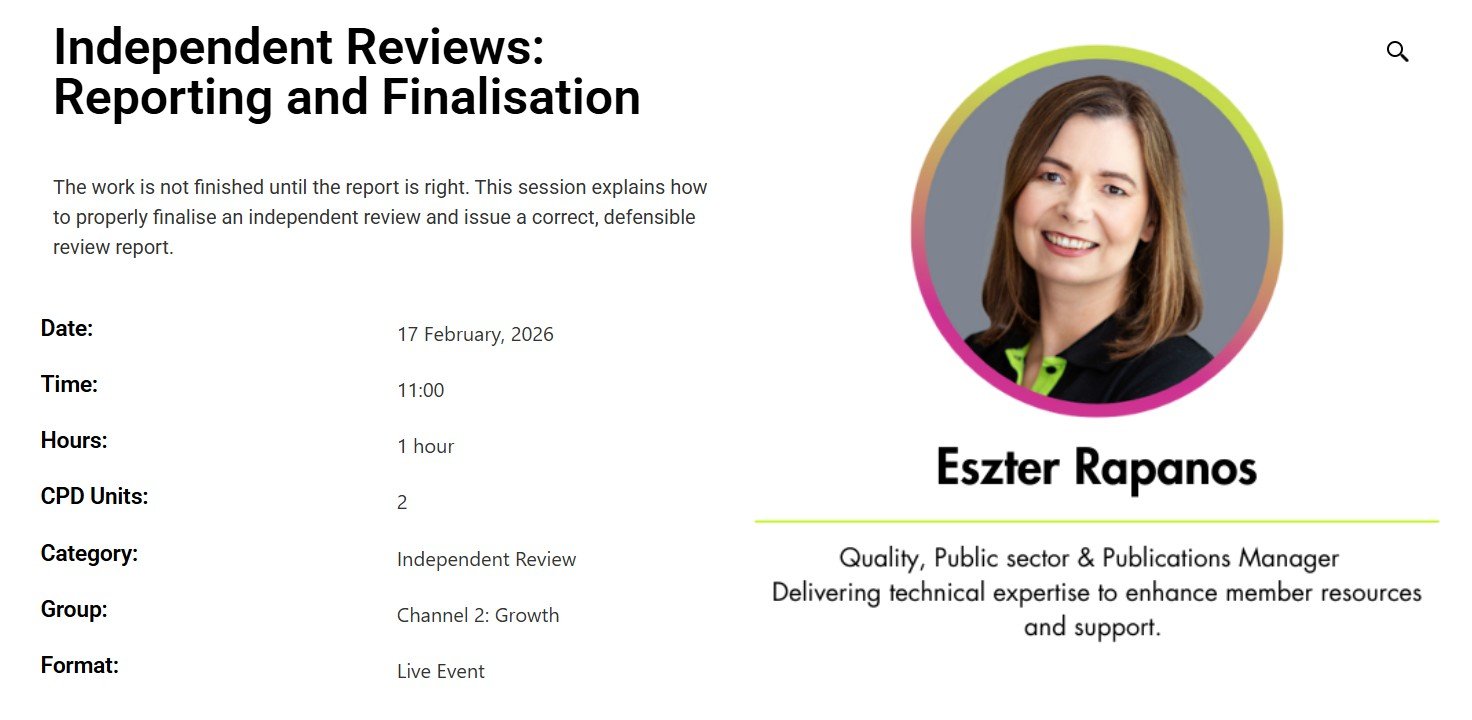
By attending this event, delegates will learn:
What must be completed before finalising an independent review
How review findings affect the final conclusion
The structure and key elements of an independent review report
How to deal with misstatements and unresolved issues
When and how to modify a review conclusion
Documentation requirements at the reporting stage
Common reporting mistakes and how to avoid them


Choose Your Path to Exclusive Insights
Stay ahead in the world of accounting with premium content designed for professionals like you. Access expert articles, industry trends, and essential resources. Become a CIBA member and claim your CPD hours from CIBA.
CIBA Member Access
R250.00 FREE!
100% Discount when you become a CIBA Member. Join now to claim your CPD Hours. Register here: https://accounts.myciba.org/register