Who Keeps The Money AI Saves? The Fee Fight Reaching SA
This article will count 0.25 units (15 minutes) of unverifiable CPD. Remember to log these units under your membership profile.
A client forwards you an article about AI in accounting, then comes the line you were dreading: "So the software does it now. Shouldn't my fee come down?"
That question was answered by the US tax regulator but the answer was not the one practitioners wanted.
The regulator said yes, the fees charged should come down
On 24 June 2026 the US IRS Office of Professional Responsibility issued Alert 2026-19, its first formal guidance on how existing Circular 230 obligations apply to artificial intelligence. Most of it reads exactly as you would expect:
verify the output
protect client data
stay competent in the tool as well as the law
keep a human in the loop.
The obligations do not change just because a machine drafted part of the work. When it got to the fees professionals charge, and it went somewhere no regulator had gone before. The OPR said practitioners using generative AI should pass along the efficiencies they gain through billing practices that reflect reduced research and drafting time, and should fairly credit clients for the cost reductions. It warned that charging for time not actually spent, because AI did it faster, could raise a question about an unconscionable fee. Circular 230 prohibits charging an unconscionable fee in any matter before the IRS.
Strip out the careful language and the message is simple. If AI made you faster, your invoice should get smaller.
The profession pushed back hard
The American Institute of CPAs (AICPA) did not agree. It has gone back to the IRS asking for clarification, on two grounds:
The first is that the language does not appear to allow for a value-pricing model. Plenty of firms have moved from charging hours times rate. Some bundle tax return preparation into a wider advisory relationship at no separate charge. A standard written around reduced drafting time assumes an hourly billing model that much of the profession has already walked away from.
The second is cost. AICPA said the OPR language is not authoritative and could be "overstepping a little bit." The AICPA's argument is that the guidance overlooks the cost and risk of implementing the technology in the first place, and that a practitioner who uses AI still carries the full liability that comes with preparing and filing a return.
That second point is the one that should land hardest with practitioners. The speed of the service changed, the exposure did not.
Here is what the argument actually looks like on a single job. Take a R12,000 annual compliance engagement that used to take ten hours of preparation, where AI now gets it done in four.
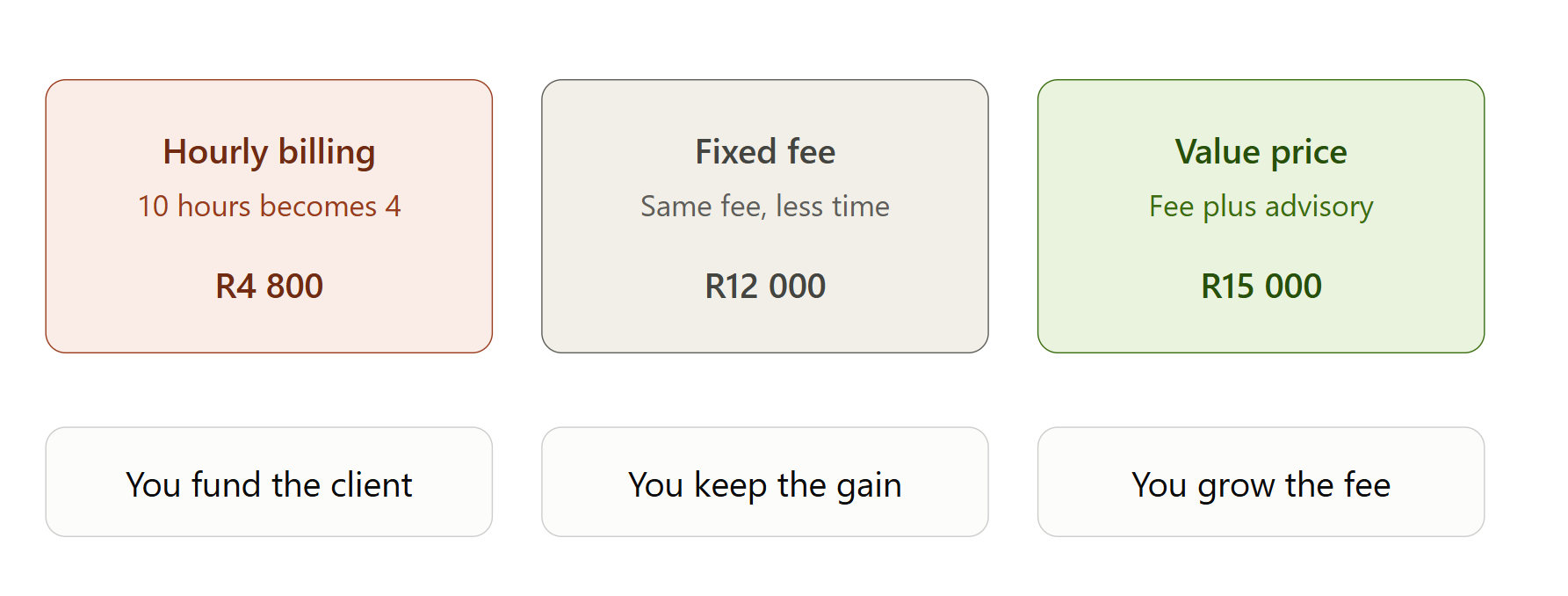
Same work, same risk, same signature. Three very different outcomes, decided entirely by how you agreed to charge before the job started.
This is not a South African rule. It is a South African conversation.
Be clear on this. No SARS notice says any of it. No recognised controlling body code says it. Circular 230 has no local equivalent, and even in the United States the guidance is introductory and creates no safe harbour. Nothing in your compliance file changes this week.
So why should you care?
Because this argument is not going to reach you through a regulator. It is going to reach you through a client who read a headline. And when it does, "because my costs went up too" is a weak answer unless you can name those costs.
What the saved hour actually costs you
The client sees an invoice that took less time. They do not see the stack sitting behind it.
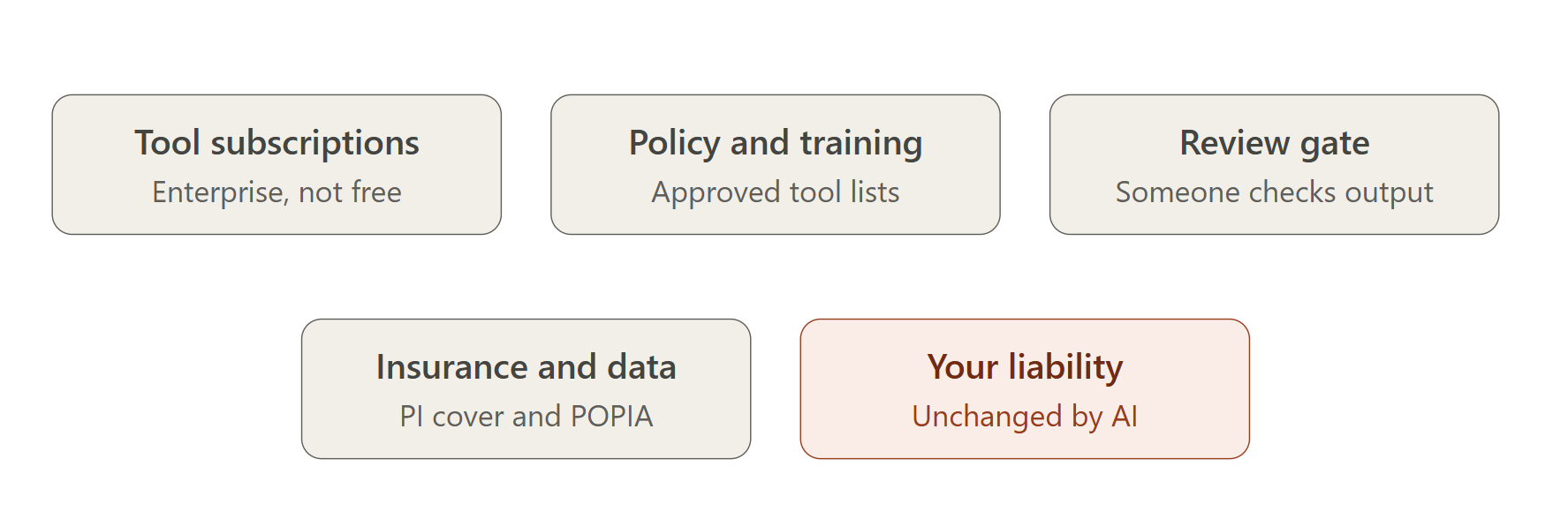
The free tool is not free. A personal or free account often lets the provider train on whatever you type in, which is exactly why the practice version costs money, as we set out in AI Policy for South African Accounting Practices. Then add the review step. The large firms have already published AI-generated errors in public, which is the whole argument in Big Four AI Hallucinations: What It Means for Your Practice. Someone in your office has to check the output before it goes out, and that someone is paid.
And at the bottom of the stack sits the part no software vendor will take off you. If the return is wrong, SARS comes to the practitioner. The tool has no registration number, no professional indemnity cover and no reputation to lose. As When Accountants Use AI puts it, saying the system classified something as low risk does not remove your responsibility.
A client asking for a discount is asking you to fund their savings out of a margin that already absorbed the cost of making those savings possible.
What you can do this week
Decide your answer before you are asked. The worst time to work out your pricing philosophy is mid-conversation with an annoyed client. Write two sentences you are comfortable saying out loud.
Get off hours where you can. Hourly billing is the only model that automatically hands your efficiency gain to the client. If you do nothing else, move your recurring compliance work to a fixed annual fee.
Price the review, not the typing. What the client is buying is a professional who stands behind the numbers. That was always true. AI just made it obvious. Say it in those words.
Put AI in the engagement letter. One paragraph covering how your firm uses AI, what it is never used for, and that the practitioner remains responsible. It protects you, and it takes the surprise out of the conversation later.
Keep the evidence. Approved tool list, review step, training record, dates. If a client, an insurer or a regulator ever questions your fee or your work, the file is the answer.
AI efficiency is real, but so is the cost of making it safe. The only question is which of you ends up paying for it.
👉 Join CIBA and we'll show you how to price AI-assisted work with confidence instead of apologising for it.