This article will count 0.25 units (15 minutes) of unverifiable CPD. Remember to log these units under your membership profile.
Unlike Freedom Day or Heritage Day, election-day public holidays aren't on the annual calendar and can be announced just a month or two in advance. For example, the public holiday on 4 November 2026 was only announced on 15 September.
If you manage payroll for your clients, you may need to add these dates to your payroll system manually. If you forget, employees could be underpaid or lose a day of annual leave. You might only pick up the error months later when an employee queries their payslip.
This guide explains how to calculate pay for employees who worked on election day and those who had the day off, and how to adjust leave balances.
Public holiday rules for election day
The Public Holidays Act allows the President to declare any day a public holiday.
When election day is declared a public holiday, you need to follow the usual public holiday rules for pay and annual leave under the Basic Conditions of Employment Act (BCEA).
Keep in mind that the BCEA's public holiday pay rules don't apply to everyone. The following employees are excluded:
Senior managers who have the authority to hire, discipline, and dismiss employees, and represent the employer.
Sales staff who travel to customers and set their own working hours.
Employees who work fewer than 24 hours a month for the employer.
There's also a difference in how you treat employees earning above the BCEA earnings threshold (R269,600.90 a year as of 1 May 2026).
If election day falls on their usual working day, the normal public holiday pay rules still apply. But if they work on what would've been their day off, you'll need to check their employment terms to see what they're entitled to.
For example, let’s say your client runs a private hospital and employs a radiographer earning R35,000 a month. If election day falls on one of her scheduled shifts and she works, she's entitled to at least double her normal daily wage.
But if she's asked to work an extra shift on what would've been her day off, you'll need to check her employment contract to determine how much to pay her.
If your client operates in an industry covered by a bargaining council agreement or sectoral determination, check whether it has different rules for public holiday pay.
For example, let's say your client manufactures steel products and employs a welder who works a full shift on election day.
Under the Metal and Engineering Industries Bargaining Council's rules, if it's his usual working day, he's entitled to his normal daily wage plus 1.33 times his hourly rate for the hours worked. In other words, you'd need to pay him more than double his normal daily wage.
Before you start making any payroll or leave adjustments, check who would've normally worked on that day. Pay particular attention to shift workers and part-time employees, as they may work different days each week.
What to pay employees on election day
Let's say your client runs an online store and employs Thandi as a customer service consultant. She works Monday to Friday and earns a basic salary of R19,500 a month.
The business stays open on election day, but Thandi's employer gives her the option of working or taking the day off. Here's how each decision would affect her payslip.
1. Who had election day off
Thandi decides to take election day off so she can vote and spend the rest of the day with her family.
Because election day falls on one of her usual working days, she's entitled to her normal pay. You'll process her monthly salary of R19,500 as usual, without deducting anything from her salary or annual leave balance.
Be particularly careful with employees who are paid by the hour or by the day. If your payroll system calculates their pay based on the hours they've worked, you may need to manually add payment for election day.
For example, if Thandi were paid R900 per day instead of receiving a monthly salary, her timesheet would show no hours worked on election day.
However, because Wednesday is one of her usual working days, you’d still need to pay her R900 for that day. Make sure your payroll system includes this payment.
If an employee doesn't normally work on the day that election day falls on and has the day off, you don't need to pay them anything extra.
2. Who worked on election day
On the other hand, let's say Thandi decides she'd rather earn some extra money and agrees to work a full day on election day.
Under the BCEA's public holiday pay rules, she's entitled to at least double her normal daily wage. If her normal daily wage plus what she earns for the hours worked comes to more than double pay, you must pay her the higher amount.
Here's how you would calculate her pay:
Normal monthly salary: R19,500
Average working days per month: 21.67
Normal daily wage: R900
Election day pay at double her daily wage: R1,800
Remember, her monthly salary already includes R900 for that day, so you only need to add another R900 to her payslip. This brings her gross pay for the month to R20,400.
If an employee earning at or below the BCEA earnings threshold works on election day when they'd normally have the day off, you must pay them their normal daily wage plus what they earn for the hours worked that day.
How election day affects annual leave
Let's say your client runs a construction company and employs Brad as a site supervisor. He works Monday to Friday and has booked a week's annual leave to visit his family in Durban.
His leave runs from Monday, 2 November to Friday, 6 November 2026, which includes an official election day.
Under the BCEA, you can't deduct a day of annual leave if it falls on a public holiday that would've been a normal working day. You should therefore deduct four days from Brad's leave balance instead of five.
If your client approved annual leave before election day was declared a public holiday, their leave system may still reflect the original number of days booked.
Run a report of all employees whose annual leave included election day. If an extra day was deducted, add it back to their leave balance.
Keep in mind that you can't pay employees for this extra day instead of giving them the leave, unless their employment is ending.
For more information on how to calculate, deduct, and record annual leave correctly, have a look at our guide to leave management.
How to adjust the leave pay accrual
If you correct an employee's leave balance, you may also need to adjust your client's financial records.
When employees have unused annual leave that they can carry forward, you need to account for what the business owes them under IAS 19 or the IFRS for SMEs Accounting Standard.
Let's say Brad earns R26,000 a month, which works out to R1,200 a day. If election day was incorrectly deducted from his annual leave, your client's leave pay accrual could be understated by R1,200.
Assuming this amount hasn't already been accounted for, you'd process the following journal entry:
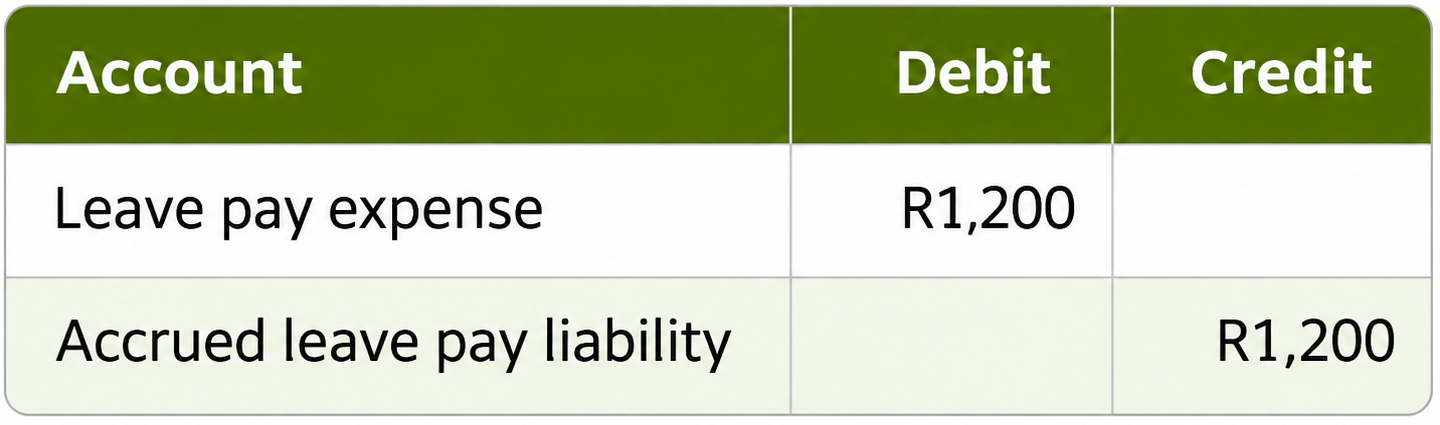
Make sure you use each employee's correct leave pay rate when calculating the adjustment.
While one day of annual leave might seem insignificant, imagine your client made the same mistake across 100 employees earning similar salaries. Their leave pay liability could be understated by R120,000.
Payroll checklist for the next election day
Having a few controls in place before the next election day can save you and your clients hours of correcting payroll and leave records later on.
Here's a checklist you can work through with your clients:
Assign someone in HR or payroll to monitor government announcements and notify management when an additional public holiday is declared.
Add the public holiday to the payroll system and check that it calculates pay correctly.
Check employees' usual working schedules and confirm who'll be working and who'll be taking the day off.
Review public holiday pay calculations before processing salaries.
Check all approved annual leave that includes election day and make sure employees don't lose a day of leave.
Reconcile payroll against attendance registers, working schedules, and leave records.
Document and approve any manual adjustments to salaries or leave balances so there's a clear audit trail.
Your clients should also communicate with their employees ahead of election day. Employees need to know whether they're expected to work, how they'll be paid, and whether their existing leave bookings will be affected.
If your client's business stays open on election day, encourage them to make arrangements that give employees enough time to vote.
You can use this same checklist whenever an additional public holiday is declared in South Africa, whether it's for an election or another special occasion.



Latest news