This year's profit is already an IFRS 18 number
This article will count 0.25 units (15 minutes) of unverifiable CPD. Remember to log these units under your membership profile.
IFRS 18 changes how every full IFRS statement of profit or loss looks from 2027. Because comparatives must be restated, the work starts with the numbers you are closing off now.
Two companies can report exactly the same profit and still leave investors with very different impressions, simply because they group, label and adjust their figures differently. IFRS 18 Presentation and Disclosure in Financial Statements is the standard-setters' answer to that problem.
If a company's financial year runs from January to December, its 2027 financial statements will be the first prepared under IFRS 18. They will also show 2026, restated in the new format. So the profit being closed off this year is already IFRS 18's comparative figure, and the ledger may not yet capture what the new standard needs.
IFRS 18 replaces IAS 1. It does not change recognition or measurement: no debit or credit moves. What changes is how income and expenses are grouped and labelled, which subtotals appear, and what management must explain when it reports its own version of profit.
Does it apply to you?
IFRS 18 applies to entities that report under full IFRS Accounting Standards. In South Africa, that includes listed companies and companies with a public interest score of 350 or more, as well as any company that chooses full IFRS. The IFRS for SMEs Accounting Standard, whose third edition also takes effect in 2027, has not adopted IFRS 18, so clients reporting under it are not affected for now.
Two groups should still pay attention. A South African subsidiary may prepare its own statements under IFRS for SMEs and still have to supply IFRS 18 figures to a parent that reports under full IFRS. And practitioners who compile, review or audit full IFRS statements will need to know what has changed before their clients ask.
Why the standard changed
Investors told the International Accounting Standards Board three things. Profit or loss statements were structured so differently that companies were hard to compare. Management's own measures of profit, such as "adjusted" or "underlying" profit, were useful, but it was often unclear what had been left out. And too much information was lumped together or labelled "other". IFRS 18 answers each complaint: defined categories and subtotals, required disclosure of management's measures, and clearer rules on grouping.
Five categories and two new subtotals
Every item of income and expense now falls into one of five categories: operating, investing, financing, income taxes and discontinued operations. Two new subtotals are required: operating profit, and profit before financing and income taxes.
The operating category holds the company's main business activities and anything that does not belong elsewhere, including unusual or once-off items. Investing and financing are defined narrowly, as explained below. The names echo the cash flow statement, but the rules are different, so do not map one onto the other.
Do not confuse operating profit with "normalised" or "underlying" profit. A large, once-off restructuring cost is still operating, because it arises from the main business.
Banks, insurers and other companies whose main business is investing in assets or lending to customers follow special rules, and some of their investment income and interest stays in operating. Most CIBA members' clients are not in that position. The example below shows how a manufacturer's statement of profit or loss might look.
Example: Karoo Components (a fictional manufacturer), statement of profit or loss
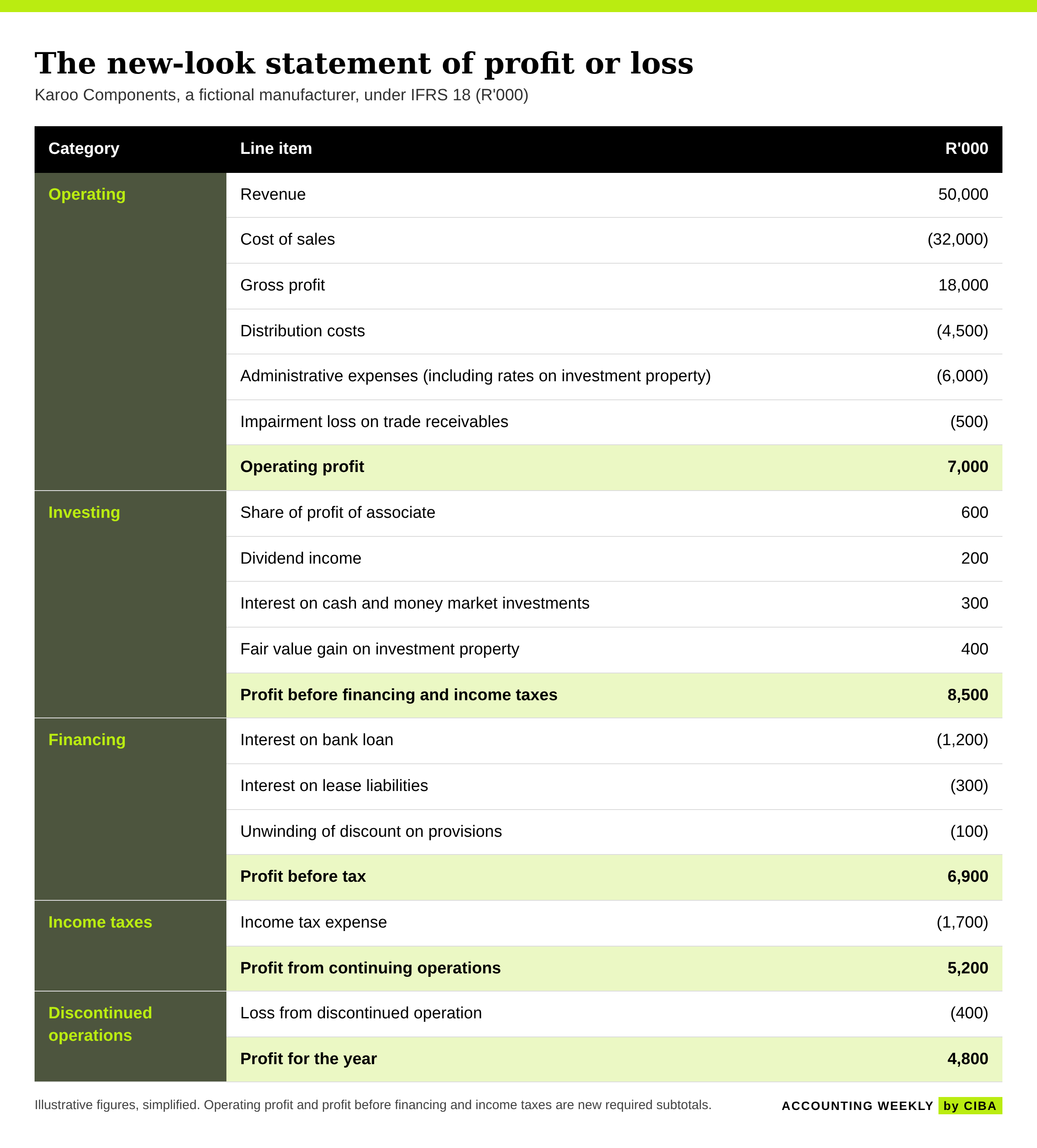
Illustrative figures, simplified. IFRS 18 lists further line items that must be presented where they are material.
Operating profit is R7 million, but profit for the year is R4.8 million. The categories show readers exactly where the difference comes from: investment returns add R1.5 million, financing costs take R1.6 million, tax takes R1.7 million and the discontinued operation costs R400,000.
Investing is narrower than it looks
Only three kinds of assets can produce investing income and expenses: investments in associates, joint ventures and unconsolidated subsidiaries; cash and cash equivalents; and assets that earn a return largely on their own, such as investment property, share investments and loans granted.
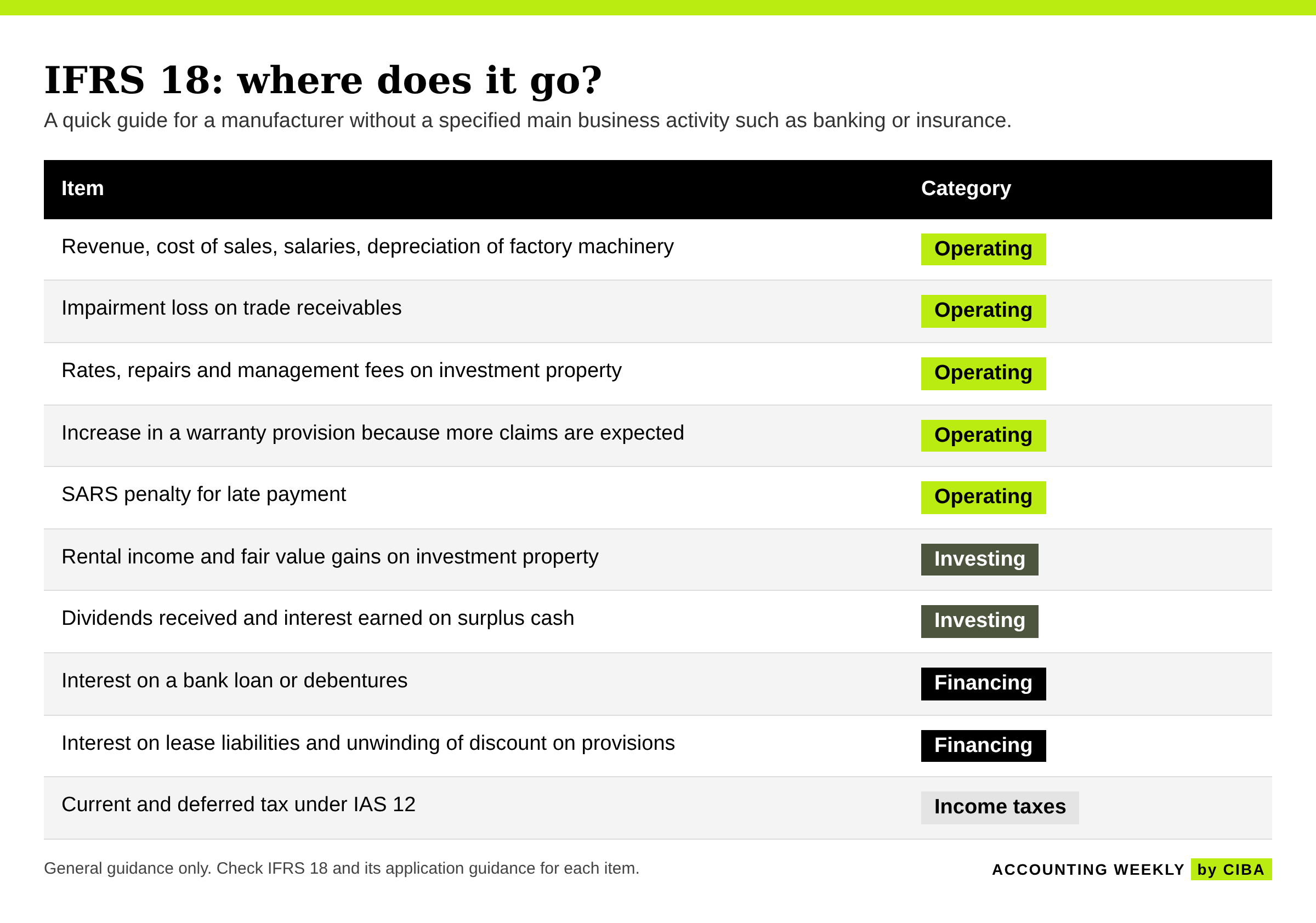
Even then, only three kinds of income and expense qualify: the income the asset generates (rent, dividends, interest), gains and losses from measuring or derecognising it, and the costs directly attributable to buying or selling it. The ongoing costs of running an investment property, such as rates, repairs and management fees, stay in operating. The standard-setters accepted that this produces no neat "net investing profit", because splitting every cost would be too complex.
Financing covers two kinds of liabilities
For liabilities that only raise finance, such as bank loans and debentures, all related income and expenses go to financing. For other liabilities, such as leases, contract liabilities and long-term provisions, only interest goes to financing, including the unwinding of a discount and the effect of changes in interest rates. If a warranty provision rises because more claims are expected, that increase is operating; the unwinding of the discount on the same provision is financing.
The income taxes category holds only current and deferred tax under IAS 12. A SARS penalty for paying late is not an income tax, so it stays in operating.
Where does it go? A quick guide
Expenses by nature or by function
Depreciation on factory machinery sits in cost of sales, depreciation on delivery vehicles in distribution costs and depreciation on office computers in administrative expenses. Presenting by function shows where costs arise, but hides the total. That is why IFRS 18 adds a note for companies that present this way.
Companies may now present operating expenses by nature (such as depreciation and salaries), by function (such as cost of sales and distribution costs) or a mix of the two, whichever gives the most useful summary. Companies that use function must show cost of sales separately, including all inventory expense, and must disclose in a single note five expenses by nature: depreciation, amortisation, employee benefits, impairment losses and reversals, and inventory write-downs and reversals, showing how much of each sits in every function line.
Group what belongs together, split what does not
IFRS 18 adds clear rules on aggregation. Items are grouped when they share characteristics and split when they do not, for example by nature, role in the business, measurement basis or tax treatment. A vehicle is property, plant and equipment for a transport company and inventory for a car dealer. The statement of profit or loss gives the summary; the notes give the detail. The label "other" is allowed only when nothing more informative will do, and goodwill must now appear as a separate line in the statement of financial position.
Management's own version of profit
Many companies tell investors about an "adjusted" or "underlying" profit in results announcements, investor presentations or management commentary. If such a subtotal of income and expenses expresses management's view of the company's overall performance, it is now a management-defined performance measure. Spoken comments and social media posts do not count.
These measures must be explained in a single note: what the measure shows and why it is useful, how it is calculated, a reconciliation to the nearest IFRS subtotal, and the tax effect and non-controlling interest effect of each adjustment. The note must also state that the measure reflects management's view and may not be comparable with other companies. If Karoo Components reports an "adjusted operating profit" of R8 million by adding back R1 million of restructuring costs, the note must show the reconciliation, with the tax effect:
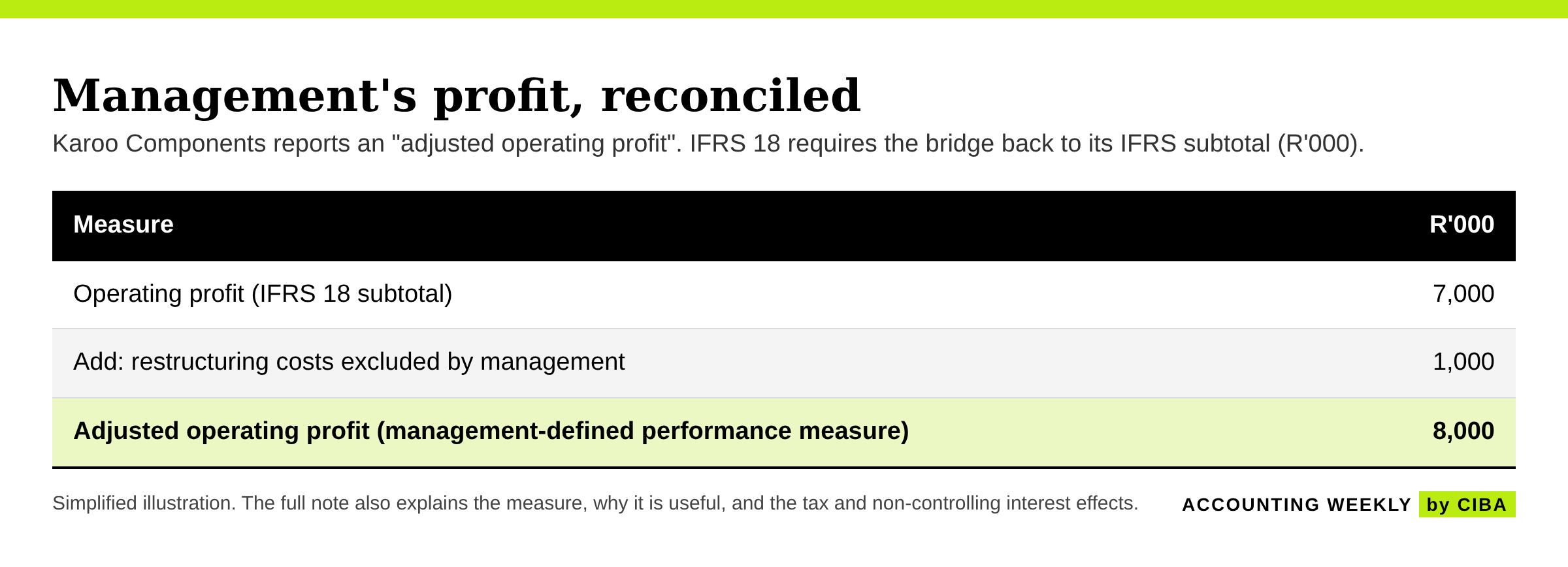
Not every figure management talks about is a management-defined performance measure. Ratios, single totals such as revenue and measures for one segment only fall outside the definition. Once a measure qualifies, though, the disclosure is not optional.
Changes to the cash flow statement
IAS 7 changes with IFRS 18. Most companies lose the choice of where to show interest and dividends: interest and dividends paid go to financing activities, and interest and dividends received go to investing activities. Operating profit becomes the starting point for the indirect method.
What this means for you
Start with the chart of accounts. Each account needs to map to a category, and some accounts will need splitting. A provision account that holds both changes in estimates and the unwinding of the discount, for example, now feeds two different categories. If the 2026 ledger cannot produce the restated comparatives, the first IFRS 18 statements will be hard work. In the first year, companies must also reconcile each line of the comparative profit or loss from the old presentation to the new one.
Then think about the story. Financial statements are not only a template filled with numbers; the notes and labels tell readers what the numbers mean. IFRS 18 pushes preparers to explain what they group, what they call "other" and how their own profit measures are built. Accountants who explain that well add value for boards, investors and lenders.
Implementation checklist: getting ready for IFRS 18
Now
☐ Confirm which clients or group entities report under full IFRS.
☐ Check the financial year that IFRS 18 first applies to, and which year becomes the comparative.
☐ Map every income and expense account to operating, investing, financing, income taxes or discontinued operations.
☐ Split accounts that mix categories, such as provision movements and interest.
Before the first IFRS 18 statements
☐ Decide whether to present expenses by nature, by function or a mix.
☐ Set up the five-expense note if you present by function.
☐ Replace "other" labels with descriptive ones where the amounts are material.
☐ List every adjusted or underlying profit figure used in public communications.
☐ Update the cash flow statement for interest, dividends and the new starting point.
In the first IFRS 18 statements
☐ Restate the comparative year and reconcile each profit or loss line to the old presentation.
☐ Present goodwill as a separate line item.
☐ Prepare the single note on management-defined performance measures, with reconciliations.
☐ Check that labels, groupings and notes tell readers a clear story.
For more information on IFRS18 please join our webinar When Financial Statements Look Right but Tell the Wrong Story



Choose Your Path to Exclusive Insights
Stay ahead in the world of accounting with premium content designed for professionals like you. Access expert articles, industry trends, and essential resources. Become a CIBA member and claim your CPD hours from CIBA.
CIBA Member Access
R250.00 FREE!
100% Discount when you become a CIBA Member. Join now to claim your CPD Hours. Register here: https://accounts.myciba.org/register