This article will count 0.25 units (15 minutes) of unverifiable CPD. Remember to log these units under your membership profile.
A trial balance can be perfectly correct and still produce a set of annual financial statements that SARS, the bank and the reviewer keep sending back. The difference is rarely the arithmetic; it is a handful of classification, disclosure and tax errors that repeat across SME files. Here are the ones to watch, grouped, with a checklist you can run before sign-off.

The problem is rarely the numbers
Most queried SME financial statements are not wrong in the ledger. The trial balance balances, the tax computation ties up, and the bank reconciliation is clean. Yet the same set comes back from SARS, the funder or the independent reviewer with questions. The reason sits one layer up, in how the numbers are classified, disclosed and presented.
A small, recurring set of errors turns a correct trial balance into a statement that invites scrutiny. Each query is rework you seldom bill for, and a quiet dent in the trust your client and their funders place in your name. The useful news is that the errors are predictable. Almost all of them fall into four families.
The four families of error
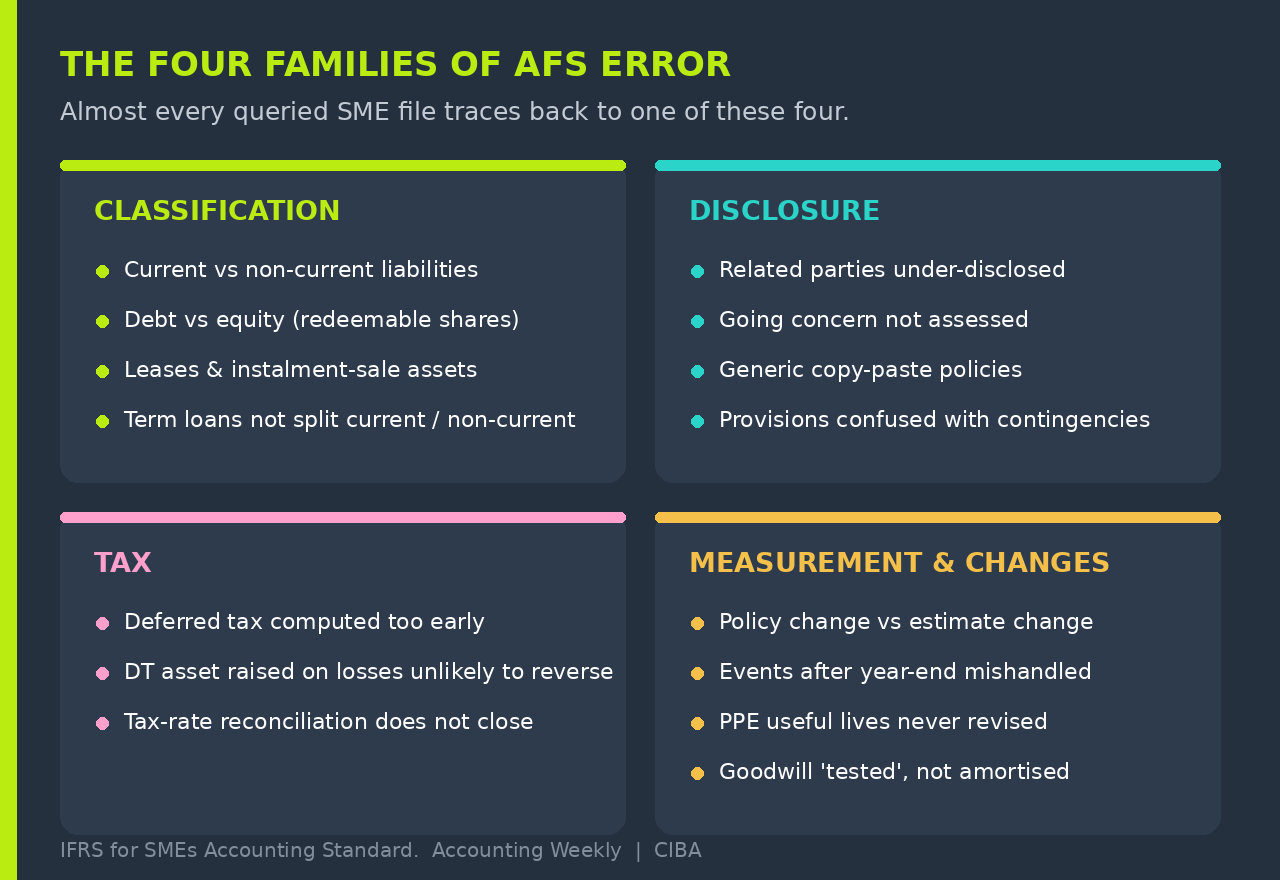
Group the errors and they stop feeling like a long list of unrelated mistakes. Classification errors put a real figure in the wrong place on the face of the statements. Disclosure errors describe a generic company rather than the one in front of you. Tax errors, deferred tax above all, unravel an otherwise good file. Measurement and change errors move the right adjustment into the wrong year. Work through them family by family.
1. Classification: the right figure in the wrong place
Start with the split between current and non-current. Under IFRS for SMEs, a liability is current unless the entity has an unconditional right, at the reporting date, to defer settlement for at least twelve months (Section 4.7). A loan repayable on demand is therefore current, and a covenant breached at year-end makes the loan current even if the bank waives the breach a fortnight later; the waiver is disclosed as an event after the reporting date. The same test splits a term loan: next year's capital is current, the rest non-current.
Two more classification traps sit alongside it. Assets bought on instalment sale or finance lease belong on the balance sheet with a matching liability, recognised at the lower of fair value and the present value of the minimum lease payments (Section 20.9), not expensed to motor or rental costs. And instruments are classified by their substance, not their name: shares the entity must redeem are a liability, not equity, even before the redemption date (Section 22.3A).
2. Disclosure: describe this entity, not a template
The most common disclosure failure is wording lifted from a template or a listed company and left generic, so it does not describe the business in front of you. Related-party dealings are the routine casualty: in owner-managed entities, director and shareholder loans and key-management pay are under-disclosed, when Section 33 requires the relationship, the terms and the amounts. Going concern must be assessed over at least twelve months from the reporting date and any material uncertainty disclosed (Sections 3.8 to 3.9).
The discipline is proportionality: match the disclosure to the entity, write each policy to describe what this business actually did, delete anything that does not apply, and use the undue cost or effort relief where a requirement costs more than it is worth. A suburban cafe does not need a listed company's financial-instruments note. Take the same care with provisions: recognise one only where there is a present obligation, a probable outflow and a reliable estimate; a possible obligation such as a lawsuit is a contingent liability, disclosed, not recognised (Section 21).
3. Tax: deferred tax is where files unravel
Deferred tax is the line that undoes good files. Compute it last, on the final temporary differences, not off the management accounts; recognise a deferred tax asset only to the extent future taxable profit is probable, and with a loss history only on convincing evidence; and reconcile accounting profit at the statutory rate to the total tax charge (Section 29). If the reconciliation does not close, something is wrong, so find it before you issue. Accounting Weekly covers this well in Income Tax, Deferred Tax, and the Art of Not Panicking.
4. Measurement and changes: the right entry in the wrong year
The last family is about timing and treatment. A change in accounting policy is retrospective: restate the comparatives and opening retained earnings. A change in estimate, including a change in depreciation method, is prospective: current and future periods only (Section 10). Put the adjustment in the wrong place and the wrong year's profit moves. Events after year-end follow the same logic: adjust only for events confirming a condition that existed at year-end, and disclose material non-adjusting events up to the date the statements are authorised for issue (Section 32).
Measurement habits round out the family. Goodwill and intangibles are amortised over their useful life, capped at ten years where the life cannot be estimated reliably, and tested for impairment only when there is an indicator; all research and development is expensed (Sections 18 and 19). And PPE useful lives are not set once and forgotten: review the life, residual value and method when indicators suggest they have changed, and treat the change prospectively (Section 17.19). Revenue belongs here too, shown net of VAT and recognised on performance rather than on the invoice date (Section 23).
Consistency: the cross-check reviewers run first
Once the four families are clean, run the consistency checks a reviewer runs first: equity ties between the balance sheet and the statement of changes in equity, cash ties to the cash-flow statement, profit flows into equity, the notes cross-cast to the face, and comparatives agree to last year's signed statements. One figure that disagrees, and the reader stops trusting the whole set.
A checklist you can run before sign-off
None of this needs a long review. The sweep below takes a few minutes and catches the errors above before the statements leave your desk.
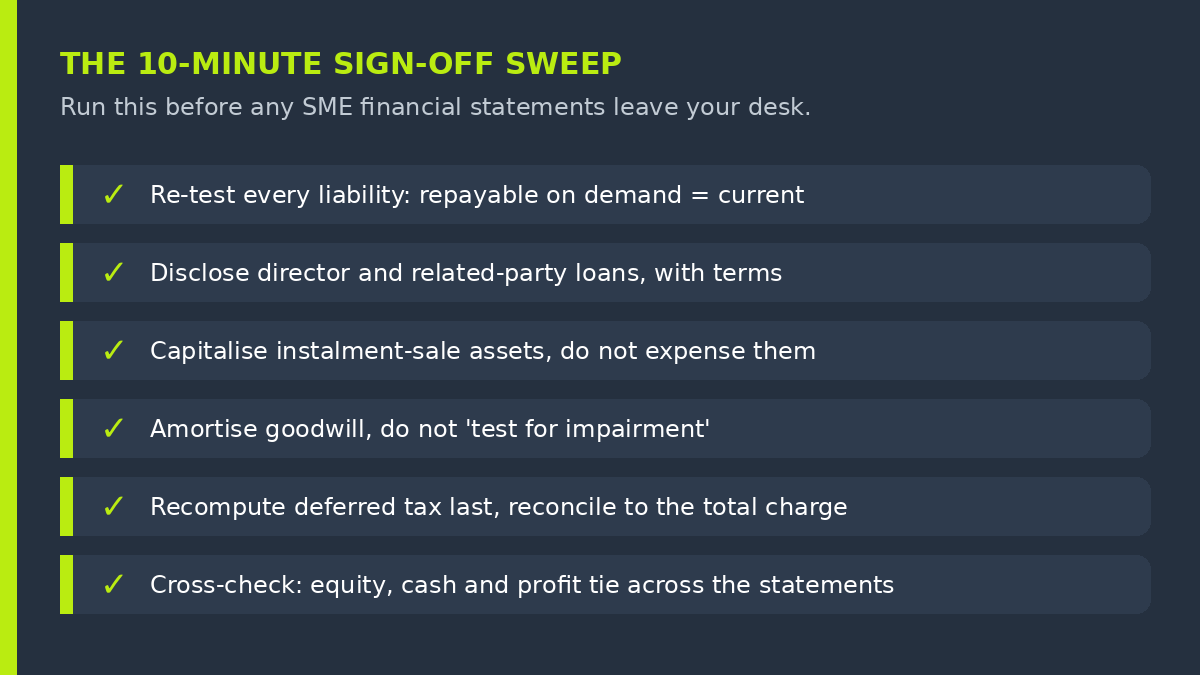
• Every liability re-tested. Apply the twelve-month right-to-defer test to each one; demand loans and year-end covenant breaches are current; split term loans into current and non-current.
• Assets on instalment sale or lease. On the balance sheet with a matching liability, and being depreciated; not expensed to motor or rental costs.
• Related parties. Directors, shareholders and other related parties, their transactions, balances and terms, and key-management pay in total.
• Policies that fit. Each policy describes this business; anything generic that does not apply is deleted; going concern is documented.
• Deferred tax. Recomputed on the final numbers, an asset raised only if recovery is probable, and the tax-rate reconciliation closes.
• Goodwill, intangibles and useful lives. Goodwill amortised, not just 'tested'; no capitalised development costs; PPE lives revisited where indicators exist.
• Provisions and events after year-end. A provision only for a present obligation; contingencies disclosed; confirming events adjusted, material non-adjusting events disclosed.
• Consistency. Equity, cash, profit and comparatives tie across all the statements, and a second pair of eyes has seen the file.
What changes in 2027
A third edition of IFRS for SMEs was issued in February 2025 and takes effect for periods beginning on or after 1 January 2027, with early adoption permitted (see Accounting Weekly's coverage of the third edition). Revenue moves to a five-step, control-based model, and the financial-instruments section is revised. (Please verify before publishing: whether the final third edition adopts an expected-credit-loss impairment model or retains the incurred-loss approach, as published summaries differ.) The discipline in this article carries straight across; the two areas to re-learn before adoption are revenue and financial instruments.
Key takeaways
• Most queries trace to one of four families: classification, disclosure, tax, and measurement or change of treatment.
• Re-test every liability against the twelve-month right-to-defer test; a loan repayable on demand is current.
• Capitalise instalment-sale and finance-lease assets with their liability; do not expense them.
• Write disclosure that describes this entity; under-disclosed related parties are the most common gap.
• Recompute deferred tax on the final numbers, recognise an asset only if recovery is probable, and reconcile it to the total tax charge.
• Put policy changes through retrospectively and estimate changes prospectively; do not move the wrong year's profit.
• Cross-check that equity, cash, profit and comparatives agree before you release the statements.

Choose Your Path to Exclusive Insights
Stay ahead in the world of accounting with premium content designed for professionals like you. Access expert articles, industry trends, and essential resources. Become a CIBA member and claim your CPD hours from CIBA.
CIBA Member Access
R250.00 FREE!
100% Discount when you become a CIBA Member. Join now to claim your CPD Hours. Register here: https://accounts.myciba.org/register