This article will count 0.25 units (15 minutes) of unverifiable CPD. Remember to log these units under your membership profile.
Over the last 2 months we explored eight articles, in which we have worked through the main changes in the third edition of the IFRS for SMEs Standard.
We have looked at the new definitions of assets and liabilities, control and consolidation, financial instruments, fair value, business combinations and the new revenue model.
I am not going to explain all of that again.
This is the final article in the series, and there are two things left to deal with. The first is the change to Section 7 on the statement of cash flows. The second is how we move from the old standard to the new one.
The third edition is effective for financial periods beginning on or after 1 January 2027. For a December year-end entity, the first annual financial statement under the new standard will therefore be the December 2027 financial statements, but those statements will also include 2026 comparative figures.
That is why the work cannot simply start in 2027.
One Last Technical Change: Section 7
Section 7 has not been completely rewritten. The basic statement of cash flow remains much the same.
There are, however, two new disclosure requirements.
The first is a reconciliation of changes in liabilities arising from financing activities.
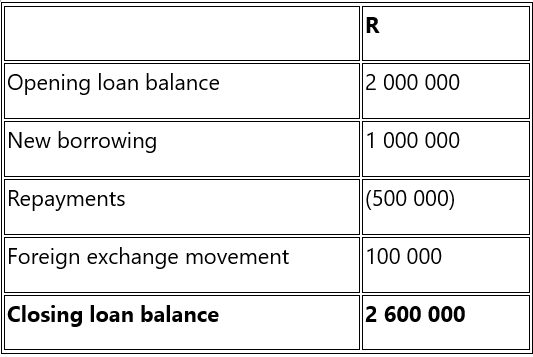
Say your client's bank loan was R2 million at the beginning of the year and R2.6 million at the end of the year. We can see that the liability increased by R600 000, but we cannot see why.
Perhaps the client borrowed another R1 million and repaid R500 000. Perhaps the remaining R100 000 was a foreign exchange movement on a foreign currency loan.
Under the new requirement, these movements need to be reconciled. You start with the opening balance, show the cash movements and non-cash movements during the year, and arrive at the closing balance.
For example:
The Accounting is not difficult. The practical problem is having the information.
A trial balance will give you the opening and closing balances, but it may not tell you what happened in between. For clients with a lot of financing activity, it makes sense to keep this reconciliation updated during the year rather than trying to rebuild it at year-end.
The second change deals with significant investing and financing transactions where no cash actually moved.
A company may, for example, acquire an asset through a financing arrangement or convert a shareholder loan into share capital. There may be no cash movement, but something important has happened to the financial position of the business.
These transactions now need clearer disclosure.
A simple question to add to your year-end checklist is: Were there any significant investing or financing transactions during the year where no cash changed hands?
Now We Need to Move From the Old Standard to the New One
Now we need to deal with the transition.
The general rule is retrospective application. For a December year-end entity, the 2027 annual financial statements will be prepared under the third edition and the 2026 comparative information will also need to be dealt with under the new requirements. Depending on the changes affecting the client, there may also be adjustments to opening balances.
This is where waiting until 2027 can create a problem.
Some information can easily be pulled from the general ledger later. Other information cannot. Contracts, financing arrangements, fair value information and the reasons behind accounting judgements are much easier to deal with when the transaction happens than a year later.
The standard does provide transition relief in certain areas, including consolidation, financial instruments, fair value measurement, business combinations and revenue.
We have already dealt with the accounting changes in these sections in the previous articles, so there is no point going through them all again here. The important thing at transition is to establish which reliefs are available to the client, decide which ones will be used and document that decision.
Transition relief does not mean that you can simply leave everything as it was.
Start With the Client, Not the Standard
Not every client is going to have the same amount of work.
A small trading company with straightforward sales, normal trade debtors and creditors and no group structure may have very little to change.
Another client may have long-term contracts, several companies in a group, complicated financial instruments, business acquisitions and several financing arrangements.
Those two clients should not have the same transition file.
Take your client list and identify which parts of the new standard actually affect each client. You have already worked through the technical changes during this series. Now you are simply matching those changes to the clients who are affected.
A spreadsheet may be enough. Put the clients down the left-hand side and the relevant sections across the top. Mark what applies, what does not apply and where further work is needed.
It does not need to be complicated.
Do the Work While You Have the Information
If an important accounting judgement is made during 2026, document it then.
If a client enters into an unusual contract, keep the contract and the assessment you made.
If a financing liability changes, update the Section 7 reconciliation.
If a client buys another business, collect the information while the transaction is still fresh.
And if you identify a transition adjustment, keep the calculation and the supporting information.
By the time the first financial statements are prepared under the third edition, your transition file should tell the story. It should show what changed for that client, which transition reliefs were used and what adjustments were made.
The first financial statements will also require transition disclosures, including reconciliations showing the effect of the changes on equity and profit or loss where applicable.
Do not wait until the financial statements are almost finished to prepare these.
If equity under the new standard is different from equity under the old standard, you should be able to explain exactly where that difference came from.
The Final Step
When we started this series, the third edition probably looked like one enormous change to the accounting standard.
After working through it section by section, it becomes much more manageable.
Not every change applies to every client, and for some clients very little will change.
The job now is not to read the entire standard again.
Work through your client list. Identify what actually affects each client. Decide which transition reliefs will be used. Keep the information and calculations you are going to need.
And for Section 7, start keeping track of the movements in financing liabilities rather than trying to reconstruct them at year-end.
The new standard applies from 2027, but getting ready for it is work that needs to be done before then.
That is the final piece of the puzzle.
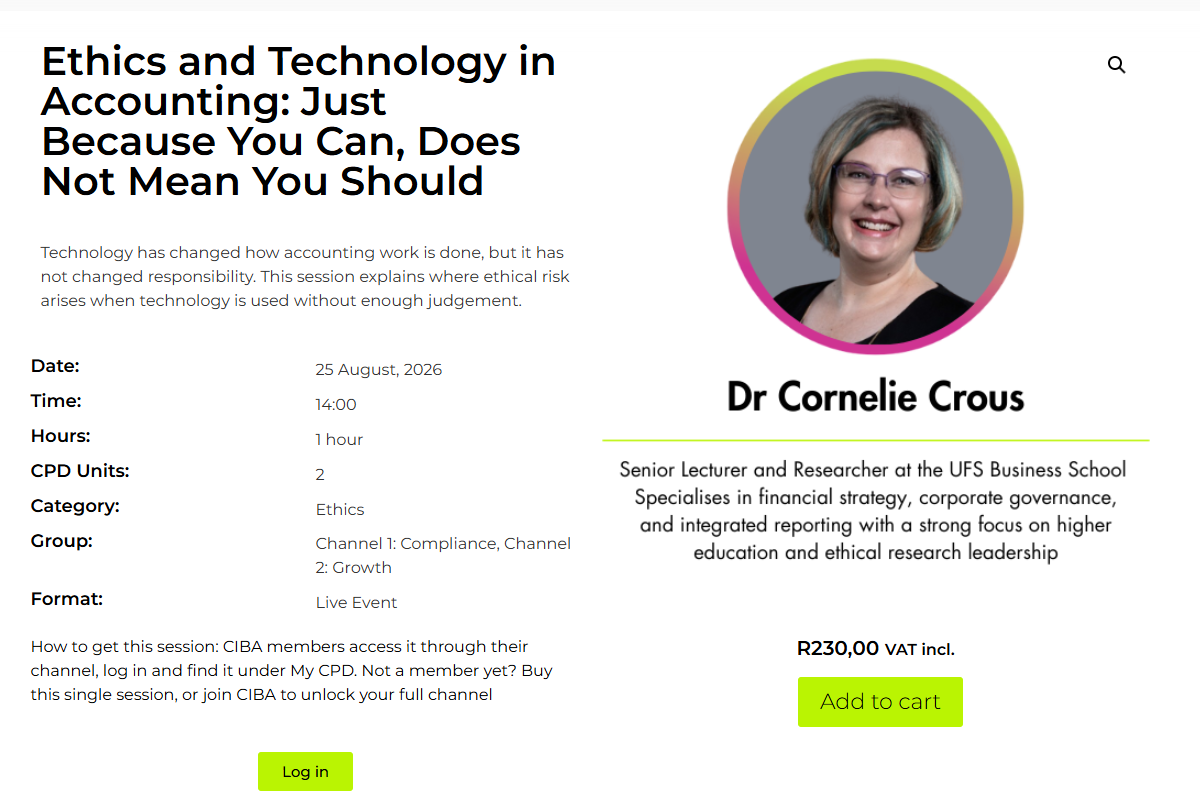
Join us for a CPD on Ethics and Technology
Accounting technology can do a lot.
But should you let it?
Automation can process transactions, systems can make decisions faster, and digital tools can save hours of work. But when something goes wrong, the accountant is still responsible.
Join us for this practical 1-hour ethics session where we’ll look at:
🔹 When you can — and cannot — rely on automation
🔹 What happens when technology gets it wrong
🔹 Who is responsible for decisions made by systems
🔹 Ethical risks when using client and financial data
🔹 Where professional judgement is still essential
🔹 How technology mistakes can damage trust
📅 25 August 2026
⏰ 14:00
🎓 2 CPD Units | Ethics
🎤 Dr Cornelie Crous
💻 Live online
Technology can help you do the work. It cannot take responsibility for it.
CIBA members: Find the session under My CPD.
Not a member? You can purchase the session for R230 VAT incl.
Find it Here


Choose Your Path to Exclusive Insights
Stay ahead in the world of accounting with premium content designed for professionals like you. Access expert articles, industry trends, and essential resources. Become a CIBA member and claim your CPD hours from CIBA.
CIBA Member Access
R250.00 FREE!
100% Discount when you become a CIBA Member. Join now to claim your CPD Hours. Register here: https://accounts.myciba.org/register