This article will count 0.25 units (15 minutes) of unverifiable CPD. Remember to log these units under your membership profile.
Managing cash flow for one company is complicated enough. But when you're responsible for the finances of several businesses owned by the same parent company, things can get even trickier.
Together, these businesses might be comfortably in the green, while one of them is heading into the red because it doesn't have enough cash to pay its bills.
As the accountant, you're walking a financial tightrope. A transfer that rescues one company today could leave another scrambling to meet its tax deadlines tomorrow.
In this guide, we'll show you how to prepare a cash-flow forecast for a group of companies, account for VAT and PAYE payments, and manage transfers between entities.
If you need a refresher on how to do this for a single company, have a look at our guide to cash-flow forecasting.
Why one company can run short of cash
Let's start by taking a closer look at what happens when a subsidiary needs money.
When a holding company owns several businesses, each one remains a separate legal entity with its own bank accounts, expenses, and tax obligations. Just because the parent company has money doesn't mean its subsidiaries can automatically use it.
Let's say your client is Ubuntu Holdings, a Johannesburg-based company that owns two other businesses, Ubuntu Manufacturing in South Africa and Ubuntu Distribution in Namibia.
At the start of January 2027, Ubuntu Holdings has R1.2m in its own bank account, while Ubuntu Distribution has N$150,000 (roughly R150,000 in November 2026). Between these two companies alone, there's R1.35m in cash.
However, Ubuntu Distribution has several payments coming up, and its biggest customer won't pay until 29 January.
Here's what its cash-flow forecast looks like:
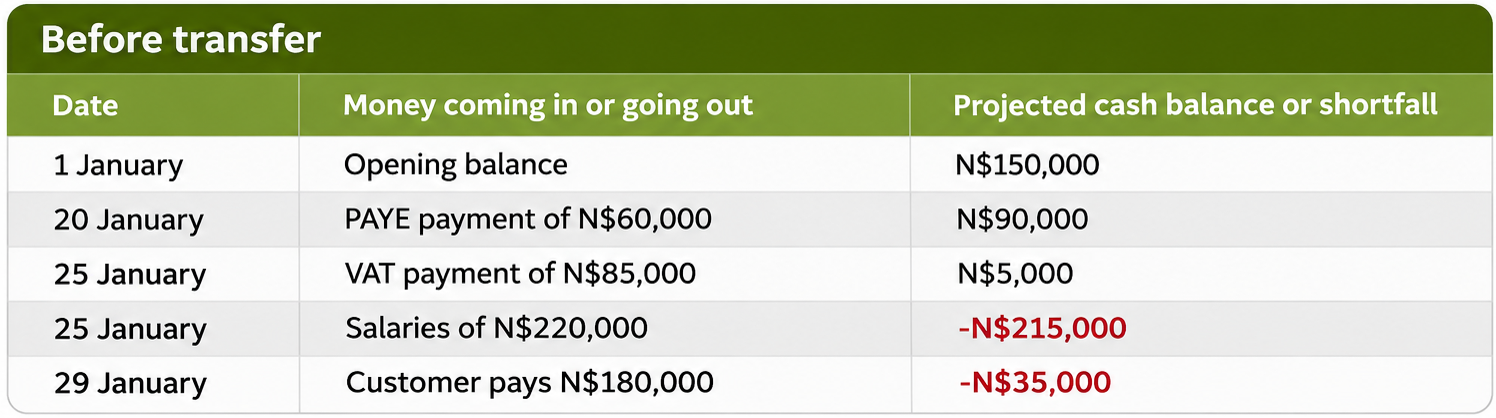
By 25 January, Ubuntu Distribution will be N$215,000 short. Even when its customer pays four days later, it will still have a shortfall of N$35,000.
Meanwhile, Ubuntu Holdings has more than R1m sitting in its own bank account. However, it can't simply use this money to pay its subsidiary's bills. The companies need to arrange and properly record the transfer, and allow enough time for the money to reach Namibia.
This is why you need to prepare a separate cash-flow forecast for each company before looking at the combined figures.
In Ubuntu Holdings' case, you'd need to identify the Namibian subsidiary's shortfall early enough to arrange the funding, while making sure the parent company still has enough cash for its own expenses.
How to forecast cash flow across several companies
When preparing a cash-flow forecast for one company, you start with its bank balance and estimate how much money will come in and go out over the coming weeks or months.
When you're responsible for several companies, you also need to consider how money moves between them, whether each business can meet its own obligations, and how these movements affect the overall financial position.
To do this, follow these six steps.
Prepare a separate forecast for each company, starting with its actual bank balance. For Ubuntu Holdings, you'd start with R1.2m, while Ubuntu Distribution's forecast would start with N$150,000.
Use the same forecast periods for every company so you can compare and combine them. In our example, weekly forecasts would help you spot Ubuntu Distribution's cash shortage before 25 January.
Include each company's tax payments on the dates they're due, taking into account the rules in each country. For Ubuntu Distribution, this means including its PAYE payment on 20 January and VAT payment on 25 January.
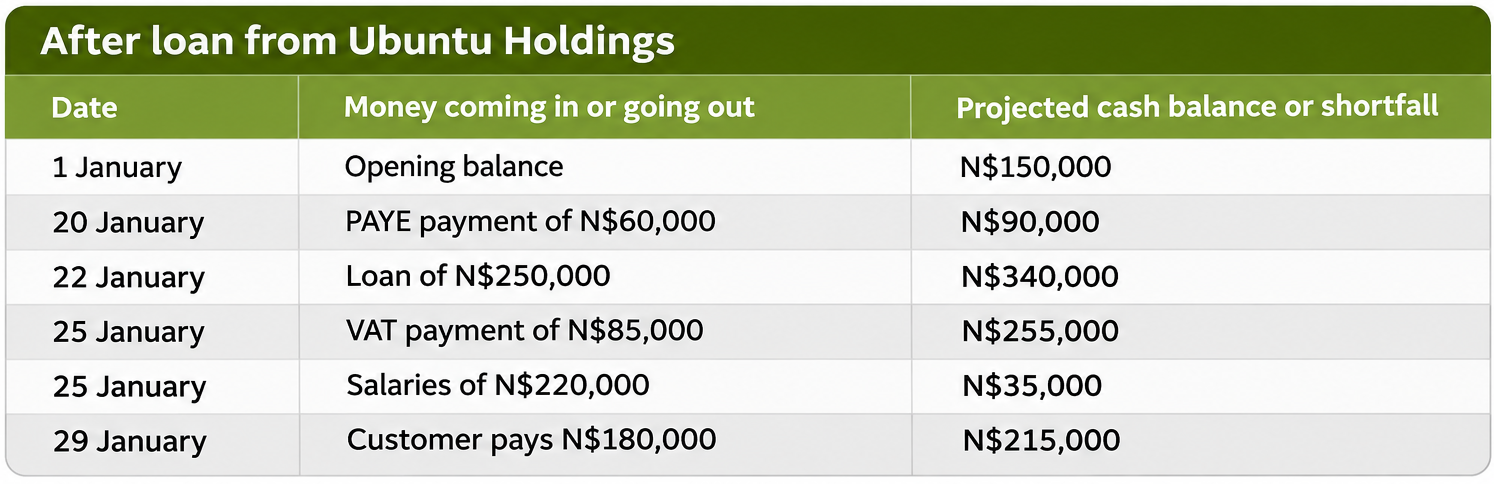
Record transfers between companies in both forecasts, using realistic payment and arrival dates. If Ubuntu Holdings lends Ubuntu Distribution R250,000 on 21 January, but the money only arrives on 22 January, both forecasts must reflect this.
Combine the forecasts into one overall view, removing transfers between the companies so the same money isn't counted twice. The R250,000 loan moves money between the companies without increasing the group's total cash.
Check each company's balance throughout the forecast period, rather than relying only on the combined figures. Before Ubuntu Holdings lends the money, you must make sure it can still afford its own salaries, taxes, and other expenses.
Once you've done this, Ubuntu Distribution's updated cash-flow forecast should look like this:
If you'd like to explore this in more detail, CIBA's recorded webinar, Budgeting and Forecasting for Business Success, explains how to prepare realistic forecasts, adjust them as circumstances change, and compare your estimates with actual results.
How to plan for tax deadlines in different countries
One of the biggest challenges with tax payments is keeping track of different deadlines. A company in South Africa might need to pay its taxes weeks before or after a subsidiary in Namibia, even when both are paying tax for the same month.
For Ubuntu Holdings, this means keeping track of payment dates set by SARS and the Namibia Revenue Agency (NamRA). Here's how the main deadlines compare.
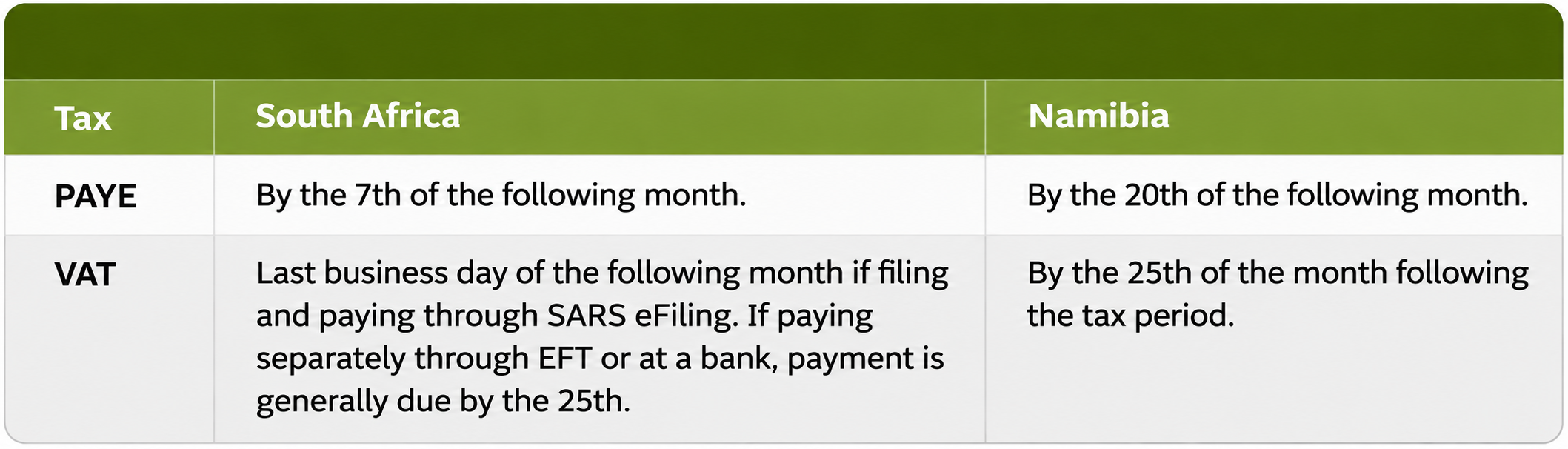
Tax deadlines and requirements differ depending on which country each company operates in. Check the relevant tax authorities' websites for the correct filing dates and payment requirements.
For VAT, remember to check each company's reporting period, since businesses don't necessarily submit VAT returns every month.
You'll also need to account for weekends and public holidays. In South Africa, for example, if the 7th falls on a weekend or public holiday, the PAYE payment is due on the preceding business day.
Make sure you don't forget less frequent payments, such as provisional tax. These can be particularly easy to overlook when you're updating a monthly forecast.
Another complication is VAT refunds. In South Africa, separately registered companies account for their own VAT. This means a refund due to Ubuntu Manufacturing can't simply be used to reduce Ubuntu Holdings' VAT bill.
If Ubuntu Manufacturing expects a refund from SARS, include it in that company's forecast on the date you realistically expect the money to arrive. Don't assume SARS will pay it immediately after the return is submitted.
The important thing is to check each company's actual tax obligations and expected refunds, rather than assuming the same dates and amounts apply across the group.
How to avoid counting the same money twice
When one company lends money to another, you need to record the transaction in both companies' forecasts. The first company loses money from its bank account, while the second receives it.
Let's return to Ubuntu Holdings. To help Ubuntu Distribution cover its upcoming expenses, the parent company agrees to lend it R250,000.
Ubuntu Holdings transfers the money on 21 January, but it only reaches Ubuntu Distribution's bank account on 22 January. You'd record R250,000 going out of Ubuntu Holdings on the 21st and N$250,000 coming into Ubuntu Distribution on the 22nd.
When you combine the forecasts, you need to remove this internal transfer from the group's total cash movements. Otherwise, you risk counting the same money twice.
For example, recording the R250,000 only as money coming into Ubuntu Distribution would make the group's cash position look R250,000 better than it actually is.
What about transfers between countries?
Moving money between countries can add another complication, since different rules and banking requirements apply.
Fortunately for Ubuntu Holdings, South Africa and Namibia are both part of the Common Monetary Area (CMA), along with Lesotho and eSwatini.
According to the South African Reserve Bank, transferring rand between these countries doesn't require approval from its Financial Surveillance Department.
However, this doesn't mean you can assume the money will arrive immediately. You still need to check the bank's processing times and any documents required for the transfer.
For companies outside the CMA, additional exchange-control requirements may apply. Before scheduling a transfer, check with the client's bank whether any approvals or supporting documents are needed and how long the process could take.
This helps you avoid relying on money that won't reach the receiving company before its payments are due.


Trending