This article will count 0.25 units (15 minutes) of unverifiable CPD. Remember to log these units under your membership profile.
Your client wants a slice of a R100 billion water infrastructure pipeline. The tender closes in three weeks. Their last signed financials are 14 months old and their municipal account is in arrears. That is the gap Operation Vulindlela has just opened up.
Half the reforms are moving. Half are stuck.
The Phase II Q1 2026/27 progress report is out. Of the 30 reform actions, 47% are on track, 40% are delayed but still active, and 3% are in real trouble. Electricity distribution reform, housing subsidies and the title deeds backlog are the laggards.
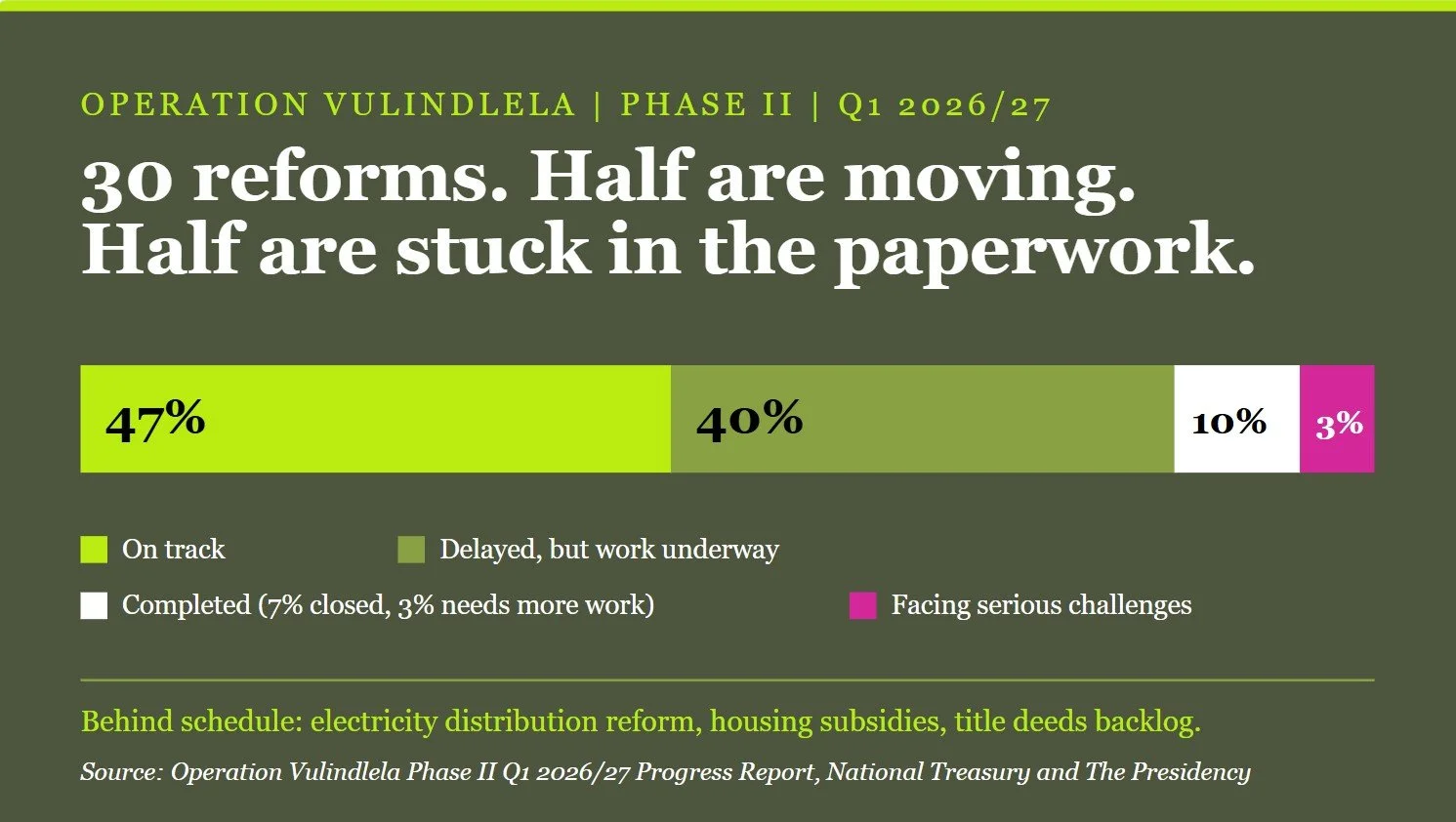
Compare that to the Q3 2025/26 update and the pattern holds: steady grind, no collapse, no miracle. What changed this quarter is that the money started moving.
Where the money is landing
Water. IFISA and the Water Partnerships Office are structuring roughly R100 billion in projects, with about R60 billion already in implementation. The municipal slice of it sits in more than 30 Water Partnerships Office projects worth R43 billion across 18 municipalities. SANWRIA has a board as of 1 June 2026 and is expected to triple annual water infrastructure investment.
Logistics. Rail Access Agreements are signed with all 11 train operating companies, with operations from early 2027. Transnet has put out proposals for a rolling stock leasing company covering about 500 locomotives and 17,000 wagons, plus a 25-year concession at the Cape Town Multipurpose Terminal.
Borders and visas. A R12.5 billion public-private partnership will rebuild the six busiest land ports of entry, which carry over 80% of cross-border trade. Trusted Employer Scheme Phase II, gazetted 20 July 2026, now covers financial sector firms and companies setting up regional headquarters here.
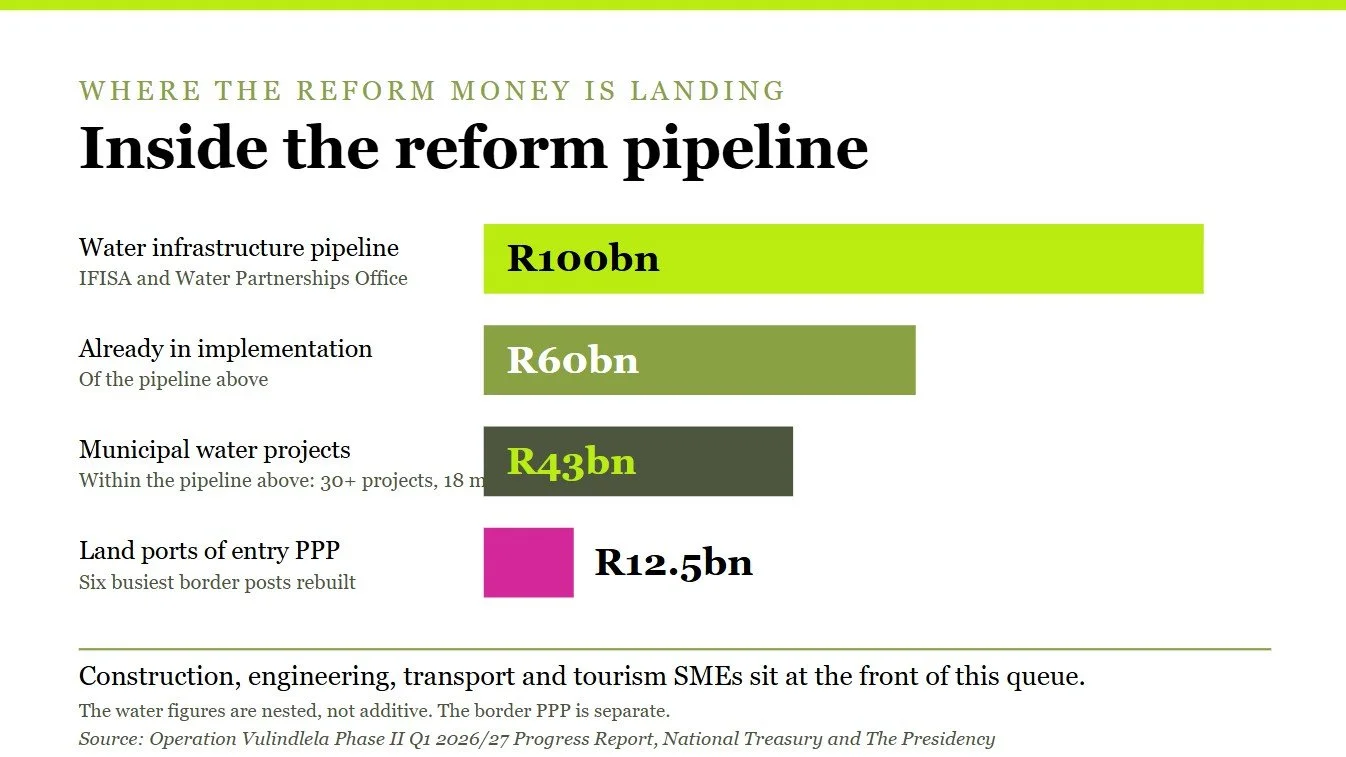
Construction, engineering, transport and tourism SMEs are first in that queue. If you have clients in those four sectors, you are their bid team whether you have priced for it or not.
The part that lands on your desk
Two reforms change your compliance work directly.
The Water Services Amendment Bill separates Water Services Authorities from Water Services Providers and introduces licensing. Target for adoption is October 2026. Metros are already ring-fencing trading service revenues, with an Independent Verification Agent appointed to check whether they actually did it. New ring-fenced entities need cost allocation, asset registers and separate financials. Someone has to build those.
The MFMA Amendment Bill goes out for public comment in September 2026, alongside a revised White Paper on Local Government proposing a single-tier system and professionalised senior appointments.
Then there is MzansiXchange. Government is moving to real-time verification against the population register, the Central Supplier Database, PERSAL and the banks. A client bidding for state work no longer waits weeks for a check. Their record is queried on the spot. Stale records now fail instantly instead of quietly.
That risk is not theoretical. Treasury has already frozen payments to 69 struggling municipalities. If your client invoices a municipality, their cash flow is exposed.
Do this before month-end
Pull your client list and flag everyone in construction, water services, transport and tourism. That is where the pipeline lands.
Clean their record now. CSD registration, tax clearance, CIPC annual returns, current management accounts. Real-time verification rewards clean files and punishes old ones.
Check municipal exposure. Any client billing a municipality needs a debtor review this month, not next year.
Price it properly. Tender-ready financial packs, funding applications and ring-fenced reporting are advisory work. Bill them as advisory, not as month-end admin.
State reform does not grow the economy on its own. It grows when businesses can actually reach the money, and someone credible signs off their numbers. That someone is you.
👉 Join CIBA and we'll show you how to turn state reform into billable advisory work.