Municipalities Are Owed R484 Billion. Their Creditors Are Still Waiting.
This article will count 0.25 units (15 minutes) of unverifiable CPD. Remember to log these units under your membership profile.
National Treasury has released its third quarter Section 71 report for local government, covering the period 1 July 2025 to 31 March 2026. The numbers confirm what many accountants working with municipal clients already suspected: collections are weak, debt is growing, and creditors are feeling the squeeze.
The headline numbers
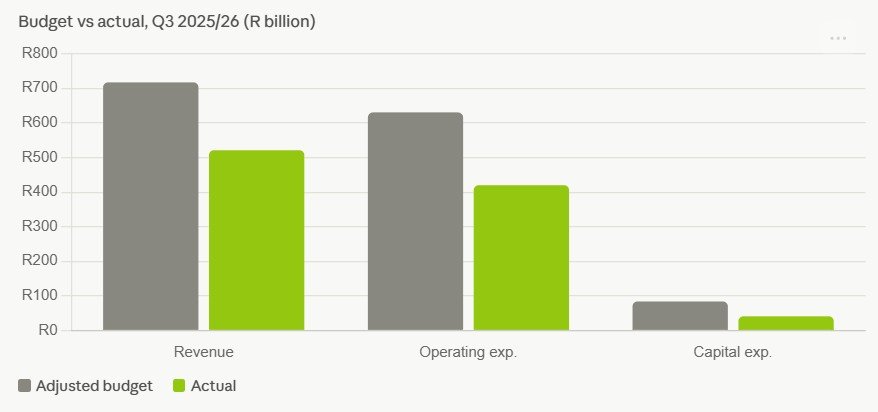
Municipalities adjusted their total revenue budgets upward to R717.2 billion for 2025/26. By 31 March 2026, total billed revenue stood at R521 billion, just 72.6 percent of that adjusted budget. Operating expenditure reached R419.9 billion against a R630.4 billion budget, a 66.6 percent performance rate.
Capital expenditure told an even weaker story. Municipalities spent R41 billion against an adjusted budget of R83.9 billion, landing at 49 percent performance and R18.2 billion behind target. Treasury notes this slow start is typical, with spending usually spiking in the fourth quarter. However, it also says incorrect reporting by some municipalities is distorting the figures, including negative capital expenditure reported by some municipalities, while metro expenditure is understated because Nelson Mandela Bay failed to report.
Debt keeps climbing
Outstanding consumer debt to municipalities reached R484 billion as at 31 March 2026, up from R416.1 billion in the same quarter last year. Households account for R339 billion of that figure, 70 percent of the total. Businesses owe R105.3 billion and organs of state owe R28.5 billion.
Most concerning for cash flow: 87.7 percent of that debt, R424.7 billion, has been outstanding for more than 90 days. Only R6.9 billion has been written off as bad debt so far.
Creditors are paying the price
The knock-on effect is visible in the creditors' age analysis. Municipalities owed R148 billion to creditors as at 31 March 2026, up from R131.8 billion a year earlier. Of that, R120.6 billion has been outstanding for more than 90 days.
Bulk electricity makes up the largest share of creditor debt at R79.4 billion, followed by trade creditors at R30.4 billion and bulk water at R26.4 billion. The Free State has the highest level of creditors outstanding beyond 90 days at R41.7 billion, ahead of Mpumalanga and Gauteng.
Treasury draws a direct line between the two problems. When municipalities are slow to collect from debtors, their cash flow suffers, and that delay gets passed on to suppliers. For accountants advising clients who do business with municipalities, this highlights a practical risk: supplier invoices may remain unpaid because municipalities are experiencing cash flow constraints caused by poor debt collection.
Conditional grants still underspent
Municipalities were allocated R46.2 billion in direct conditional grants for the year, of which R43.3 billion had been transferred by 31 March 2026. Municipalities reported spending 52.2% of the allocation by 31 March 2026. By comparison, National Transferring Officers reported expenditure of 59.2%, while the comparable figure reported for the same period in the previous year was 55.9%. Treasury points to late submission of business plans and ongoing supply chain management problems as the main causes. These issues resulted in reduced allocations for some municipalities during the adjustment budget process.
There was one bright spot. Capacity building grant spending improved significantly, with municipalities reporting 62.4 percent of their allocation spent, well ahead of the 49.4 percent recorded in the same quarter last year.
What this means for your practice
Businesses supplying municipalities should anticipate the possibility of payment delays and factor these into cash-flow planning. Build payment delays into your client's cash flow planning, check the municipality's payment track record before large contracts are signed, and keep an eye on which provinces are under the most creditor pressure. The Free State, Mpumalanga and Gauteng are showing the most strain right now.