
This article will count 0.25 units (15 minutes) of unverifiable CPD. Remember to log these units under your membership profile.
Finance Minister Enoch Godongwana tables the 2026 Medium Term Budget Policy Statement (MTBPS) in the National Assembly on Wednesday 21 October 2026 at 14:00. Economists expect tax revenue to come in well ahead of the February Budget, mainly because of higher gold and platinum prices. They also expect a weaker growth forecast, and the main question is whether Treasury saves the extra revenue or spends it.
What the MTBPS is
The MTBPS updates the February Budget halfway through the financial year. It revises the economic forecasts, the revenue and spending estimates and the government’s debt path for the next three years. It does not usually announce new tax rates; those come in the February Budget. The figures it sets out guide the proposals in the 2027 Budget.
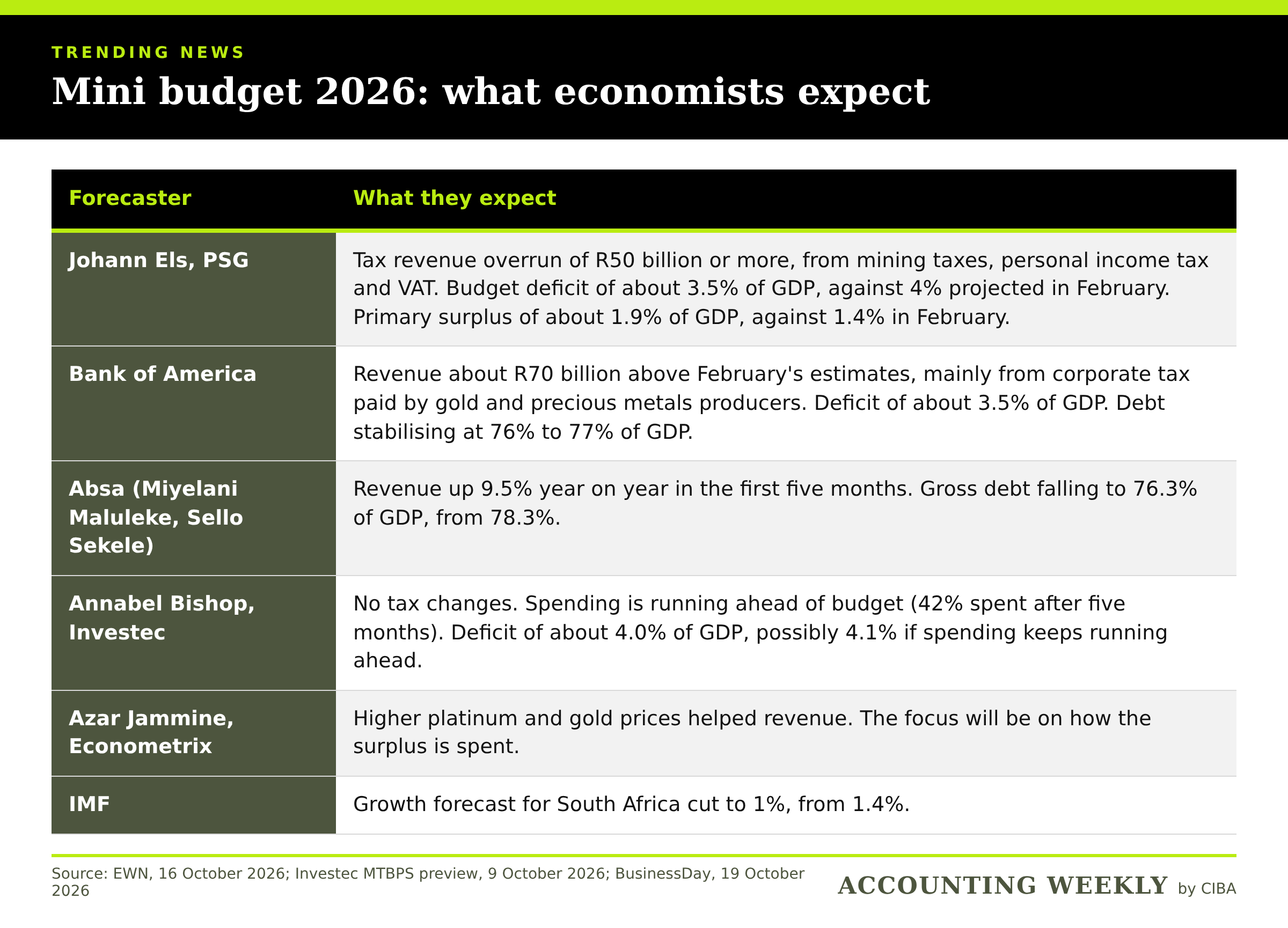
What economists expect
These are forecasts, not Treasury figures. Some differ from each other.
What else to watch
Growth. The February Budget forecast 1.6% growth for 2026. The economy shrank by 0.2% in the second quarter, and the Reserve Bank now expects about 1.2% (Sunday World, 18 October 2026). Commentators expect Treasury to cut its forecast.
The tax pledge. The Minister undertook not to raise taxes in 2026.
Fuel prices. Petrol passed R30 a liter in October. The Automobile Association has asked for a R3 a liter cut in the General Fuel Levy, and Cosatu wants new measures to protect consumers. BusinessTech reported on 17 October, citing DailyInvestor, that government is developing a R10 billion fuel relief plan. No official source has confirmed it.
Spending pressures. Treasury has estimated that expanding the Social Relief of Distress grant could cost about R90 billion a year (Absa, as reported by Sunday World). Treasury has flagged 162 municipalities as financially distressed.
A fiscal anchor. Investec and BusinessDay point to the Minister’s promise of a fiscal anchor, a set of rules to limit borrowing and spending.
What this means for accountants and finance professionals
An early signal for February. If revenue is strong and the tax pledge holds, clients may face fewer tax increases in the 2027 Budget. A weak growth outlook points the other way. Wait for the MTBPS figures before advising clients.
Forecasts and budgets. Finance teams should update growth, inflation and fuel cost assumptions for the next financial year once the MTBPS is published.
Client questions. Clients will ask about fuel levies, tax increases and relief. Base answers on what Treasury publishes on 21 October.
CIBA’s input. CIBA will comment on the MTBPS on behalf of members.
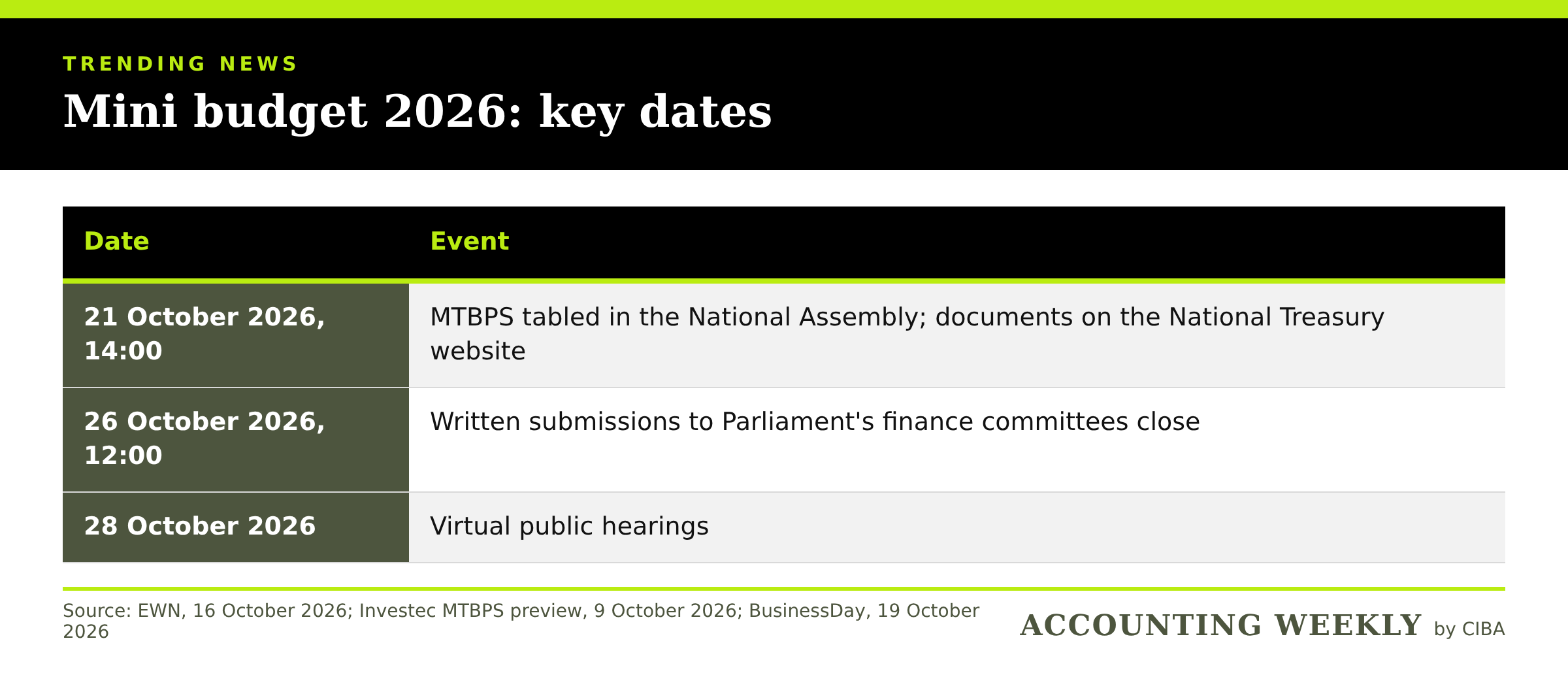
Key dates
What to do
Watch the tabling on 21 October or read the MTBPS documents on the National Treasury website.
Compare the revenue, deficit and growth figures with the expectations above.
Look for any changes to fuel levies or relief measures that affect clients’ costs.
Note the proposals that may shape the February 2027 Budget.
Sources: EWN, 16 October 2026 · Investec MTBPS preview, 9 October 2026 · BusinessDay, 19 October 2026 · Sunday World, 18 October 2026 · BusinessTech, 14 October 2026 · BusinessTech, 17 October 2026 · Parliament: MTBPS notice