This article will count 0.25 units (15 minutes) of unverifiable CPD. Remember to log these units under your membership profile.
National Treasury published the annual policy benefit escalations as defined by the Demarcation Regulations (Regulations), issued in terms of section 72 of the Long-term Insurance Act, No. 52 of 1998 (LTIA) and section 70 of the Short-term Insurance Act, No. 53 of 1998 (STIA). The 2026 limits apply from 1 April 2026, although National Treasury published the supporting media statement and Annexures on 1 September 2026. The 2026 escalated benefits therefore apply from 1 April 2026 until before the next escalation date.
What the Demarcation Regulations do
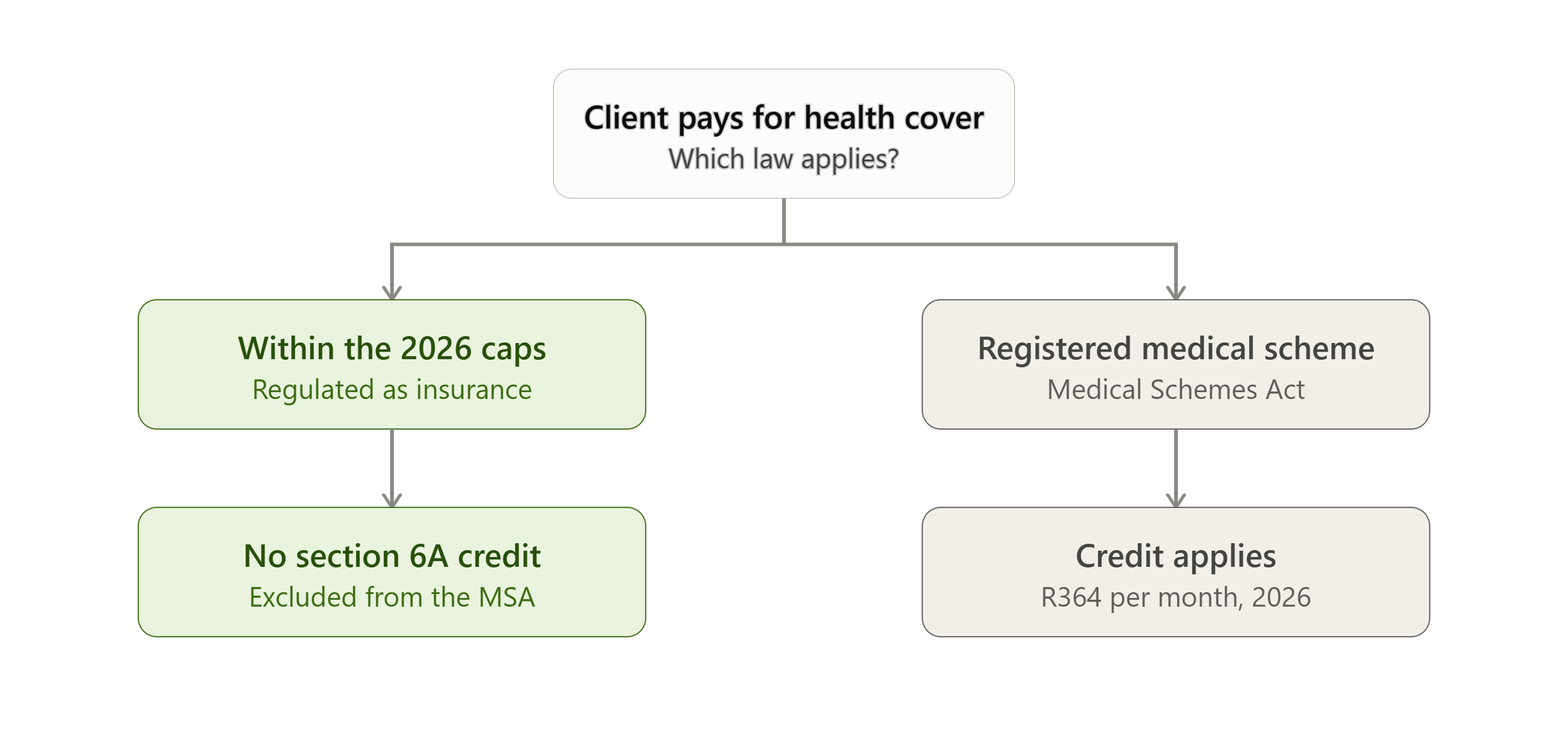
Some insurance products look like medical aid, i.e. hospital cash plans, gap covers and accident covers. The Demarcation Regulations decide which law applies to them. If the payouts stay under a set limit, the product is treated as insurance and it falls outside the Medical Schemes Act. The Demarcation Regulations set requirements for policy benefits that determine which contracts are regulated as health policies under the LTIA and as accident and health policies under the STIA. These contracts are excluded from the Medical Schemes Act.
These are the caps that keep certain health and accident products inside insurance law and out of the Medical Schemes Act. Breach the cap and the product stops being a lawful insurance policy. This is the same annual exercise we covered in last year's 4.4% escalation.
What has changed
The policy benefits escalate annually by the applicable inflation rate, as provided for in Regulation 7.2(2). The 2026 escalation is 3.2%, based on the 2025 CPI annual inflation rate published by Statistics South Africa. The new amounts applied from 1 April 2026.
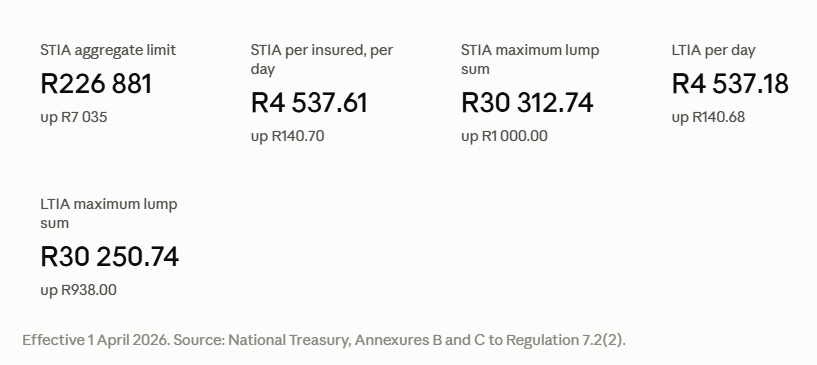
Short-term insurance policies, meaning accident and health cover:
Total payout limit: R226 881.03, up by R7 035.07
Per insured person, per day: R4 537.61, up by R140.70
Maximum lump sum: R30 312.74, up by R1 000.00
Long-term insurance policies, meaning health policies:
Per day: R4 537.18, up by R140.68
Maximum lump sum: R30 250.74, up by R1 952.54
This is the same yearly update we covered when the increase was 4.4% in 2025.
Why this matters to your clients
Here is the part clients get wrong. Because these products are insurance and not medical aid, the contributions do not earn a medical tax credit. SARS confirmed this again for the 2026 tax year.
So a client paying R1 200 a month for "health cover" may believe SARS will give them the R364 monthly credit back. They will get nothing.
One figure to double-check
The two Annexures use the same 2025 CPI annual inflation rate of 3.2% and both show a 2025 lump-sum amount of R29 312.74. However, the published 2026 figures differ: the STIA Annexure shows R30 312.74, while the LTIA Annexure shows R30 250.74. For reporting purposes, use the figure applicable to the relevant policy and Annexure.
Do not pick one at random. Use the table that covers the actual policy. If a client's cover is close to the limit, ask the insurer in writing which figure they are using.
Three things to do this week
Check work affected by the new limits. The 2026 policy benefits apply from 1 April 2026, so check benefit schedules and calculations against the applicable 2026 limits.
Tell your clients the truth about the tax credit. Hospital plans, gap cover and accident cover give no medical tax credit. Say it on the next call and put it in writing.
Diarise 1 April. The escalation date is 1 April each year, and Regulation 7.2(2) provides for the annual escalation of the policy benefits.
If you advise insurers, brokers, or any client with a health-related benefit, that first check is work you can charge for. It is not a favour.
For more information refer to:
Demarcation Regulations Long-Term Insurance Act (LTIA), Annexure A Regulation 7.2(2)
Demarcation Regulations Short-term Insurance Act (STIA), Annexure B Regulation 7.2(2)
👉 Join CIBA and we'll show you how to turn regulatory updates like this into a paid annual client review.