This article will count 0.25 units (15 minutes) of unverifiable CPD. Remember to log these units under your membership profile.
You have probably already used AI to rewrite an email, explain a complicated concept or summarise a document. But there is a much bigger opportunity for accounting and tax practitioners. AI can help with research, legislation, technical queries, drafting, analysing information and preparing explanations for clients.
The problem is that AI can also give you a very confident wrong answer. For a South African practitioner, this is particularly important. Tax legislation changes regularly, SARS issues interpretation notes, binding rulings and guides, and court decisions can change how a provision is understood.
So the question is not:
“Should I use AI?”
The more useful question is:
“How do I use AI without giving up my professional judgement and responsibility?”
Here are seven practical rules.
Don't treat AI as the authority
An AI-generated answer is not legislation, a SARS ruling or a court judgment. Think of AI as a research assistant rather than the final authority.
For example, you might ask: “How does section 8C of the Income Tax Act apply to this transaction?”
AI may give you a useful starting point. But you should then go back to the actual legislation and relevant SARS guidance to confirm the answer. The same applies to VAT, PAYE, provisional tax, trusts, companies and any other area where the rules matter.
In practical terms, use AI to help you find and understand the answer. Use authoritative sources to confirm the answer. For tax work, that means checking the relevant source, such as the Income Tax Act, the Value-Added Tax Act, SARS Interpretation Notes, SARS Binding Private or General Rulings, SARS guides and other official guidance etc.
2. Always ask: “Where did this answer come from?”
This may be the single most important habit to develop. If an AI tells you: “SARS allows this deduction” do not stop there. Ask: “What is the authority for that statement?” Then verify it, go to the section, read and make sure it is correct. A good AI research process should identify the source behind the conclusion. Ideally, you want to be able to trace the answer back to the relevant legislation, ruling, case or other authoritative material. This is particularly important when the issue is contentious or the amount involved is significant.
For an important technical conclusion, don't settle for: “AI says so.” You want to be able to say: “Here is the conclusion, here is the authority, and here is why the authority applies to these particular facts.”
3. Give AI the facts without giving confidential information unnecessarily
There is an important difference between asking: “What are the tax consequences when a company sells an asset?” and: “My client, ABC (Pty) Ltd, sold its factory at 15 Main Street to XYZ (Pty) Ltd for R12 million. The shareholders are John and Mary…”
The second question may produce a more useful answer because the AI has more context. But it also creates a confidentiality and data-security issue. Before putting client information into an AI system, you need to understand what happens to that information. Ask:
Is client information stored?
For how long?
Who can access it?
Is it used to train the AI model?
Can information be retrieved later?
Is the data encrypted?
What access controls are available?
Where is the information stored?
What happens when an employee leaves the practice?
For South African practices, this should also be considered in the context of your professional confidentiality obligations and POPIA requirements.
As a rule, don't put identifiable client information into an AI tool simply because it makes the question easier. Where possible, anonymise the facts. Instead of:
“John Smith, ID number XXXXX, director of ABC (Pty) Ltd…”
use:
“A South African private company has two individual shareholders…”
You can then add the specific facts that are actually necessary for the analysis.
4. Use AI for the work that takes time — not the judgement that makes you valuable
One of the biggest opportunities is to stop spending professional time on tasks that are essentially information-processing exercises. AI can potentially help you:
identify relevant legislation;
summarise lengthy documents;
compare different provisions;
identify issues that require further research;
analyse a technical question;
prepare a first draft of a technical memo;
turn technical information into plain language for a client;
develop checklists;
prepare questions for a client meeting; and
identify areas where further research is required.
This doesn't mean that AI should make the professional decision. You should still ask: “Does this actually apply to my client?”
That is where professional judgement comes in. A useful division of labour will look like this:
AI: Find, organise, compare and explain.
Practitioner: Verify, interpret, apply and decide.
That is a much safer way to think about AI.
5. Don't ask vague questions and expect professional answers
The quality of your AI output depends heavily on the quality of your question.
Compare these two prompts.
Weak prompt
“Tell me about VAT on property.”
Better prompt
“A South African VAT vendor owns a commercial property that has been rented to another business for five years. The vendor is considering selling the property. Identify the potential VAT consequences, the provisions that need to be considered and the SARS guidance or other authoritative sources that should be checked. Highlight any facts that could change the conclusion. Do not assume facts that have not been provided.”
The second question tells the AI:
the jurisdiction;
the type of taxpayer;
the asset;
the transaction;
what you want analysed; and
what you don't want it to assume.
As a rule, when using AI for technical work, always include:
Jurisdiction + taxpayer + facts + transaction + question + required authority.
And ask the AI to identify missing facts rather than invent them.
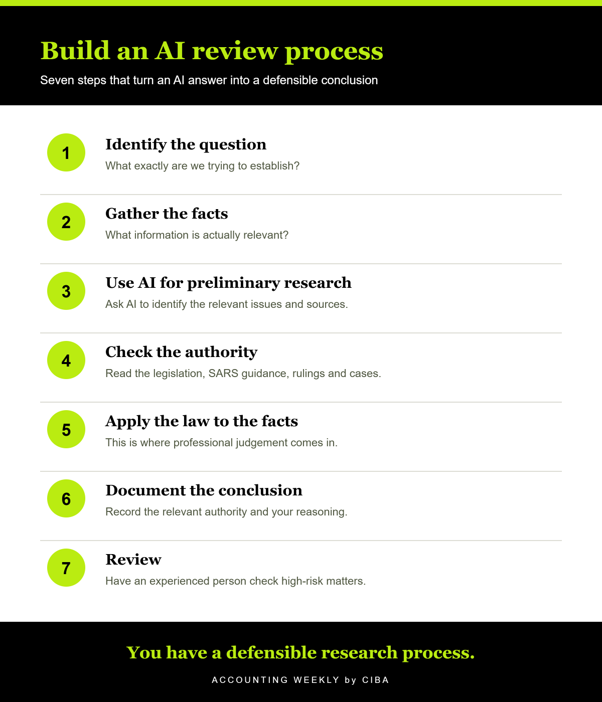
6. Build an AI review process into your practice
7. Remember that saving time is not the same as reducing risk
AI can potentially reduce research time significantly, but don't make speed your only measure of success. Suppose AI reduces a two-hour research task to 20 minutes and that sounds fantastic. But if the answer is wrong and you send incorrect advice to the client, the 100 minutes you saved may have been very expensive. The real objective should therefore be:
✔️ Faster research + better documentation + reliable sources + professional review.
Not simply:
❌ Faster answers.
What should a small practice do tomorrow?
You don't need to transform your entire practice overnight.
Start with five simple steps.
1. Choose one low-risk use case
For example:
summarising legislation;
drafting client explanations;
preparing meeting agendas;
creating checklists; or
brainstorming research questions.
2. Create three standard prompts
Develop prompts that your team can reuse.
For example:
“Identify the relevant South African legislation and SARS guidance relating to the following issue. Provide the section numbers and explain what each provision does. Do not invent sources and clearly identify anything that requires further verification.”
3. Create an AI verification rule
For example:
No AI-generated technical conclusion may be sent to a client without verification against the underlying authoritative source.
4. Train your staff
Junior staff need to understand that a fluent AI answer is not necessarily a correct answer.
Teach them to ask:
“What is the source?”
and
“Does the source actually say what AI claims it says?”
5. Keep a record of your process
For significant technical matters, retain the relevant research, source material, reasoning and final conclusion in the working papers. That way, you can demonstrate not only what conclusion was reached, but how you reached it.
The accountant's role is changing
AI does not necessarily make the accountant less important.
It changes where the accountant adds value.
If AI can find information in seconds, the value of the professional increasingly lies in being able to:
ask the right question;
identify the relevant facts;
understand the legislation;
recognise exceptions;
challenge the AI's answer;
exercise professional judgement;
explain the consequences to the client; and
take responsibility for the advice provided.
The practitioner who simply searches for information may find that AI can do much of that work.
The practitioner who can interpret information and turn it into sound advice becomes even more valuable.
A simple rule to remember
When using AI in your accounting practice, remember:
AI can assist with the research.
AI can assist with the analysis.
AI can assist with the drafting.
But: You remain responsible for the professional conclusion.
Use AI to make yourself faster and more effective, not to outsource your professional judgement.
That is where the real opportunity lies.